The Three Moms Who Built a Projector to Un-Glue Kids From Tablets
Three mothers, one pandemic, and a stubborn belief that kids deserve stories on the ceiling instead of screens in their hands. Tikino turned that idea into a profitable hardware company - without spending a euro on ads.
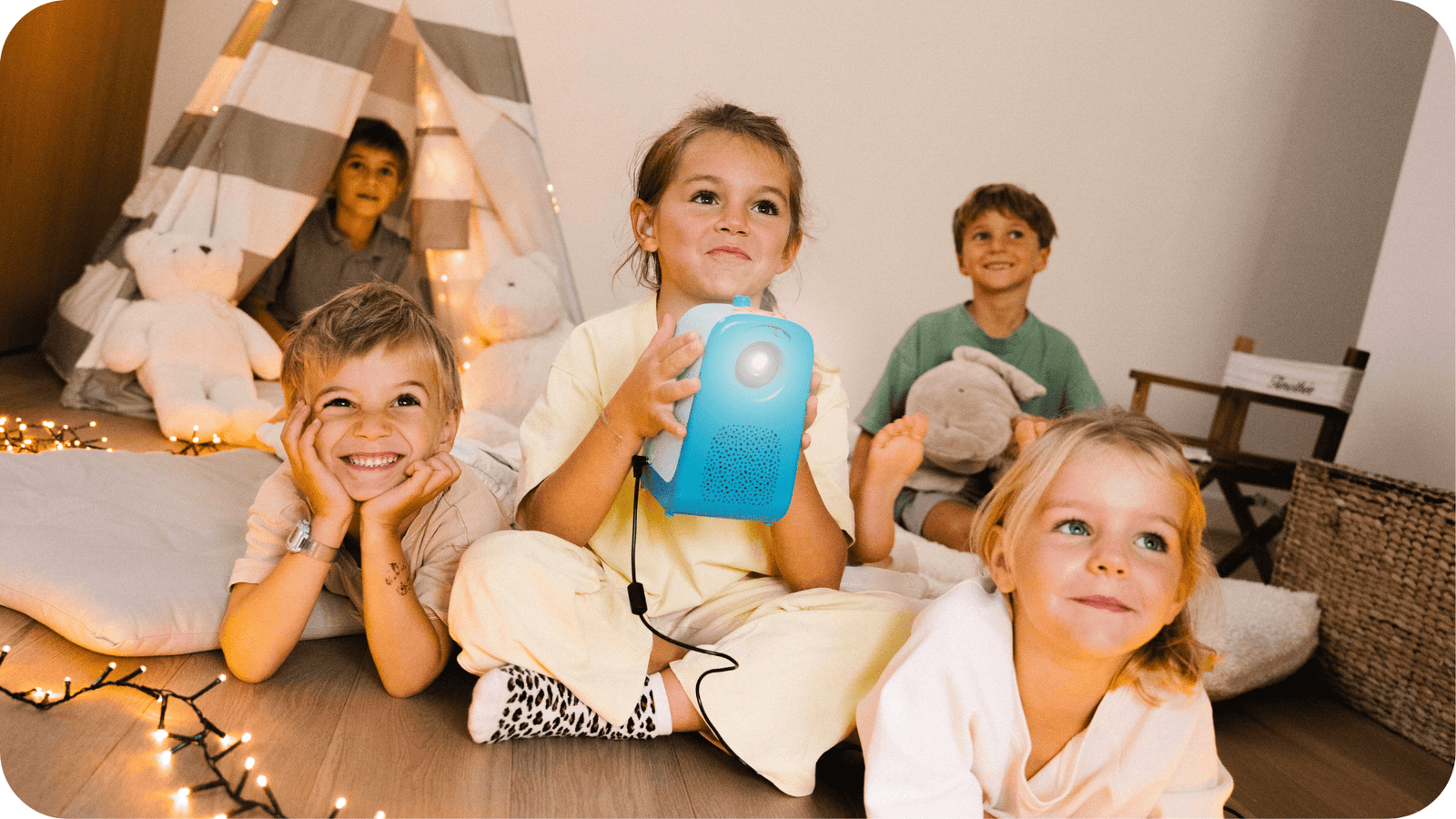
It is 7pm somewhere in France, the kids are wired, and a tired parent reaches for the one thing that reliably buys twenty minutes of quiet: a tablet. Tikino was built by three people who watched themselves do exactly that during lockdown, felt the familiar pang of guilt, and decided the fix was not more willpower. It was a different object entirely - a small projector that throws a gently animated story onto the bedroom wall, or the ceiling, while the child lies back and simply looks.
The Paris startup, registered as CHARADE, sells a screen-free device for children aged 3 to 10. Point it at a flat surface, press play, and a fable by La Fontaine or a short film about the ocean appears at roughly cinema size. No backlit screen inches from the eyes. No autoplay feed engineered to keep pulling. No ads. The founders like to call it a "boite a histoires" - a story box - and the whole pitch fits on a fridge magnet: awaken and amaze children, without the parental guilt.
01 / The IdeaTwo friends, one pandemic, a third mom
The company began with Laurene Altmayer and Alienor Bouvier-Lewi, longtime friends and mothers who kept arriving at the same complaint: to get a moment to themselves, they were handing their kids a screen. Thiphaine Le Roy, an engineer trained at Telecom Paris who had spent years in marketing and product at SFR and co-founded the shipping startup Boxtal, joined a few months in. Three co-founders, all mothers, all convinced the market had a hole in it.
They were not naive about the difficulty. Building hardware is famously unforgiving, and being three women pitching a children's device came with a particular flavor of dismissal. Some read the venture as a hobby rather than a company. The founders leaned on complementary backgrounds instead of arguing with the skeptics: an engineer's rigor on product, an HEC-trained operator's sense for distribution, and a shared, non-negotiable point of view on what a screen does to a small brain. It is the kind of team that reads a lukewarm investor meeting as a data point, not a verdict.
Growing a hardware company is a relentless challenge - marked by uncertainty, tough decisions, and a lack of investor interest. Thiphaine Le Roy, Co-founder, CPO & CMO

02 / The Launch1,207 pre-orders, and a missed Christmas
Instead of chasing venture money, Tikino went to the crowd. Its Ulule campaign pulled more than 800 pre-orders in the first week and 1,207 in total, landing in the platform's Top 5 for the children's category. Demand outran the supply chain - the launch famously blew past its Christmas delivery deadline, an early, painful lesson in how hardware punishes optimism. By the time the first projectors reached families in 2022, over a thousand households were on board, and that summer's stock sold out.
03 / The ProductSlow on purpose
The most interesting design decision at Tikino is one you would never guess from the spec sheet: the animation is deliberately slow. Where a typical cartoon cuts every few seconds to hold attention, Tikino's images drift and unfold, giving a child time to notice the details. The company frames this as a stance against overstimulation, and it has the lab numbers to back the marketing - roughly 24 times less blue light than a tablet, and about 9 times less visual stimulation than a classic animated series.
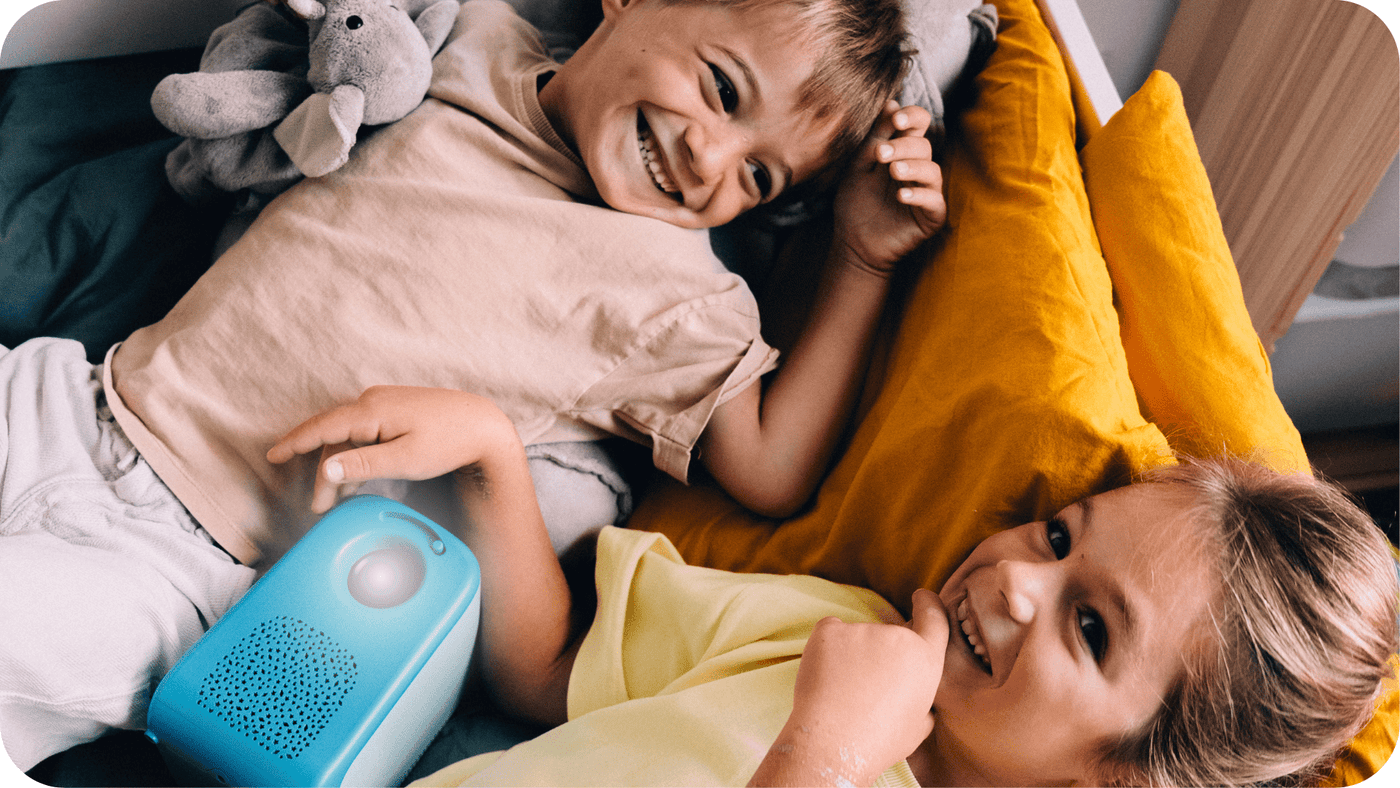
That restraint is easier to describe than to build. Projecting reflected light instead of shining a backlit panel into a child's eyes changes the ergonomics of an entire evening: a kid can lie flat, look up, and let the story come to them rather than hunching over a glowing rectangle. The content is developed with people who know children - specialists in child development, image and sound - rather than optimized by an engagement team. Every title is chosen and produced, not surfaced by a recommendation engine, which is why there is no infinite scroll waiting at the end of a story to pull for one more.
The hardware keeps getting quieter, literally and figuratively. The current model is compact - under a kilo - throws a 16:9 image, and works from as close as 85 centimeters, a change made specifically for bunk beds, attic rooms and blanket forts. Its wifi is dual-band for faster downloads but, crucially, switches off with a button, so the device can run completely wave-free in a child's room. And in a move that runs against every accessory-upsell instinct, Tikino made the battery an optional add-on rather than a default - lighter box, lower price, fewer parts to fail.
04 / The ModelSell stories like books, not subscriptions
Tikino makes money twice, gently. First on the projector - currently around 169.90 euros - and then on content, which it sells the way a bookshop sells picture books: one title at a time, roughly 5 to 8 euros each, no mandatory subscription hanging over the family. The catalog runs past 300 titles and grows every month, spanning three worlds: dreaming (tales, lullabies, poetry), discovering (history, mythology, science, English), and doing (yoga, meditation, dance, shadow puppetry). Across the library, families have made more than 300,000 content purchases.
Bringing a product to life, achieving commercial success, and showcasing it at CES in Las Vegas have been incredible milestones. Thiphaine Le Roy, Co-founder
The distribution story is the part other founders should study. Tikino reached roughly a million euros in annual revenue within three years while spending nothing on paid advertising - growth came entirely from influencers and word of mouth, backed by more than 1,100 customer reviews. It sells direct from a Shopify storefront and through retailers including Nature & Decouvertes, where it holds top-seller status, plus Oxybul, Cultura and Amazon. The road there was not straight: the team describes three years and two pivots before the current projector clicked.
The Tikino spec sheet, plainly
- Compact LED projector, under 1kg, 16:9 image on wall or ceiling
- Works from 85cm to over 4m; ~150cm-wide picture at 2m
- Dual-band wifi with an off switch for wave-free use
- Battery is an optional accessory on the current model
- Projector ~169.90€; individual titles ~4.99-7.99€, no subscription
- Designed and assembled in France, in the Aisne near Soissons
05 / The Catalog PlayTintin moves onto the ceiling
In 2025 Tikino made its cleverest content bet yet. It brought five heritage characters into the catalog - Petit Ours Brun, Babar, Monsieur Madame, Tintin and Lucky Luke - some of them remastered to hold up on a modern projector. The logic is quietly shrewd: the figures parents loved as children are exactly the ones they will trust, and want to pass on, in their own kids' bedrooms. It reframes screen time as inheritance, delivered through publishers like Bayard, Milan and Didier Jeunesse and licensors including Mediatoon.
06 / The MarketWhere it fits
The screen-free kids' category is real and getting crowded - audio boxes like Lunii, Yoto and the Toniebox have built devoted followings by replacing the tablet with something calmer. Tikino's wedge is that it kept the picture. It is not competing to be the best speaker; it is betting that a shared, slow, projected image on the ceiling is a different and stickier ritual than audio alone, and different again from the streaming services and generic kids' tablets it was built to replace. For a five-person team in Paris, that is a defensible slice: too specific for the giants, too well-executed for the clones.
None of this required a growth-hacking cheat code. It required a product parents were willing to film themselves, a content shelf that keeps filling, and the discipline to keep subtracting - the battery, the blue light, the wifi waves, the noise - until what was left was something a child could just lie back and watch.