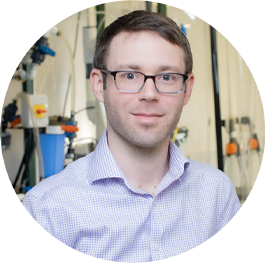
The molecule at the center of Thomas Sisto's company was never supposed to store electricity. He built it for solar cells, during a postdoc in the Nuckolls lab at Columbia University, chasing the question of how to move charge through organic materials. The compound did something odd. It accepted electron after electron and simply would not degrade. In a field where most organic molecules quietly fall apart, this one set a record for how many electrons a single molecule could swallow and survive.
Most chemists would have written a paper and moved on. Sisto saw a battery. In 2019 he spun the chemistry out of Columbia, co-founded XL Batteries, and traded the lab bench for the founder's chair. The pitch is deceptively simple: the grid needs somewhere to park solar and wind power for hours and days at a time, and lithium - expensive, flammable, and largely controlled by China - is the wrong tool for the job.
So XL Batteries does not use lithium. It builds water-based organic flow batteries, where energy lives in tanks of liquid electrolyte rather than in solid cells. Flow batteries are an old idea, usually built around costly vanadium soaked in corrosive sulfuric acid. Sisto's twist is to swap all of that out for organic molecules - carbon, oxygen, nitrogen - dissolved in pH-neutral saltwater. Cheap inputs. No fire risk. No acid eating the hardware.
"It's an unsolved problem. It's a $4 trillion market with a T. It's unsolved because it's a technical problem."
- Thomas Sisto, Category Visionaries
From the bench to the boardroom
Sisto did not arrive at energy by way of business school. He studied chemistry at Colby College, picked up a master's at Boston University, and earned his Ph.D. in organic chemistry at the University of Oregon. Before any of that, fresh out of college, he taught high-school chemistry at Fryeburg Academy and built an organic chemistry course for seniors from scratch - an early sign of someone who likes to construct things that did not exist before he showed up.
The Columbia postdoc was the hinge. The work on solar materials produced the stable molecule, and the molecule produced the company. The jump from synthetic chemist to chief executive is not a small one. One role rewards precision and patience; the other rewards conviction and the ability to raise money against a problem nobody has cracked. Sisto talks about the grid-storage gap the way a scientist talks about a hard reaction - not as a marketing story, but as a technical puzzle with a real answer hiding inside it.
Borrowing the oil industry's playbook
Here is the part that makes people stop and reread the sentence. XL Batteries leans on the very fossil-fuel infrastructure it hopes to help retire. The organic molecules come from petrochemical feedstocks - commodity chemicals that, in Sisto's words, are "global, ubiquitous, and made at the largest scales in the world." And the batteries can live inside the same kind of giant storage tanks the oil and gas world already builds.
That is why XL ran its first pilot with Stolthaven Terminals, a petrochemical storage operator in Houston. Sisto's math is vivid: take two of Stolthaven's biggest tanks, fill them with his electrolyte, and you have a 700 megawatt-hour battery. The container handles the chemistry; the tanks handle the scale. Capital cost, he argues, "should be ultra low."
How the battery works
Energy is stored in liquid, not in solid cells. Tank size sets how much energy; the number of 40-foot containers sets how fast it charges and discharges. Scale the tanks, scale the storage.
01
Organic molecules in saltwater
02
Pumped through a 40ft container
03
Stored in scalable tanks
Why not lithium?
Sisto's claimed advantages over the incumbents, side by side:
Safety (non-flammable)HIGH
Domestic supply chainHIGH
Lifespan (targets 50+ yrs)HIGH
A team with a grudge against lithium
Sisto did not build XL alone. Several people on the team came out of A123 Systems, the once-celebrated American lithium-ion pioneer that was acquired by China's Wanxiang Group in 2013. That history is not a footnote. For engineers who watched a domestic battery champion pass into foreign hands, building a lithium-free, made-in-America alternative is personal as much as professional.
The work is moving from slideware to steel. In 2025 XL commissioned its first grid-scale pilot, then got tapped by data-center developer Prometheus Hyperscale to provide long-duration onsite storage - a market exploding as AI data centers strain the grid. Sisto's stated timeline is aggressive but specific: demos in customers' hands soon, very large-scale commercial projects "significantly before 2030."
"If we took two of their biggest tanks, it'd be a 700 megawatt-hour battery."
- Thomas Sisto, on the Stolthaven pilot
The bet
Strip away the chemistry and Sisto's thesis is about economics. The cheapest battery wins, and chemistry decides the price. Lithium and vanadium are expensive because the materials are scarce and the supply chains are concentrated. Carbon, oxygen, and nitrogen are not. If XL can make organic molecules behave reliably at industrial scale - the thing that molecule first proved it could do in a Columbia lab - then the cost floor drops and the grid gets a storage option that does not depend on a mine on the other side of the world.
That is the unglamorous, enormous wager underneath the headlines. Not a flashy consumer gadget. Not a new chemistry nobody understands. A founder who knows his molecule cold, a team that has been burned before, and a $4 trillion problem that stayed open precisely because it was hard. Sisto likes those odds. He has, after all, already spent a career making stubborn molecules do exactly what he wanted.