Breaking
FORM ENERGY // Google deal reportedly ~$1B for world's largest battery system FUNDING // Series F $405M closed Oct 2024, total raised past $1.3B CHEMISTRY // 100-hour iron-air battery stores power by rusting iron FACTORY // Form Factory 1 rises on a shuttered Weirton, WV steel mill FORM ENERGY // Google deal reportedly ~$1B for world's largest battery system FUNDING // Series F $405M closed Oct 2024, total raised past $1.3B CHEMISTRY // 100-hour iron-air battery stores power by rusting iron FACTORY // Form Factory 1 rises on a shuttered Weirton, WV steel mill
Co-founder & CEO / Form Energy

Mateo
Jaramillo

He left the company that made batteries famous to bet on a cheaper one - made of iron, water, and air.

Iron-Air Battery Climate Tech Ex-Tesla 100-Hour Storage
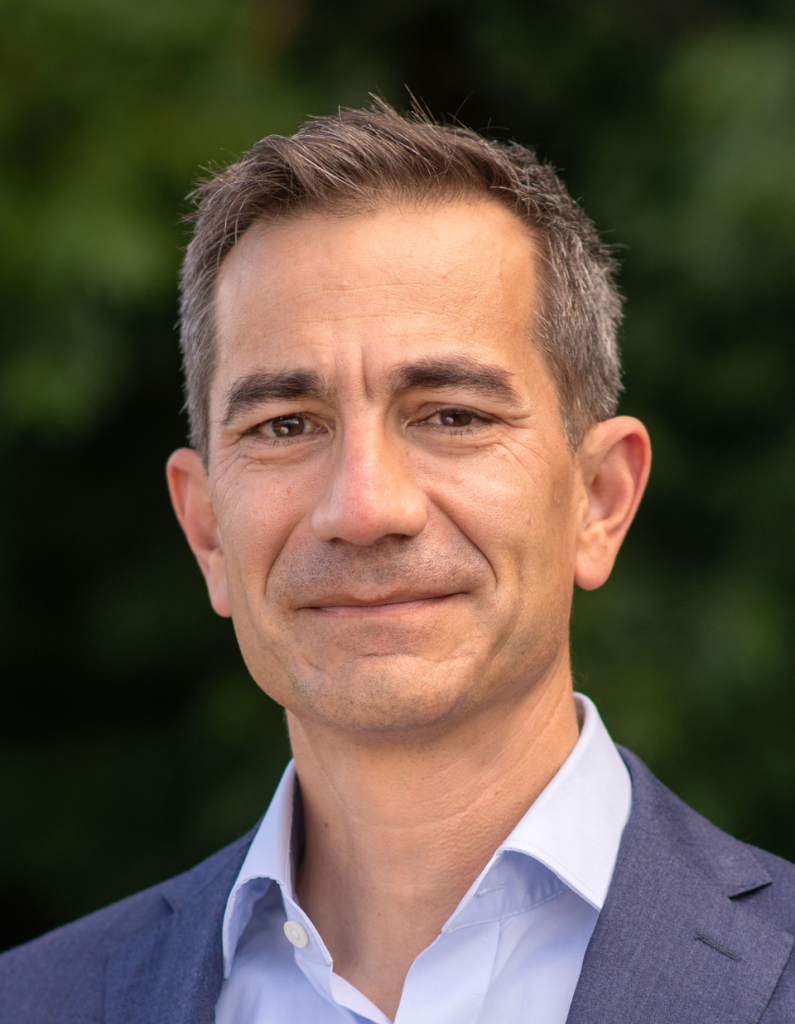
Mateo Jaramillo, co-founder and CEO of Form Energy
The accidental rust evangelist.
A theology grad who decided the grid was the better sermon.
The Dispatch

Storing five days of power in a stack of rust

The batteries Mateo Jaramillo is building right now do something most engineers spent a century trying to prevent: they rust on purpose. Inside a Form Energy cell, iron meets oxygen, turns to rust, and gives up electrons on the way. Reverse the current and the rust turns back into iron. That single, deliberately boring reaction is the bet behind a company that has raised more than $1.3 billion and just signed a deal with Google reported at around a billion dollars.

Jaramillo co-founded Form Energy in 2017 and runs it as CEO from Somerville, Massachusetts. The product is a battery designed to discharge for 100 hours - not the four hours a lithium-ion grid battery typically manages. The number is not marketing. It is the rough length of a polar vortex, a heat wave, a hurricane sitting over a region for days. He picked the duration to match the disasters.

The first commercial cells are now leaving Form Factory 1, a plant built on the carcass of the old Weirton Steel mill in West Virginia. A town that lost its steel jobs is making the metal batteries that may keep the lights on through the next storm. Jaramillo likes that symmetry, and he likes the math behind it even more.
"We started the company with the premise that, if you could identify a chemistry that's cheap enough, you could have a much longer duration - roughly four or five days."
Mateo Jaramillo
100
Hours of discharge
$1.3B+
Total funding raised
2017
Year Form was founded
~$20
Target cost / kWh
How it works

The reversible-rusting machine

Iron is abundant, cheap, and safe. The trick was making it breathe.

Fe

Discharge

Iron takes in oxygen from the air and rusts, releasing electrons.

O₂

Breathe

The cell pulls oxygen in and pushes it back out as it cycles.

Charge

Apply current and the rust converts back to iron. Repeat.

Abundant materials in, storms survived out. No lithium required.
The number that matters

Why 100 hours, not four

A typical lithium-ion grid battery empties in about four hours. Useful for smoothing an evening peak. Useless when a five-day weather event knocks renewables offline. Jaramillo's analysis kept landing on the same window.

"That 100 hours sounds simple and like a nice, appealing round number," he has said, "but it is actually very much supported by the math." Extreme weather, almost anywhere on Earth, tends to run in roughly 100-hour chunks. Build for that, and a battery can start to do what a gas plant does.

Lithium-ion
~4h
Form iron-air
100 hours
Discharge duration, illustrative. The gap is the whole company.
"Think about a polar vortex or a heat bomb or a hurricane or a sandstorm. Any place in the world has roughly a four-to-five-day weather signature."
On choosing the duration
The road here

Harvard. Yale Divinity. Then a decade of batteries.

Before he was a battery executive, Jaramillo studied economics at Harvard and earned a master's in theology from Yale Divinity School. It is not the resume you would draft for the person reinventing the electric grid, which is part of why it is worth telling.

He found his way into energy storage early, helping found Gaia Power Technologies. Then in 2009 he joined Tesla, where he started the stationary storage business from scratch and helped put the Powerwall and Powerpack into the world. In 2017 he left to chase the storage problem Tesla's chemistry could not solve cheaply: not hours, but days.

1999

A.B. in Economics, Harvard University.

2004

Master of Theological Studies, Yale Divinity School.

2009

Joins Tesla; leads $600M+ in powertrain contracts, then starts its stationary storage line.

2017

Co-founds Form Energy to build multi-day storage.

2021

Form reveals its 100-hour iron-air battery.

2024

$405M Series F; total funding tops $1.3B.

2026

Google & Xcel deal for a 30 GWh system, reported near $1B.

The founders' table

A hundred years of batteries in one room

Form was built by materials scientists, an MIT professor, and the operator who knew how to sell what they made.

The operator

Jaramillo brought the commercial playbook from Tesla - product definition, policy, the unglamorous work of turning chemistry into contracts.

The scientist

Co-founder and chief scientist Yet-Ming Chiang, an MIT professor, anchors the materials side. The team counts decades of battery experience between them.

The crew

Co-founders Ted Wiley, Billy Woodford, and Marco Ferrara round out a founding group spanning startups, academia, and earlier storage ventures.

In his words

Said out loud

When we founded the company, we didn't anticipate the boom of data center demand that we're currently experiencing.

We're quite confident that we will hit that roughly $20 a kilowatt-hour cost within a very short period of time.

If you could identify a chemistry that's cheap enough, you could have a much longer duration - roughly four or five days.

That 100 hours sounds simple, but it is actually very much supported by the math.

Margin notes

Things that stick

The aim

Make multi-day storage cheap enough to retire fossil plants - and call it a reliable, fully renewable grid.