Thomas P. Coffey had already made partner at Kirkland & Ellis when he took a job whose central problem was getting people to cooperate. He left private practice to serve Harold Washington as Chicago’s director of intergovernmental affairs. The lawyer had helped elect the city’s first Black mayor. Now came the less photogenic assignment: helping an election victory function as a government.
The distinction matters in Coffey’s story. Campaigns end with a count. Administrations begin with a list of things the count has failed to settle. Who will work with whom? Which institution has authority? Who can delay a decision? A title like intergovernmental affairs sounds suitably upholstered for an office directory. In a divided city, it describes an obstacle course.
Coffey later co-founded the Haymarket Group, the public-affairs consultancy also known as Haymarket Public Strategies. His career connects a law firm, a reform administration and a business built around government and community relationships. There is a useful question running through those chapters: what happens between having an argument and getting something done?
A victory with work still attached
Washington’s 1983 campaign had its own demanding arithmetic. Before agreeing to run, he wanted at least 50,000 newly registered Black voters. By November 1982, the registration effort had nearly doubled that goal. He announced his candidacy that month, entering a contest against incumbent Jane Byrne and Cook County State’s Attorney Richard M. Daley.
Washington won the Democratic primary with 36.28 percent of the vote. In April’s general election, his share was 51.72 percent. Those numbers describe two different tasks: assembling enough support to win a crowded nomination, then building a majority in a bitterly divided city. Coffey’s contribution belonged inside that wider effort, alongside the organizers and voters who made the candidacy possible.
Washington arrived at City Hall after service in the Illinois legislature and the U.S. House. He had broken with Chicago’s Democratic machine and acquired a following among voters who wanted more independence from it. His election challenged an established system of political authority. The system’s officeholders did not become agreeable simply because the electorate had spoken.
For an adviser, that creates a peculiar kind of work. The public mandate is clear enough to celebrate. Its translation into individual votes, departmental decisions and working relationships remains unfinished. Coffey moved into that gap. The election supplied the authority for change; his job placed him among the people trying to make institutions respond to it.
Share of the vote. Winning the nomination and assembling a majority were different jobs.
The job between the institutions
Chicago’s early Washington years became known as the Council Wars. An opposition bloc of 29 aldermen could obstruct a mayor in a 50-member council. That is an awkward arrangement for anyone charged with getting an administration’s work through the building. It is also a reminder that winning the most visible office does not deliver control over every other office.
Washington’s Political Education Project, established in 1984, worked on electoral politics beyond the mayor’s official duties. In 1986, special aldermanic elections changed the council’s balance. Candidates including Luis Gutiérrez and Jesús García helped break the stalemate. Registration, field operations and election-day monitoring were part of the effort. The institutional impasse eventually had an electoral answer.
Coffey’s own City Hall chapter ended in early 1986. His move into consulting therefore followed a finite, difficult period in government. That sequence helps keep the portrait in proportion. An adviser can contribute to an administration without owning its victories, and can leave before the political conditions that constrained it have fully changed.
The career also raises a practical point about expertise. Knowing the formal rules is one qualification. Understanding why people resist an otherwise lawful proposal is another. A lawyer working across governments encounters both. The work sits where procedure meets persuasion, a place rarely improved by announcing that everyone ought to be reasonable.
“He is bright, hard-working and tactful.”David Orr, then Chicago alderman, on Coffey
1987: a firm, and a school-reform problem
In 1987, Coffey and Jay Doherty formed the Haymarket Group. Doherty brought his own background in Democratic campaigns and civic relationships. The partnership joined two people familiar with the political life surrounding public decisions. Haymarket’s subsequent client list included Senator Carol Moseley Braun and Alderman Ed Burke, a range that illustrates how consultancy work can extend across different parts of a city’s political world.
An early assignment gives the business a more concrete shape. During Chicago’s 1987 teachers’ strike, the C.U.R.E. school-reform coalition wanted its proposals translated into legislation. Designs for Change enlisted Coffey and civil-rights organizer Al Raby, both Haymarket partners, to help find financial backing for the drafting work. The firm secured a commitment from commodities trader Richard Dennis.
Then came the line-by-line work: attorneys and coalition members reviewed legislative language and tried to reach agreement across a diverse group. It is an unusually revealing detail. The assignment required money, legal drafting and a process through which people could decide what they were prepared to support. An ambition for reform had to survive the wording.
There is little glamour in reviewing a clause until everyone understands its consequences. There is considerable importance. A coalition can agree on a broad objective while disagreeing sharply about the powers, safeguards and obligations that will put it into practice. Coffey’s involvement places him at that practical junction, where civic enthusiasm encounters the need for an actual bill.
An ambition for reform had to survive the wording.On Haymarket’s early legislative drafting work
What twenty-five years looked like
By 2012, Haymarket had been operating for a quarter-century. Chicago City Council marked the anniversary with a resolution that recognized Coffey’s earlier Marine Corps service, his legal career and his work for Washington. It designated August 28, 2012, as Haymarket Group 25th Anniversary Day. A consultancy had acquired a civic birthday.
The resolution’s description of the firm is more informative than a celebratory adjective. It brought together experience in government, politics, media, law, community organizing, public relations and mediation. Its clients included corporations, nonprofit organizations, institutions and elected officials. Its work covered government relations, economic development, community relations, and campaigns and elections.
Put those areas next to each other and a pattern becomes visible. Each involves people who possess different kinds of authority. An official may have a vote. A neighborhood group may have the ability to organize opposition. An institution may have the resources to propose a project. Legal permission alone does not explain how those people will behave toward one another.
That is an interpretation of the business Coffey helped build, rather than a promise that every negotiation ends happily. Public affairs exists because interests diverge. The disagreement is part of the assignment, and it persists even when the meeting has a carefully prepared agenda. The school-reform drafting episode supplies a modest, specific illustration of the work: identify what is needed, find support for it, and help a group agree on language it can take into government.
A captain, a family, a boat called Innisfree
Coffey’s route into this work began far from a consultancy pitch. Born in 1944, he studied English at Loras College and law at DePaul University. He served as a Marine lawyer in Okinawa before joining Kirkland & Ellis in 1974. His interests also extended to sailing. He named his 38-foot boat Innisfree after his favorite Yeats poem.
That name is a pleasing complication in a political biography. A career spent around public argument coexisted with an attachment to a poem about retreat. A boat’s name is a small piece of autobiography, chosen without the assistance of a corporate positioning committee. Innisfree supplies a glimpse of the reader and sailor alongside the lawyer and consultant.
His family’s remembrance identified him as a Marine captain, a member of the Chicago Yacht Club, Beverly Country Club and Chicago Athletic Association, and the husband of Mary Alice Butler. He was the father of Tom, Matt and Catherine, and grandfather to ten children. The public titles occupied only part of a life with its own family geography.
Coffey died in August 2022, aged 77, in Hinsdale. The dates place his career within a particular stretch of Chicago history: the Washington election, the confrontations of the 1980s and the decades of consultancy that followed. His experience belonged to the city’s political changes while also extending into the ordinary continuity of family, friendship and leisure.

The work after the applause
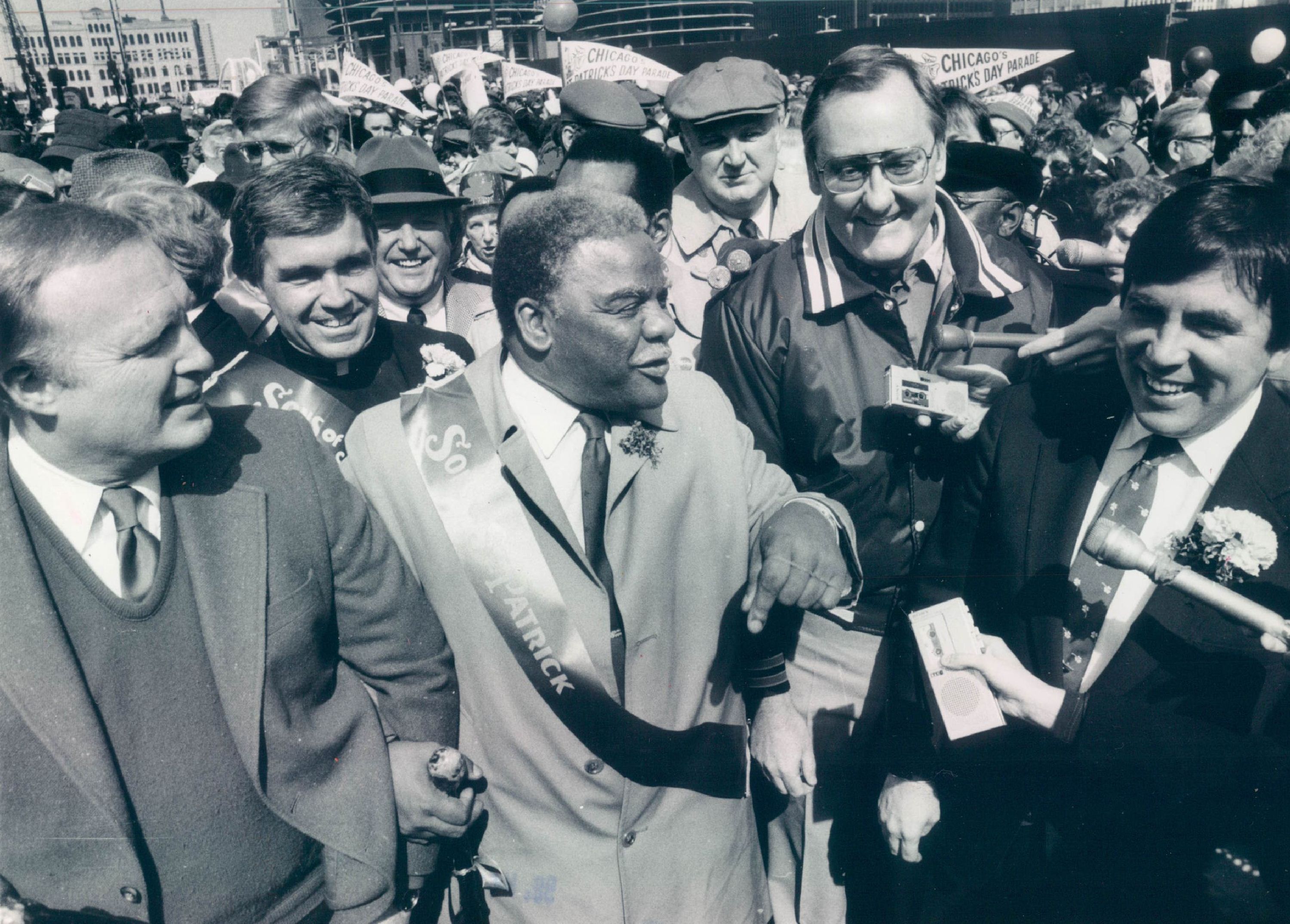
A photograph of Coffey beside Washington at a St. Patrick’s Day parade offers a different view of the adviser’s place. Washington is in the public scene; Coffey is at the right of the frame, smiling. A photograph cannot explain a working relationship. It can preserve the proximity in which that relationship took place, away from the abstractions of an organizational chart.
Another image shows Coffey at his boat’s helm. The two pictures need no elaborate metaphor to be interesting together. They show a person taking part in public life and enjoying a private enthusiasm. The firm, the city appointment and the anniversary resolution become easier to understand when their subject is allowed to have a life beyond them.
Coffey’s story is most useful when kept at that human scale. He helped a candidate, served a mayor, formed a firm and joined practical efforts to turn proposals into decisions. The work depended on other people, who had their own commitments and limits. That dependence is the point of the career. Public change needs voters and leaders; it also needs people willing to stay with the clauses after the speeches are over.