In December 1980, a small newspaper announcement recorded a change of address that would shape Joseph P. O’Neill’s working life. He had been running Senator Lloyd Bentsen’s Austin office. Now he was going to Washington to become the senator’s administrative assistant. The notice offered the usual ingredients of a staff appointment: the departing aide, the incoming aide, the degrees, the family move. Careers can begin their consequential chapters in remarkably small type.
Bentsen’s explanation was practical. O’Neill knew Texas and its people. The senator wanted that experience beside him in Washington. Before the national campaign, the company and the corporate boards, there was this assignment: bring knowledge of the state into the office where its senator worked. The distance between Austin and Washington would remain a recurring feature of O’Neill’s career, even as the institutions on either end changed.
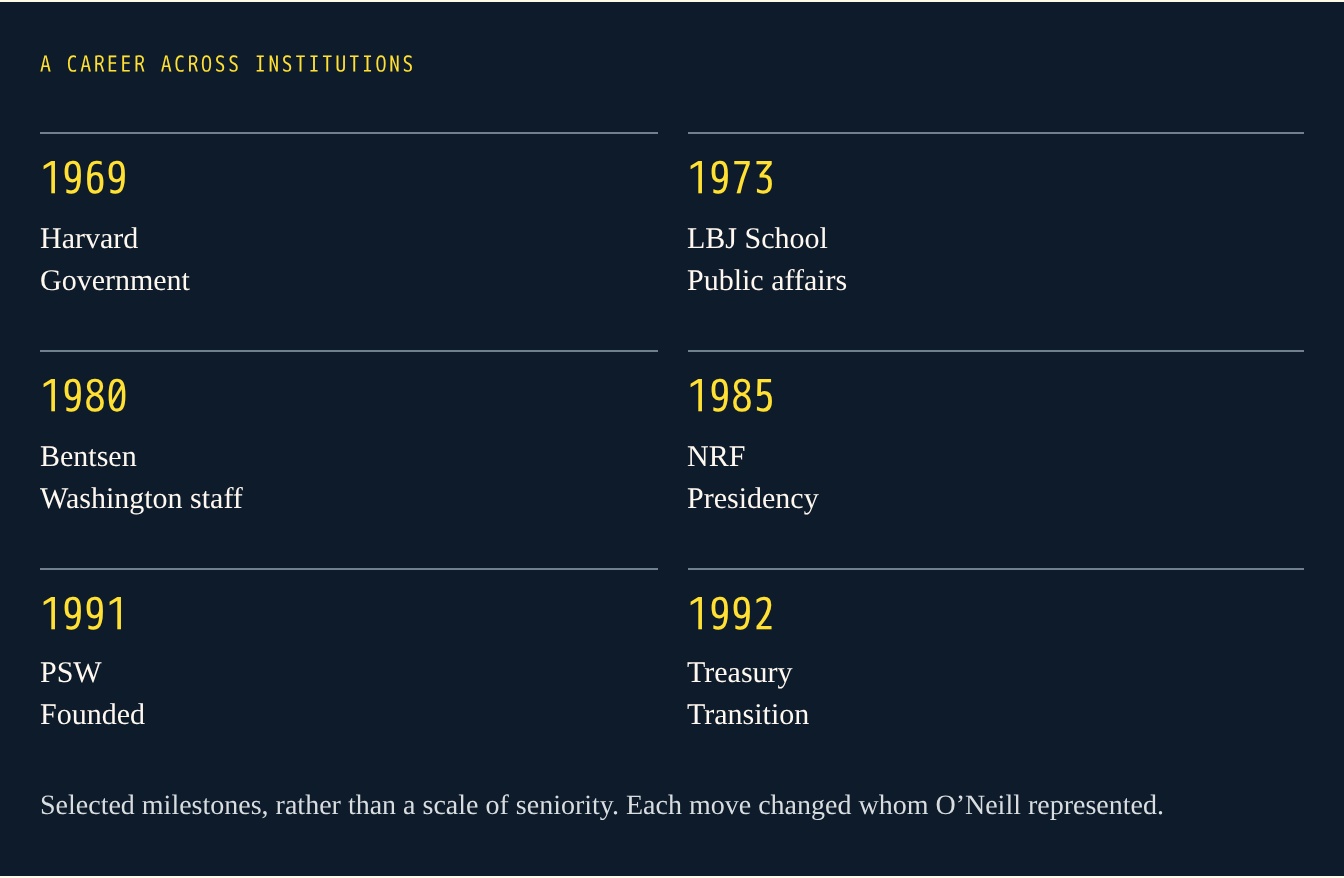
He would become president of the National Retail Federation, manage Bentsen’s vice presidential campaign and found Public Strategies Washington in 1991. A year after establishing the firm, he would return to help Bentsen prepare for the Treasury Department. The sequence gives his story its shape. Each new position changed the organization he served. An earlier working relationship kept producing another invitation.
The appointment in small type
O’Neill’s education had already brought him from Massachusetts to Texas. He graduated from Harvard College in 1969 with a degree in government, then earned his master’s at the University of Texas at Austin’s LBJ School of Public Affairs in 1973. Those subjects put public institutions at the center of his training. His early work also included planning and urban development in Dallas, and economic consulting at NASA’s Johnson Spacecraft Center in Houston.
That is a more varied beginning than the label “Washington lobbyist” suggests. City planning and a space center present rather different versions of the public sector. One concerns the organization of a place; the other belongs to a national undertaking. O’Neill’s later career would likewise move among organizations with different scales, interests and responsibilities. The continuity was public affairs itself.
By the time of the Washington appointment, he had spent five years in charge of Bentsen’s Austin office. A state office gives a senator a connection to the people and concerns back home. Moving its head to Washington carries some of that local knowledge into the national operation. Bentsen’s public endorsement emphasized precisely that familiarity. The appointment was an expression of confidence in someone whose work he already knew.
A retailer’s view of Washington
In 1985, O’Neill became president of the National Retail Federation. He remained there until 1991. The move placed him on a different side of the conversation with government: representing an industry whose commercial concerns reached into legislation and international negotiations. His responsibilities included legislative strategy and trade advice. He also led delegations to Europe during the Uruguay Round of the General Agreement on Tariffs and Trade.
The trade work expands the picture beyond Capitol Hill. An association president had to consider decisions made across negotiating tables as well as inside Congress. Retailers had reasons to care about the terms on which goods moved between markets. An adviser working in that setting needed to understand both the business concern and the public process through which it might be addressed.
Six years at the federation placed a substantial chapter between O’Neill’s Senate service and the founding of his firm. It also interrupted any tidy division between his public and private careers. While leading an industry association, he took leave in the summer of 1988 to join Bentsen’s vice presidential campaign. The senator’s name had returned, this time on a national ticket.
The view from the wings
O’Neill served as Bentsen’s campaign manager and chief of staff during the Dukakis-Bentsen campaign. The assignment put an experienced Senate aide and association executive into the machinery surrounding a candidate for national office. In October, at the vice presidential debate in Omaha, he watched from the wings as Bentsen delivered his response to Dan Quayle’s comparison with John F. Kennedy.
“I was in the wings and I could see the audience, and it was spontaneous combustion.”
Joseph P. O’Neill, recalling the 1988 debate
His recollection fixes the scene on the audience. The candidate had the microphone; O’Neill could see the room respond. It is an apt vantage point for a career spent organizing the work around public figures. A campaign manager participates in the event while standing outside its central image. The television frame has limited accommodation for everyone with a job to do.
The Democratic ticket lost the election. O’Neill’s work with Bentsen nevertheless continued beyond that campaign. Four years later, the task would involve preparing for an executive department. The relationship had survived the distinction that election night makes so brutally between a memorable performance and a winning result.
A firm, then another call
O’Neill founded Public Strategies Washington in 1991. By then he had worked inside a Senate operation, led a trade association and managed a national candidate’s campaign. The business brought those experiences into a practice advising organizations dealing with federal decisions. Tax policy, defense, financial services, telecommunications and energy were among the areas covered in his work.
The firm describes itself as independently owned and emphasizes attention from its principals. Its displayed client roster includes businesses such as Nasdaq, Lockheed Martin, Southwest Airlines and Canadian National Railway. These organizations operate in different markets, but all have reasons to follow public decisions closely. PSW’s founding made O’Neill an owner in the business of helping clients participate in that process.
In November 1992, Bentsen asked him to head his Treasury transition team for the incoming Clinton-Gore administration. A transition makes an appointment operational. People must be considered for jobs; an incoming secretary needs a staff and an organization through which to work. For O’Neill, the assignment was another return to a familiar principal in a new institutional setting.
That combination also attracted scrutiny. During the Treasury transition, O’Neill and his firm were representing Mexico. An investigation of foreign lobbying examined the overlap between that paid work and his role helping Bentsen prepare for office. The issue belongs in the career story alongside the appointments and the company founding: moving between public responsibilities and private representation invites questions about how those roles meet.
The questions are especially pertinent in a profession built partly on accumulated knowledge and relationships. Experience acquired inside government can be useful to clients outside it. The same continuity that makes an adviser valuable also makes the boundaries of an assignment consequential. O’Neill’s transition work brought those concerns into view early in PSW’s history.
There was also a scorecard
A less formal glimpse appeared in May 2014, when O’Neill played golf with President Barack Obama, former trade representative Ron Kirk and businessman Milton Carroll at Robert Trent Jones Golf Club in Virginia. Kirk and O’Neill shared a connection through Bentsen’s staff. Mark McKinnon, who knew both through Texas politics, described O’Neill as enjoyable company. The outing adds a social scene to a chronology otherwise crowded with offices.
O’Neill’s listed handicap in Golf Digest’s Washington ranking, where he tied for 44th.
The golf detail has the advantage of being wonderfully specific. Washington can describe a person as connected, experienced or influential without telling a reader very much. A handicap is less accommodating. It brings an actual recreational pursuit into the picture, complete with a number and the possibility of an uncooperative afternoon. Even a well-arranged foursome must eventually deal with the ball.
The school stayed in the picture
O’Neill’s professional life also extended into corporate governance, including service as lead director of Affiliated Computer Services. His connection to the LBJ School continued through its advisory board, which he chaired. In 2016, the University of Texas Graduate School named him its Outstanding Alumnus. More than four decades separated the master’s degree from that recognition.
Another connection followed in 2017. He served on the dinner committee for the LBJ Foundation’s Liberty & Justice for All Award event honoring David Rubenstein. Linda and Joe O’Neill were also listed among the sponsors. Proceeds benefited the LBJ School Washington Center and its graduate program. The school that had been part of his preparation remained a place to which he gave time and support.
Read together, these episodes bring the story back to its geography. Austin supplied an education and years in a senator’s state office. Washington supplied a staff appointment, association leadership, campaign work and a company. The LBJ School’s Washington Center connects those two places institutionally. O’Neill’s career had been moving between them long before.
The December 1980 notice is still a useful place to begin. It catches him before the founder’s title, when a senator wanted someone who understood the state to join him in Washington. Later assignments would change the setting and enlarge the responsibility. Again and again, O’Neill’s work would concern the people and organization surrounding a public decision. The headlines came and went. There was always another appointment to make.