A president can sign an order in a few seconds. Building the thing the order promises takes rather longer. Michael Catanzaro has worked on both sides of that gap: inside the White House, where policy is announced, and in private consulting, where companies must decide what an announcement will actually allow them to do. His career lives in the interval between a political intention and an operating reality. It is a crowded interval. There are agencies in it, and committees, and occasionally a judge.
In December 2024, as Washington prepared for Donald Trump’s return, Catanzaro joined a discussion about deregulation. The subject invited sweeping predictions. His opening answer brought the conversation back to procedure. Agencies have to work through the Administrative Procedure Act, including notice and comment. Undoing a rule can require its own substantial record. Legal challenges can follow either direction. A campaign promise may have excellent stage presence; it still needs someone to read the instructions.
“The process by which they do it will be the same,” he said. It was an observation from experience. Between 2017 and 2018, he had served as special assistant to the president for domestic energy and environmental policy at the National Economic Council. Today, he is chief executive of CGCN Group, the Washington public affairs firm. Across those jobs runs a recurring question: how does political power become something a company, an agency or an electricity customer can use?
“The process by which they do it will be the same.”
Michael Catanzaro · December 2024
First, learn to write Washington
Catanzaro’s first professional beat was the political story itself. He began as a writer and reporter for Robert D. Novak, editing the Evans-Novak Political Report and helping draft syndicated columns. Before he helped shape government decisions, he helped put political developments into sentences. That beginning gives his later work an unusual starting point. The career begins with an editor’s problem: which part of a complicated argument matters enough to keep?
The academic background was similarly concerned with how public decisions are made. He earned a bachelor’s degree in political science and philosophy at Fordham University, followed by a master’s in government at Johns Hopkins University. Those are the documented credentials. The more revealing continuity is between political writing and policy advice. Each involves taking several competing accounts of an event and making an argument someone else can act upon.
By 2003, he was communications director for the Senate Environment and Public Works Committee. During the 2004 election cycle, he became deputy policy director for the Bush-Cheney reelection campaign. Writing, communication and policy were already sharing a desk. The sequence matters because his later profession combines all three. A regulation has substance, a legislative proposal has an audience, and both acquire a political life through the way people explain them.
A career with several entrances
His federal service then moved into the executive branch. He worked in the White House Council on Environmental Quality and subsequently at the Environmental Protection Agency during George W. Bush’s administration. In 2007, he moved to PPL Corporation as director of federal relations. The direction changed again in 2009, when he became deputy staff director for the Senate Environment and Public Works Committee’s ranking Republican, Jim Inhofe.
He went on to advise Speaker John Boehner on energy and environmental policy. These positions put the same subject in different institutional settings. A utility company approaches Washington with a business to run. A committee has legislation and oversight to conduct. A speaker’s office has a broader congressional agenda to manage. The experience gives the chronology more shape than a succession of impressive office doors. Energy policy keeps returning, while the place from which he examines it keeps changing.
In 2013, he joined FTI Consulting as a managing director. CGCN followed in 2015. Two years later, he entered the Trump White House, advising the president and helping develop policy across agencies. His departure was announced in April 2018, with a return to CGCN. The route contains a loop rather than a clean ascent: consulting, government, consulting again. The subject remained energy; the practical question became what each institution could accomplish, and what it needed from the others.
- 2013FTI ConsultingManaging director
- 2015CGCNJoins the firm
- 2017White HouseEnergy policy adviser
- 2018CGCNReturns in April
The useful art of knowing the limits
That loop can make an adviser valuable to a client. It also creates questions about how closely private interests sit beside public decisions. In 2017, Catanzaro received an ethics waiver allowing him to work on energy matters despite his previous lobbying. His earlier clients included energy companies and industry organizations. The waiver belongs in any account of his White House service. His government experience and private advocacy are connected parts of his public career, with the scrutiny that connection attracts.
After his return, he continued to appear in public energy discussions. In November 2024, he participated in a post-election panel about renewables and other parts of the energy transition. Discussing federal funds already committed under the outgoing administration, he warned that attempting to recover them could create legal difficulties. The detail is revealing: political control and contractual obligations operate on different schedules. An election can change the people making decisions without erasing every decision made before them.
In March 2025, he made a related point at a Council on Foreign Relations discussion: some obstacles to the administration’s energy ambitions required congressional action. His argument drew a boundary around executive authority. That boundary is a recurring subject in his work. For an adviser, the useful answer is sometimes a description of the institution that must act next. Knowing whom to call helps. Knowing what the person answering is permitted to do helps considerably more.
A deadline with a small-print problem
Catanzaro’s writing on permitting supplies a close view of how he thinks about policy design. In June 2023, he examined the permitting provisions attached to the bipartisan debt-ceiling agreement. He welcomed the recognition that infrastructure approvals needed attention, then investigated whether the mechanisms would deliver the promised speed. A time limit looks crisp on a page. Its exceptions can make it rather less crisp in practice.
His concern was the route available when an agency missed a review deadline. Consultation, a lawsuit and a subsequent court decision could still leave developers uncertain about when a review would finish. He also asked whether an applicant would want to sue the agency responsible for issuing its permits. That is a practical political question nested inside a procedural one. Rights written into legislation have to be exercised by people who expect to deal with the same officials afterward.
The bargaining problem interested him too. Republicans and Democrats could favor faster construction while prioritizing different kinds of infrastructure. He pointed to the 2015 agreement pairing the end of the crude-oil export ban with extensions of wind and solar tax credits as a precedent for exchange. His analysis treated disagreement as something to negotiate through a legislative package. The parties could arrive wanting different things and still find a reason to approve the same bill.
The view from another room
Alongside his consulting work, Catanzaro became a nonresident senior associate at the Center for Strategic and International Studies. He was also a policy fellow at the University of Chicago’s Energy Policy Institute in 2019-2020. At the time, he described an interest in bringing what he had learned in Congress and the White House into a collaboration that could produce better-informed policy. It was an aspiration stated publicly, with an institutional setting in which to pursue it.
Those affiliations add another room to a career already full of them. Think-tank commentary and university discussion ask an adviser to explain his reasoning to an audience beyond a client or an elected official. His published subjects have included permitting and the respective roles of the Department of Energy and the Federal Energy Regulatory Commission in liquefied natural gas exports. Once again, the question is often where one institution’s authority ends and another’s begins.
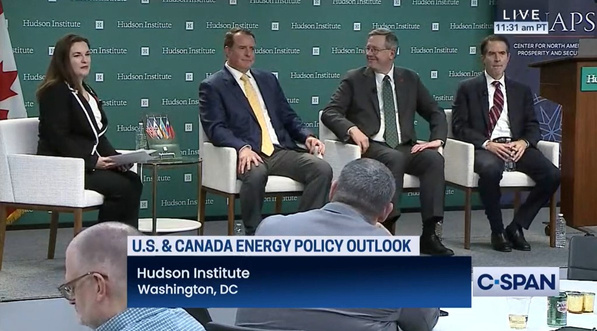
In November 2024, he appeared at Hudson Institute’s North American Energy Preeminence Forum alongside Christopher Sands and Steve Myers, with Jamie Tronnes moderating their panel. The discussion concerned alignment between policy and energy security across the United States and Canada. The wider setting matters: a Washington adviser’s subject can be domestic regulation while its consequences travel across borders. Pipelines, power supplies and export markets have little respect for the tidy boundaries of a job title.
The new customer is an algorithm
By June 2026, Catanzaro was writing as executive director of the American Energy + AI Coalition. The coalition joins energy and technology stakeholders around electricity supply and infrastructure policy. His argument linked America’s technological ambitions to its ability to authorize and construct the facilities needed to power them. The futuristic part of the story has a thoroughly physical requirement. A data center needs electricity, however abstract the work inside it appears on a screen.
In his June 24 commentary, he advocated broader permitting reform and distinguished permission to build from obligations to comply with operating standards. Those are his policy positions, rather than settled conclusions everyone shares. They give his current work a clear direction: make infrastructure approvals faster and more predictable while framing electricity supply as part of technological competition. The coalition presents reliable, affordable power as essential to American AI development.
Its stated principles also include remaining technology agnostic and respecting federal-state boundaries in the electricity system. That makes the advocacy more specific than a general demand for more energy. It concerns the rules for connecting supply, serving new demand and distributing responsibilities. Catanzaro’s older preoccupation with institutional authority has found a new set of customers. The language has changed from familiar energy debates to AI competition; the construction and regulatory questions remain stubbornly recognizable.
Catanzaro’s coalition work connects electricity infrastructure with America’s technological ambitions.
Back to the sentence that matters
At CGCN, the same idea now shapes an organizational argument. In announcing dedicated Policy & Regulatory and Analytics practices, the firm said it was formalizing capabilities alongside lobbying and strategic communications. Catanzaro’s energy and environmental work sits within that structure. His public case is that companies need to understand policy, communicate an argument and engage government together. The newsroom beginnings are visible in the combination, even after the intervening years of agency and congressional work.
A firm can arrange its departments neatly. Washington offers fewer guarantees. A persuasive message can meet a statute that refuses to cooperate. A technically sound proposal can meet a coalition that cannot agree. Catanzaro’s public record repeatedly returns to that friction, whether he is considering a rulemaking, a missed deadline or the electricity demands of new technology. His professional subject is the effort required to turn a position into a decision that will hold.
The story started with political news and now reaches the infrastructure behind artificial intelligence. Along the way, Catanzaro has moved through a utility, Congress, federal agencies, two Republican administrations and consulting. The through line is unusually consistent. He keeps returning to the mechanisms that sit beneath the headline. Washington likes an announcement. His career makes a case for staying to read the next paragraph.
Keep reading. Or listen in.
- CGCN biography
- Michael Catanzaro on LinkedIn
- CSIS writing and appearances
- Permitting analysis, June 2023
- University of Chicago fellowship
- Watch the North American energy forum
- Listen: deregulation and permitting
- His June 2026 permitting commentary
- American Energy + AI Coalition
- CGCN’s new practices
- White House departure, April 2018
- Energy policy discussion, March 2025
- Post-election funding discussion
- 2017 ethics-waiver record