A landscape photograph can show you a mountain, a river, a stretch of desert. Kai Anderson’s maps make room for the people standing just outside the frame. Senators appear alongside conservation campaigns. Companies, communities and government offices occupy the same sheet of paper. The drawings are colorful, crowded and concerned with a question that an ordinary atlas tends to neglect: who can actually get something done here?
Anderson is chief executive officer of Cassidy & Associates, a Washington government relations firm. He is also a Stanford-trained geologist, a former deputy chief of staff to Harry Reid and someone who has spent much of his working life on the awkward border between natural resources and political decisions. A mountain does not care which committee has jurisdiction. Everyone trying to protect it eventually has to.
His career is interesting because the two maps, physical and political, kept meeting. The western public lands of his childhood became the territory of his professional life. The scientific training that seemed destined for a university became useful inside the Senate. And the habit of drawing connections became something he could teach to other people trying to preserve a place.
The professor took a different flight
Anderson grew up in eastern Oregon, hunting, fishing and hiking on public lands. At Stanford, he earned a bachelor’s degree in 1993 and a doctorate in Geological and Environmental Sciences in 1998. The expected next chapter was an academic job. Washington entered the picture through a fellowship, rather than a long-standing ambition to become a lobbyist.
His wife, Rennie, had accepted a court clerkship in Washington after law school. Anderson applied for a congressional science fellowship and went to work in Senator Joseph Lieberman’s office. As the fellowship ended, he returned to looking for a professorship in California. Then, on a flight back to Washington, an email brought news of an opening with Nevada Senator Harry Reid.
The invitation mattered because it offered a different use for knowledge he already possessed. A scientist could help interpret an environmental issue for a legislator. A legislator could do something about it. Anderson joined Reid’s office in 1999 and stayed until 2005, rising to deputy chief of staff. His work on energy, environmental issues and public lands put him in the middle of arguments about the West’s future.
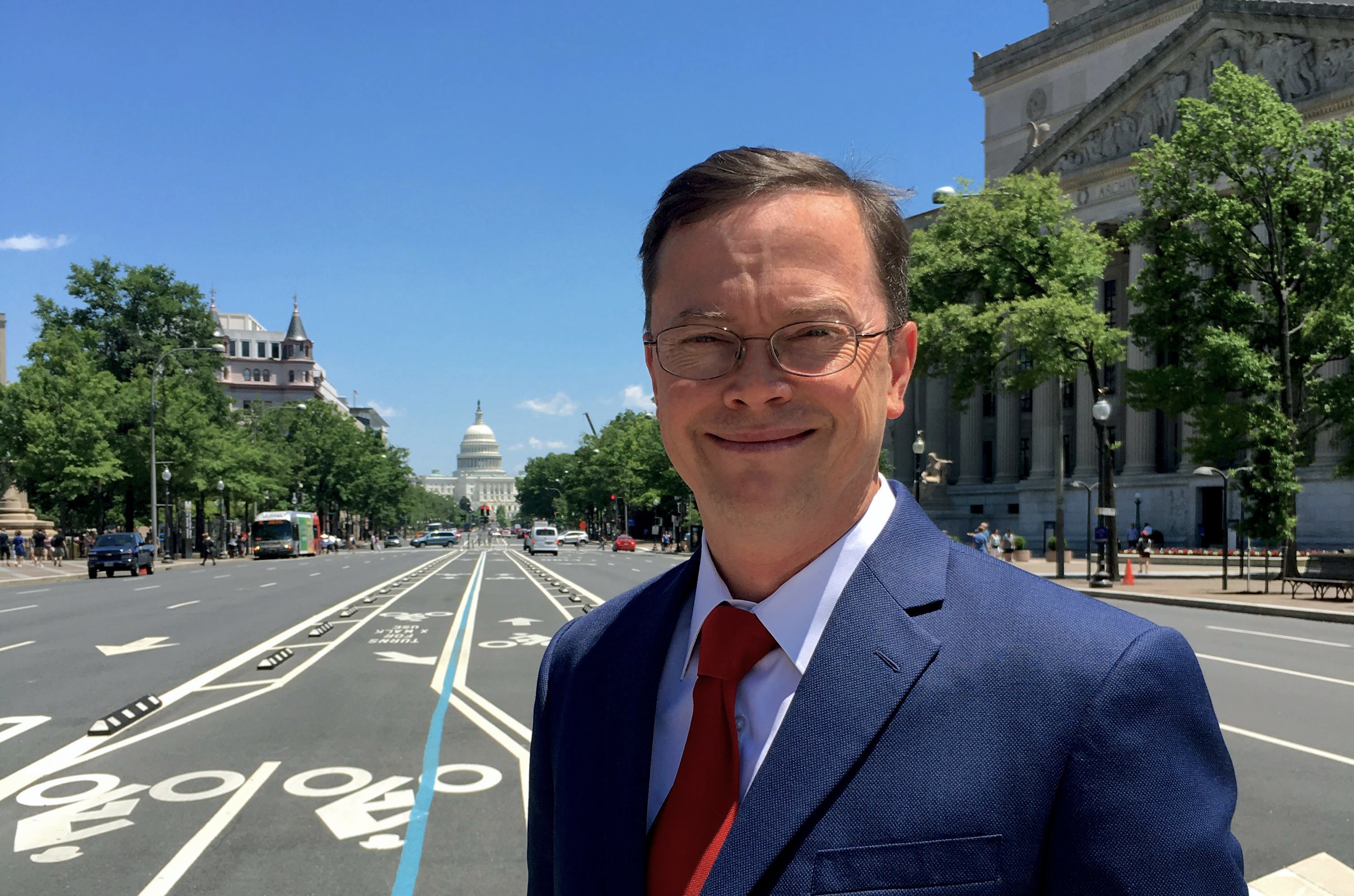
That detour makes the usual career advice about following a straight line look rather optimistic. Anderson had prepared for one profession and found another where the preparation still counted. The geological questions did not disappear when he changed offices. They acquired a second set of questions: who has authority, who objects and what would make an agreement possible?
A drawing with room for disagreement
The power map he made of Reid’s environmental work gathers campaigns and relationships around a geographic map of Nevada. It is a record of a political career, with different panels for different fights. It also demonstrates a working method: putting people, institutions and events where they can be considered together, rather than allowing each to vanish into a separate briefing paper.
Anderson has taught power mapping at Stanford and in conservation workshops. The attraction is easy to understand. A campaign may involve several kinds of authority, different definitions of success and people who use the same words to mean different things. A drawing gives the argument a common surface. You can point to a missing participant. You can see a connection that has not yet been made.

The format has a useful humility. A map can be corrected. An omitted person can be added. A route can be reconsidered. That is a better starting point for negotiation than assuming the plan has become inevitable simply because someone has written it down. In this reading of Anderson’s drawings, the point is to expose the work still required.
“Mapping it out helps to make sure that you see all the pieces at once.”
Kai Anderson, 2020
A picture of conserved land records an outcome. A power map invites you to inspect the machinery behind it. The people on the page have different interests, and the drawing gives those differences somewhere to live. Agreement becomes a problem to work through, with identifiable participants, rather than a pleasant sentiment hovering above the landscape.
A river has an opinion about sediment
One of Anderson’s client projects brought that combination of science and strategy to the Matilija Dam in Southern California. Patagonia hired Cassidy to help advance removal. Anderson mapped the participants and looked at precedents for taking dams out. The work included reconsidering how sediment could move, revising cost assumptions and connecting parties with an interest in the project.
His geological instinct supplied an unusually economical line: “gravity is free at all times.” A river already has a mechanism for moving material. Working out when that mechanism can safely do the job is a scientific question with consequences for the political argument about cost. The phrase is amusing because, in a discussion full of budgets, gravity arrives without an invoice.
An editorial schematic of the questions involved, rather than Anderson’s original map.
There is an essential distinction between making a project more feasible and completing it. Matilija remains a removal effort in progress. Ventura County describes a dam built in 1947 whose former reservoir holds approximately nine million cubic yards of sediment. The county’s project connects eventual removal to bridges, levees, water diversion and habitat restoration. Each piece has neighbors.
The current planning also includes technical studies of potential marine and groundwater effects. That is a reminder of how much can be concealed inside the phrase “remove a dam.” Downstream people need flood protection. Water supplies need to keep functioning. Fish need passage. Sediment has to go somewhere. A policy proposal becomes much more persuasive when it can answer the physical questions in detail.
Seen through Anderson’s career, Matilija is an example of the kind of problem for which a scientific education can be useful far from a laboratory. Knowing how to ask a specialist a good question matters. So does knowing which public decision depends on the answer. A promising idea has to survive both examinations before it can become a workable project.
Fish, wilderness and the other side of the desk
Anderson’s conservation connections extend beyond client assignments. In October 2010, he joined the board of trustees of Trout Unlimited for a two-year term. The organization’s purpose is conserving and restoring trout and salmon fisheries and their watersheds. For someone whose childhood included fishing on public lands, the connection is a concrete one: a fishery is a place, a species and a set of decisions about water.
He has also served with the Alaska Wilderness League, whose 2013 annual report listed him as vice chair, and the Conservation Lands Foundation. The foundation’s 2024 impact report places him among its board emeritus. These are dated roles in conservation organizations, alongside his professional work in Washington. They show where he has chosen to spend time outside the firm’s own leadership.
The overlap is worth considering without turning every association into proof of influence. Serving on a board means joining an institution with a purpose and other people responsible for it. In a career concerned with how groups act together, those affiliations offer another view of the same practical problem: how to organize effort around a place that matters to people.
Building the team that reads the map
Anderson joined Cassidy in 2005 and established its energy and environment advocacy practice. He took on firm leadership in 2013, became CEO in 2015 and led a management buyout in 2017 that returned the business to independent ownership. The change brought responsibility for the firm alongside the client work that had brought him there.
- 1998Stanford doctorate; the academic path opens.
- 1999Joins Reid’s Senate office.
- 2005Builds Cassidy’s energy and environment practice.
- 2015Becomes chief executive officer.
- 2017Leads the management buyout.
Recruitment reveals something about how he approaches that responsibility. In 2017, Cassidy hired Chad Sydnor, a defense policy aide to Republican Senator Richard Burr. Anderson pointed to Sydnor’s legal training, military experience and defense knowledge. A year later, Julie Eddy Rokala joined from Democratic Representative Doris Matsui’s office. Anderson emphasized substantive expertise, leadership and political reach in describing the people the firm wanted.
Those two hires make the idea of a bipartisan team tangible. The work requires people familiar with different offices and different policy subjects. An energy specialist will not automatically know a defense procurement problem. Knowing Washington as a whole is a fine ambition; knowing the particular decision in front of a client is a more demanding assignment.
Cassidy’s current services include legislative and regulatory strategy, executive branch engagement, policy analysis and coalition management. Its published resources include a 2026 congressional calendar and a map of the federal critical minerals and materials ecosystem. Even the everyday tools suggest the need to know both the subject and the institution handling it. A calendar can be as consequential as a compelling argument.
A little sunshine, then back to the West
Washington supplied Anderson with one small comic surprise in 2013. Cassidy’s then-office building appeared in the opening credits of House of Cards. He had not been watching. Learning that the workplace had acquired a television role prompted a reconsideration: “I’m going to have to resubscribe to Netflix and start watching.”
His comments about the building itself were less theatrical. He liked its sunshine and its environmental certification. It is a pleasing detail in a profession frequently imagined through dark rooms and closed blinds. Sometimes an office move is appealing because the office is brighter. The political drama can wait until the subscription has been sorted out.
At home in Washington, Anderson grows figs and pomegranates and uses a backyard pizza oven. He returns to the West when he can. Those particulars bring the person into focus without demanding that dinner become a metaphor for leadership. A pizza is allowed to remain a pizza.
The public work offers its own ending. Anderson started with an education in the earth and found a career among the people deciding what to do with it. His drawings preserve both kinds of knowledge on the same page. Look closely at a landscape, they suggest, and then keep looking until the people involved come into view.