In June 2015, San Francisco’s elected officials received an invitation with an unusually practical dress code: whatever you wear to catch the bus. For 22 days, they were asked to ride Muni, share their experiences and explain the days they chose another way to travel. Thea Selby, then chair of San Francisco Transit Riders, wanted the people making decisions about transportation to spend some time being transported.
The number had a point. Twenty-two years earlier, voters had endorsed a policy encouraging city officials to use public transit at least twice a week. The challenge turned that aging promise into a calendar. There would be journeys, public posts and a hashtag, #OnBoardSF. Government had supplied the intention. An advocacy group supplied the homework.
It is a useful place to begin with Selby. Her titles span a marketing company, a publishing organization, a neighborhood association, a college board and transportation advocacy. The bus experiment puts those interests within reach of each other. Find an audience. Give people a reason to care. Make participation specific enough that somebody can actually do it.
Twenty-two days, one old promise
The campaign began with a City Hall gathering whose announced speakers included supervisors Scott Wiener, Jane Kim, Eric Mar, Julie Christensen, John Avalos and David Campos, alongside transportation authority executive director Tilly Chang and Selby. This was a public invitation with names attached. Residents could follow along while their representatives navigated the same system they did.
The exercise also allowed for a little comedy, as public transportation generally does. When officials first accepted the challenge, Avalos hoped his J-Church journey would escape a turnback. Wiener wanted to try routes beyond his familiar ones. A city looks different when the route is somebody else’s daily routine.
By the end, the participation was uneven. Some supervisors logged many trips; others recorded three or fewer. Selby reported more than 650 tweets and over a million impressions for the campaign hashtag. Those were the organizers’ communication figures, rather than a count of new riders or proof of a lasting policy change. Their value was in making an ordinarily private journey a subject of public attention.
Selby’s ambition was for that experience to influence the priority officials gave transit funding. The experiment stopped short of solving the city’s transportation arguments. It did something more manageable: it made an invitation, gave it a deadline and let residents watch the response. A marketing practitioner could recognize the machinery. A passenger could recognize the subject.
The audience comes first
Selby co-founded Next Steps Marketing during the dotcom downturn. The firm’s early account describes four marketing specialists coming together to serve clients who needed communications and audience development. Its work crossed media, nonprofits and government. Behind those categories sat a practical question: how do you get a message to the people who might act on it?
Today, Selby is the company’s principal and CEO, working alongside fellow principal Mike Popalardo. The firm’s services include audience research, community outreach, advertising and event production. Its project list ranges from transportation agency reports to ferry festivals. The work requires decisions about language, timing and where to meet people. A public announcement is only one part of the job.
The distinction matters in a career so closely associated with public institutions. An agency may have engineers, a budget and a proposed project. Residents arrive with their own questions. Outreach is where those two sets of concerns encounter each other, sometimes politely and sometimes at considerable volume. Selby has made that encounter part of her professional work.
Publishing supplied another setting for building an audience into a community. She helped found Exceptional Women in Publishing, an organization whose history dates its beginnings to 1998. Its purpose included supporting women working in publishing and supporting women and girls through publishing itself. Professional development, mentoring and gatherings gave those aims a working form.
By 2013, the group’s leadership conference was in its fifth year. Selby appeared in its program as a co-founder. In this part of her career, the audience consisted of colleagues with ambitions of their own. A conference creates room for those ambitions to be discussed aloud, across companies and job descriptions. It also gives people a reason to come back.
A neighborhood with a pirate rabbit
The Lower Haight offers a less corporate illustration. In 2013, artist Jeremy Fish returned to the corner of Haight and Laguna to freshen up his pink bunny sculpture. The rabbit acquired an eye patch, and the surrounding artwork became a pirate ship. San Francisco’s appetite for civic improvement is broad enough to include a better-dressed rabbit.
Selby had helped bring the neighborhood mural project into being through the Lower Haight Merchants and Neighbors Association. After the makeover, she supplied a photograph of herself with Fish beneath the sculpture. It is an agreeable interruption to the usual professional portrait: two people on a sidewalk, with a vast pink creature presiding over them.
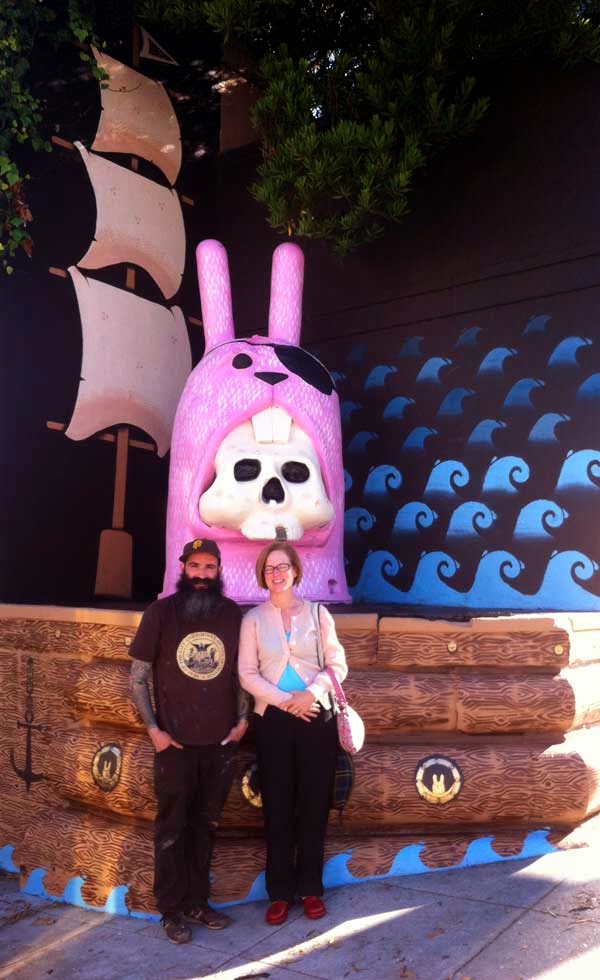
Her neighborhood involvement also included the ordinary work around public art: giving people occasions to meet and reasons to identify with a place. She helped lead the association and participated in the Lower Haight’s ArtWalk activity. A corner, an event and an association each offer a different invitation to belong.
Her firm’s current biography describes monthly happy hours connecting merchants and neighbors. That detail deserves its place beside the board memberships. People can discuss the future of a neighborhood across a meeting table; they can also begin by learning the name of the person who works down the street. The second conversation may make the first easier.
The trustee in the classroom
In November 2014, Selby led the early returns in the City College board race. Asked how she felt, she offered a compact campaign-night assessment: “Cautiously optimistic, less sleepy than yesterday.” She won a seat and later secured re-election in 2018. She served as board president in 2017.
The college was more than a governing responsibility. Selby took classes there herself, including American Sign Language, geology focused on the San Andreas Fault and swing dance. Her education had already taken her through Soviet Studies at UC Berkeley and a marketing MBA at the University of Oregon. Community college allowed the course list to keep growing.
There is something pleasingly San Franciscan about that combination. A public institution can offer a path to a degree, a new language and a chance to improve one’s footwork. The governing challenge is that these different uses share the same institution and must coexist within its finances. Affection for the classroom does not settle the budget.
“I understand budgets, I understand numbers.”
Thea Selby, 2022
Selby said Rafael Mandelman had recruited her to help the college during its accreditation difficulties because of her business background. She saw education as a route to opportunity and wanted stronger funding. The numbers and the purpose were intertwined in her account of why she had taken on the work.
Transportation reached into this chapter too. Building on a student-led effort, she negotiated $400,000 toward free student transit passes. A college place and a way to reach it are connected in daily life, even when they appear in different public budgets. Her advocacy experience gave her another way into an education problem.
Yet her tenure also included decisions that brought determined opposition. In 2022, she supported faculty layoffs and course cuts to balance the budget. She defended the choices as necessary to the institution’s finances. Faculty and union-backed challengers argued for a different direction. Any account of her college years has to accommodate that disagreement.
She lost her re-election bid that November, alongside fellow incumbents John Rizzo and Brigitte Davila. Earlier that year, she had finished fourth in the special primary for California’s 17th Assembly District. Winning support, holding office and retaining it had proved to be different tasks. Her public career contains the losses as well as the invitations.
A larger room, the same question
Her transportation work had already taken her beyond city limits. She served on the California High-Speed Rail Authority board; its 2015 report listed her as vice-chair. She also co-founded Voices for Public Transportation, bringing community organizations and organized labor into the discussion of regional transportation funding.
Those settings ask participants to think across boundaries. A rider’s journey can pass through several jurisdictions while remaining one journey to the person making it. A regional coalition has to bring organizations with different constituencies into the same discussion. Selby’s professional and volunteer work repeatedly puts her near that difficult middle ground.
In September 2024, she moderated a Transit Month panel on gendered perspectives in transportation advocacy. Its participants included Abibat Rahman-Davies, Lian Chang and Haleema Bharoocha. The format gave different experiences of the same public system a shared platform. Listening was built into the event’s design.
The published agenda for Move Bay Area’s October 16, 2026, South Bay gathering listed Selby to introduce the initiative in Mountain View. It is a recent entry in a long sequence of invitations, meetings and campaigns. The scale has changed since the neighborhood mural. The work still involves getting people into a conversation about a place they share.
That is what makes the 22-day bus challenge such a revealing episode. It gave officials a modest, concrete action and left room for the experience to complicate their assumptions. Selby’s career has plenty of titles. Here, the instruction was short enough to fit on a transit notice: get aboard, take the trip, tell us what happened.