The corporate-training industry has a wonderfully convenient definition of success: the employee reached the final screen. Perhaps there was a quiz. Perhaps there was confetti. The Regis Company would like to ask a more awkward question. When that employee faces a frustrated client, a shrinking budget and a team split between two bad options, what do they actually do?
Regis sells a way to rehearse that moment before it becomes expensive. Its SimGate platform lets learning teams build simulations in which workers make choices, see consequences, receive feedback and try again. The pitch sounds obvious because pilots and surgeons have practiced this way for decades. In the office, though, the default has been content: slides, video, a multiple-choice test and a tidy completion rate.
The company is small - roughly 52 employees in the supplied business record - and based in Golden, Colorado. Its reach is less small. Regis says its work has touched more than 1.2 million learners across six continents and 25-plus large enterprises. Its public customer pages name or display companies including PwC, Lilly, IBM, Abbott, Accenture, Deloitte, Mastercard, Cisco, Lockheed Martin and McDonald's. The lesson underneath all those logos is consistent: people need somewhere safe to make the wrong call.
A good idea trapped inside expensive custom work
Mike Vaughan co-founded Regis in 2003 after working at the intersection of learning and technology. His academic mix - neuroscience, cognitive science and computer science - reads like a product requirements document for the company he built. For two decades, Regis designed custom business simulations for large organizations. The work won more than 50 awards, according to the company, and established a specialty in leadership, judgment, business acumen and team decisions.
But the first thing to fail was the economics of access. Bespoke simulations take time, subject-matter expertise, software work and careful facilitation. Regis says the tools were expensive enough that the largest organizations were the natural buyers. That is a fine consulting business and a frustrating way to spread a learning method. Every new program risks beginning again with a blank page.
The company tried to change that equation with SimGate, formally announced alongside a $3.5 million seed round in September 2023. Access Venture Partners led the investment, joined by Firebrand Ventures, FirstMile Ventures and strategic investor Management Concepts. The round did not invent Regis's practice-first philosophy. It funded the attempt to package twenty years of it into software.
“Practice-based learning, where people work through real scenarios and make decisions, is how skills genuinely develop.”The Regis Company
SimGate is a rehearsal room with telemetry
Inside SimGate Studio, a designer lays out rounds, states and activities. A learner might play a manager handling a supply crisis, a consultant leading a client meeting or a seller coordinating an enterprise deal. Decisions branch. Feedback changes. Scores can reflect business results, team health or a competency model. The platform supports self-guided, team-based and facilitated experiences, plus adaptive paths that skip what a learner has already demonstrated.
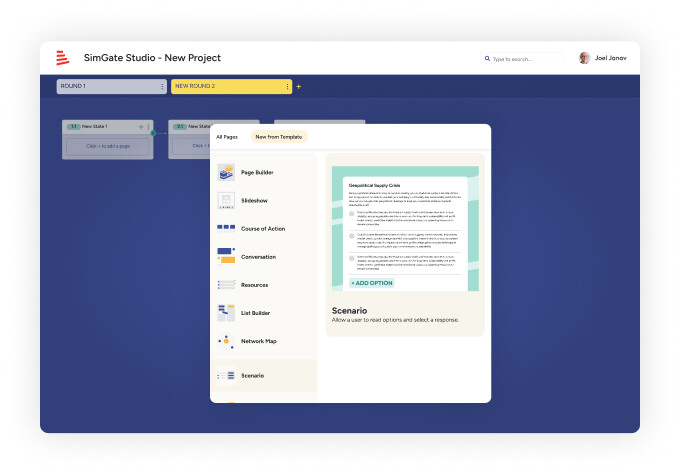
The difference from a learning-management system is important. An LMS distributes material and records attendance. SimGate is an authoring and practice layer that can sit within the wider learning stack. Its more ambitious output is behavioral evidence: which choice a person made, how that choice affected the scenario and whether the next attempt improved. Regis calls this skills intelligence. In plain English, it is an effort to replace “they passed” with “here is what they did.”
AI changed the build, not the bet
What changed Regis's mind about scale was not a sudden discovery that simulations work. It was the arrival of AI good enough to accelerate the tedious parts of making them. SimGate's co-author can draft scenarios and learning content from an organization's existing material. Integrations add voices, avatars, video and images. Smart Templates supply pre-built structures for microlearning, role practice, scoring and feedback.
Regis says this toolset has cut simulation design and development cost by 90%. In 2025, the company said its newer AI content engine reduced development time by as much as 75%, while Smart Templates could put a designer 70% of the way to a first draft on day one. These are company claims, not universal laws. They reveal the strategy: let the machine handle the first-pass volume while a human designer concentrates on whether the dilemma feels true.
Company-reported efficiency claims
That human role is not decorative. A generic branching story with an AI avatar is still a generic branching story. Regis's own best case studies depend on client specificity. A global professional-services firm put 25,000 managers through six to eight hours of asynchronous simulation over two to three weeks. The decisions connected project economics, client satisfaction and team health. A biopharmaceutical company delivered a leadership simulation in eight languages across more than 125 countries. An enterprise software company replaced a day of sales presentations with three rounds of team practice for more than 500 people.
The capacity test that became a sales tool
Software companies often discover their first failure in the least philosophical place: load testing. When a major prospect required proof that SimGate could handle an enormous audience, Regis lacked the internal bandwidth to run the performance work on a tight deadline. A proposed approach was also too costly. The company brought in infrastructure consultancy SuperOrbital, which tested and tuned the system to demonstrate support for 100,000 concurrent users.
The outside engagement paid for itself in unusually legible fashion. The published case study frames the result as a ratio: the evidence helped Regis secure a contract worth 50 times the performance-testing investment. An engineering expense became proof a buyer could use.
Regis sells through quote-based discovery rather than a public price card. The package can combine software access, implementation, custom design, facilitation or certification. Jumpstart is the hands-on option for a tailored program built with Regis. Accelerator trains an organization's own team to build and maintain simulations. A network of service-delivery partners extends the design bench.
Who buys it - and who should not
The natural customer is an enterprise learning leader with a consequential performance gap: new managers making tradeoffs, consultants facing clients, sellers navigating complex teams, or leaders operating in regulated and mission-critical environments. SimGate sits between course-authoring software, coaching tools and custom leadership consulting. Its distinction is the combination of no-code simulation design, enterprise deployment, adaptive feedback and behavioral measurement in one system.
The market signal has strengthened. Regis reported 100% year-over-year revenue growth in 2025, though it does not disclose dollars. It added Jumpstart and Smart Templates, hired former NovoEd executive Charlie Chung to lead sales, and received Training Industry recognition for experiential learning and AI authoring. In January 2026, it announced three Brandon Hall Group Gold awards spanning simulation technology, leadership tools and skills intelligence.
When the model breaks
- The goal is simple information distribution, not judgment or behavior.
- No one can define an authentic decision, consequence or standard of good performance.
- The organization wants AI to replace subject-matter experts instead of accelerating their work.
- Leaders will collect simulation data but never connect it to coaching, staffing or job outcomes.
- The audience needs a cheap compliance record and nothing more. A simulation may be unnecessary theater.
The part anyone can copy
A company does not need SimGate to borrow the sharpest part of the Regis method. Start with the decision, not the syllabus. Find a moment where capable employees reliably hesitate or where two reasonable goals collide. Build the smallest credible version of that moment. Let people choose without real-world damage. Show the consequence quickly. Give feedback tied to the role. Then let them try again.
Measurement should follow the same discipline. Count the behavior that matters, not the decorative activity around it. A manager who opens every module has proved an ability to open modules. A manager who improves a difficult conversation after feedback has offered more useful evidence. The method works best when the practice is close to the job and the organization is willing to act on what the exercise reveals.
Regis's bet is that corporate learning is moving from libraries toward laboratories. The old product stored answers. The new one creates a controlled place to make decisions, watch them go wrong and return smarter. AI makes the lab faster to assemble. It cannot decide which experiment is worth running.