Every company has a colleague who knows how the place really works. She can defuse the angry client, find the buried spreadsheet and explain the product in a sentence that customers understand. Then someone buys a learning-management system, uploads a 47-minute video and wonders why her knowledge never travels. Peer-Tree, a tiny education-software company in Franklin, Tennessee, is built around the suspicion that the problem is not a shortage of content. It is a shortage of useful exchange.
The company calls its model Learning Community as a Service, or L-CaaS. In practical terms, Peer-Tree gives a business, association or education group a private, branded place to gather members, publish material, coordinate events, send targeted messages and watch engagement. The software overlaps with a learning-management system, a community platform and a newsletter tool. The difference is the organizing idea: members are not merely an audience. Their examples, questions and revisions are part of the curriculum.
That makes Peer-Tree easy to misunderstand. It is not selling a public social network where reach is the prize. It is not simply a course shelf where completion is the prize. It is trying to make a smaller, bounded group more intelligent over time. For teams whose know-how lives in people rather than manuals, that is a credible problem to solve.
The productA course with the chairs turned inward
Peer-Tree's product vocabulary reveals the design. Its application includes learning communities, organizers, members, stories, resources, events, invitations, reviews and bookmarks. One of its clearest patterns begins with “Initial Thoughts,” a private prompt that asks a member to consider a subject before the lesson does any persuading. A story then introduces ideas. Members can add resources and examples for one another. Finally, “New Insights” asks the original question again.
The loop worth stealing
Ask before teaching. The response stays private.
Give the group a concrete idea to examine.
Let members contribute examples, links and experience.
Ask again and make the change in thinking visible.
The move is small but smart. Most online learning asks whether a person finished. This loop asks whether a person's thinking moved. It also gives quieter members somewhere to begin before the most confident voice fills the room. Software alone cannot guarantee candor, but the sequence puts reflection ahead of performance.
“The product is not the feed. The product is the change between the first answer and the second.”YesPress analysis
The long buildThe first thing that failed was publicity
Peer-Tree did not arrive fully formed with a neat SaaS category. A developer's public work history dates an early version to 2011 and describes it as an HTML5 social platform for publishing, sharing and consuming educational content. It was still under development and not available to the public. That first incarnation did not become a visible consumer destination. The useful lesson is not that its premise failed. The packaging was too broad: educational publishing and sharing describes half the internet.
John Dunavan and Paul Van Hoesen kept working around the idea for roughly a decade. Dunavan spent those years inside organizational learning, including leadership roles at Brookdale Senior Living and accounting and advisory firm LBMC. His earlier teams built tablet-based training for 2,000 therapists and a 90-day sales curriculum intended to compress a development cycle previously measured in 12 to 18 months. Those programs received industry awards, but the more important inheritance was operational: learning has to survive contact with a job.
By 2020, Dunavan was listing Peer-Tree as his full-time CEO and founder role. By 2022, the pitch had hardened into a scalable, private learning community. What changed the founders' minds is not recorded as a dramatic epiphany. The public trail shows an evolution instead: from a general social platform for educational content to infrastructure that an existing organization could brand, organize and use around a defined group. That narrower buyer and clearer job are the pivot.
Private prototypeAn HTML5 platform for educational publishing and sharing appears in a developer's work history.
Founder goes full timeDunavan begins listing Peer-Tree as his CEO role.
The company finances the next versionTwo offerings sell a combined $170,000 in equity and debt.
A live learning labPeer-Tree joins Virginia Tech and EPIC Education Foundation in a remote internship.
Research affiliationDunavan co-authors a peer-reviewed health-communication pilot study.
MoneyWhat the documented build cost
Peer-Tree's public financing is modest enough to understand without a cap-table decoder ring. A March 2022 securities filing reported $150,000 of equity sold to two undisclosed investors against a planned $500,000 offering. A September filing reported $20,000 of debt sold to two investors against a planned $600,000 offering. Together, the disclosed proceeds were $170,000, and the debt filing set a $20,000 minimum investment.
That is not evidence of traction by itself. It is evidence of constraint. A three-person company cannot win by matching every button in Docebo, Circle, Mighty Networks or Microsoft Teams. It has to make a more opinionated product. Peer-Tree's opinion is that community behavior belongs inside the learning design, not bolted on after a course is published.
In the fieldFrom an astronaut's challenge to aging science
The best public example of Peer-Tree at work came from Virginia Tech. Graduate students in instructional design joined a remote internship with Peer-Tree as the principal industry partner and the EPIC Education Foundation as client. EPIC was founded by Charles Camarda, a former NASA astronaut, to teach collaborative problem-solving through challenges. The students developed personas, scripts, storyboards and prototypes, delivering milestones every two weeks.
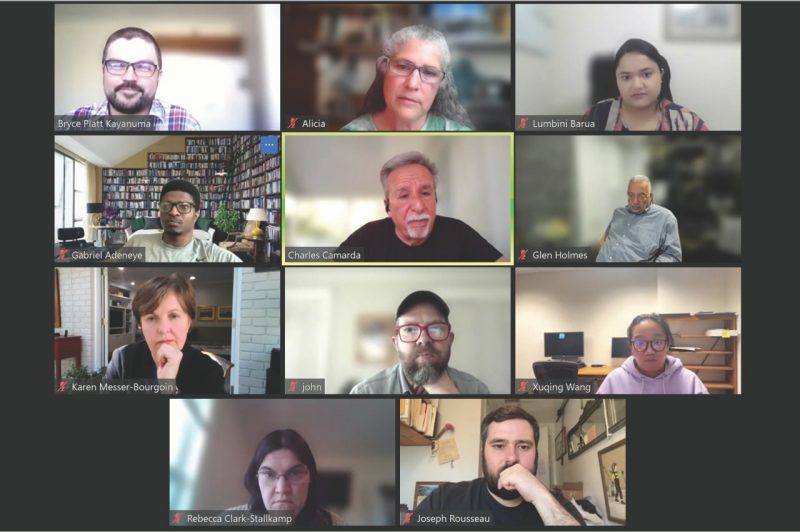
The arrangement demonstrates the product thesis better than a feature list. Learners were not practicing on a fictional brief. They were doing real design work for a real program, receiving feedback and revising on a cadence. Peer-Tree's role sat between platform, learning designer and industry translator. It is a harder position to scale than pure software, but it is also harder for a generic community tool to imitate.
A second signal appeared in 2024, when Dunavan was listed with Peer-Tree Experiential Learning as a co-author of a peer-reviewed pilot study about communicating mitochondrial fitness science to aging adults. The study does not prove the platform's commercial performance. It does show the company's learning expertise traveling into an interdisciplinary health context alongside researchers from Vanderbilt, the University of Utah and Middle Tennessee State University.
The stealCopy the behavior, not the category name
The most portable part of Peer-Tree is available to any team with a form, a meeting and a little discipline. Begin with a question that exposes current thinking. Keep the first response private so people do not merely imitate the boss. Introduce one strong story or problem. Ask members for evidence from their own work. Then return to the opening question and record what changed. The technology can make that loop repeatable, searchable and measurable, but the loop is the engine.
A five-line operating manual
- Choose one group with a reason to learn together.
- Design a recurring prompt, not an endless content library.
- Make contribution useful to the contributor's real work.
- Give an organizer a cadence and clear permission to facilitate.
- Measure changed decisions and shared practice, not logins alone.
There are conditions where this will not work. A compliance department that only needs audit trails may be better served by a conventional LMS. A group with no facilitator, no shared problem or no psychological safety will become a beautifully branded ghost town. And if members already exchange expertise effectively in Teams or Slack, adding another destination may create friction rather than learning. Community is not a feature that administrators switch on. It is a behavior they must continually earn.
The marketThe useful middle
Peer-Tree occupies an awkward but interesting middle. LMS vendors are strong at assignment, administration and compliance. Community specialists are strong at identity, conversation and events. Learning consultants can diagnose the human problem but often leave behind slide decks instead of infrastructure. Peer-Tree is attempting to combine those pieces for organizations that need a private, branded environment and an opinion about how people learn inside it.
That will not make the company right for everyone, which is precisely why the position has shape. Its likely customer is not searching for “more content.” It is an association whose members know things the staff cannot author, a company trying to spread practice across experienced employees, or an education initiative that needs learners to make and revise things together. Peer-Tree's small public footprint leaves commercial scale unproven. Its underlying observation is sturdier: knowledge moves differently when the learner is allowed to become a teacher.