An insurance office is an unlikely place to leave your shoes. In December 2015, however, shoes were precisely what two State Farm offices had been collecting. Brandon Shreves’s effort in Mobile and a pickup from fellow agent Kacky Kortenber in Memphis culminated in a delivery to Soles4Souls in Nashville. The NALA’s announcement put the total at approximately 3,500 pairs.
Consider what that gave a publicist to work with: named people, actual places, a journey and a count. There was something to photograph. There was a reason to invite the neighborhood inside. An insurance agent had a story that did not require anyone to be shopping for insurance.
This was a revealing piece of work for the NALA, the Ventura marketing business whose name expands to National Association of Local Advertisers. Its pitch joined the ordinary chores of getting a business found online with the more interesting question of what people might discover once they found it.
The news was already in the neighborhood
When the NALA launched its News Division in August 2013, the proposed service went well beyond writing an announcement. Staff would research, interview, help shape promotions, distribute the release and deal with interested media afterward. Arranging interviews and photo shoots was part of the offer.
Its launch announcement included Mark Johnson, owner of Universal Martial Arts Center in Palm Desert. He wanted people to know about new self-defense classes. In his testimonial, he reported that two local newspapers had run stories with images. The subject was modest. For someone nearby looking for a class, it was also useful.
“Everyone has a news story”Jeff Velis, VP of Operations, in the 2013 News Division announcement
The practical appeal is easy to see. A business owner knows what changed this month, but may not recognize which change makes a story. An opening, a new class or an organized collection can supply the raw material. The agency’s job begins with asking questions and continues after publication, when a reporter wants a photograph or an interview.
A founder who understood the shopping trip
Jeffrey Rosenthal, identified in company announcements as the NALA’s founder, also founded StarKart, the grocery-cart advertising business. A 2015 account described his involvement in local grocery advertising stretching back more than 30 years. The NALA’s LinkedIn profile dates the agency to 2010.
The pairing explains its place in the market. Rosenthal’s businesses dealt with owners whose next customer might live a few streets away. A supermarket offered one route to those people; a local article offered another. Different media, similar geography.
Executive Business Services, the parent company described in those announcements, brought together marketing, public relations, journalism, branding, design and web work. In 2015, EBS described personalized strategies implemented over at least 12 months. That was a service operation, with people preparing and coordinating campaigns over time.
For a busy owner, that coordination was part of the product. Buying a website, hiring a writer and organizing publicity separately creates its own management job. The NALA presented a single point of contact across several of those tasks.
Being found was only the opening move
By January 2014, the agency’s advertised menu included eListings, press releases, email messaging, social posts, blogs, SEO, personalized video and websites. Its eListings description was unusually specific: staff manually posted business information and a branding video to selected directories and social or professional networks.
There is little glamour in getting a business’s details onto a directory. Yet this sits close to the moment when a potential customer needs an answer. Where is the office? What does it do? How do I reach it? A publicity campaign and a useful business listing solve different parts of the same journey.
The agency sharpened that proposition with a 2016 rebrand. Its new website explained services in more depth, carried weekly business blogs and featured testimonials. Creative marketing manager Julia Weikel described content creation alongside additional coaching for clients. The promise rested on access to people as well as access to publishing tools.
The part a distribution button cannot do
A 2016 Cision account identifies a concrete operating problem: serving businesses across many locations required both centralized distribution and accurate contacts for hyperlocal media. The NALA used Cision’s database, PRWeb distribution and reporting tools to support that work.
In that account, communications lead Tiffani Tendell emphasized understanding where releases had appeared and who was seeing them. Cision reported television appearances, radio interviews, local articles and donations to client charity drives. These are results described in a vendor case study, rather than an independently measured return on advertising spend.
The interesting decision was to organize the work around a shared set of tools. National distribution alone could not identify every useful neighborhood contact. A contact database alone could not supply a worthwhile announcement. Reporting helped the agency explain the work afterward. Each addressed a different point where a campaign could lose momentum.
The collection box came with responsibilities
The charity program made the agency’s combination of services particularly visible. Its published campaigns included a Syracuse law firm serving as a Soles4Souls drop-off location and a RE/MAX agent in Parker, Colorado, inviting shoe donations. These were businesses with offices a community could actually visit.
By the end of 2019, the NALA reported that its businesses had collected more than 1,500 pairs of shoes that year. Caribe Resort accounted for more than 640. The agency also reported enough fundraising for Operation Warm to make 50 winter coats, alongside client toy collections for Toys for Tots.
Those numbers make the activity legible. They should retain their meaning: shoes collected, coats funded, toys donated. A business may also gain attention, but counting donations does not tell you how many insurance policies, legal consultations or resort bookings followed.
A reader can copy the campaign’s structure without copying its wording. Choose a partner whose needs you understand. Establish what can be collected, where it will be stored and how it will be delivered. Give the community a specific request. Then report what happened. The announcement becomes easier to write because the underlying work has details.
A monthly price needs a scope attached
SourceForge’s NALA listing quotes a starting price of $129 per month after a 14-day trial for its reputation and listing offering. Treat that as a historical directory-listed price. It is not a current quote for a publicity campaign, a website or the full collection of services.
The agency’s 2014 announcement instead described packages built around individual budgets and marketing needs. That distinction matters when comparing alternatives. A subscription tool gives an owner tasks to perform; a managed service also sells staff time. A local PR specialist, a website studio and a directory-management product each cover a different portion of the job.
For a buyer, the useful comparison is the work included: interviews, writing, distribution, follow-up, reporting and ongoing updates. The charity approach also depends on willingness to organize a real activity. It is a poor fit for an owner who wants immediate, predictable sales from an announcement, or who cannot handle the collection and delivery commitments.
The checkout is still part of the story
Visit thenala.com in September 2026 and the address redirects to STARSTIX. Its website presents advertising on supermarket checkout dividers, including the insurance advertisement pictured here. That is the current destination of the old domain; the NALA’s earlier campaigns belong to their documented dates.
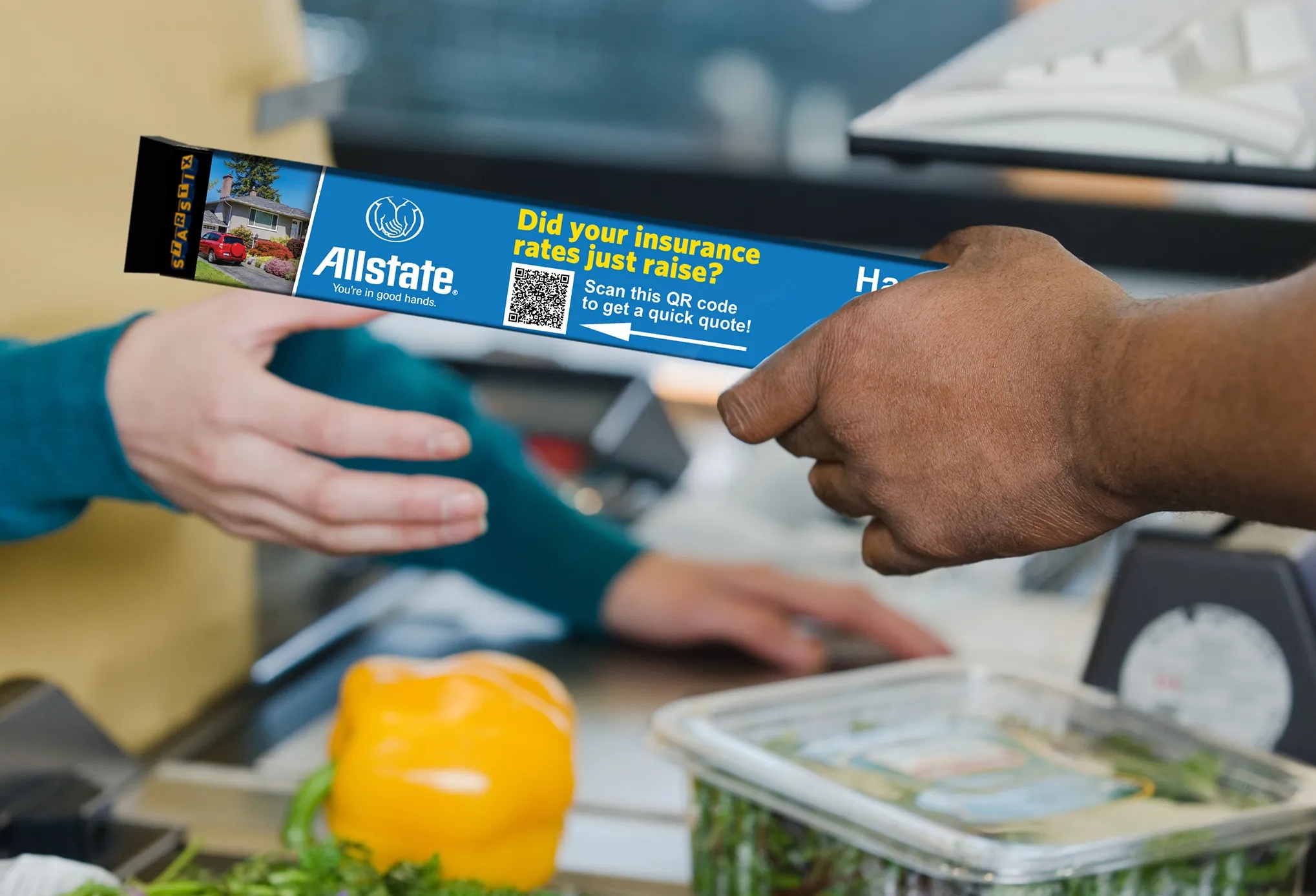
The photograph makes a useful companion to the shoe-drive story. One business name appears during a shopping trip. Another becomes associated with a place to bring donations. The NALA’s documented work invites a practical question for any local owner: what can people encounter, join or remember before they need what you sell?
Follow the local trail
Explore the former NALA domain, now leading to STARSTIX. Find the agency’s historical profiles on LinkedIn, X, Instagram, Facebook and YouTube.
Further reading: the PRWeb customer story and the 2016 website relaunch.