The glamorous life of a computer lasts about eleven minutes. There is the peel of the box, the immaculate screen, the brief fantasy that every file will migrate politely. Then the machine joins an office. Someone forgets a password. Wi-Fi sulks. A battery swells. A warranty becomes a scavenger hunt. This is the less photogenic territory where TenPlus Systems has made itself useful since 1992.
The Raleigh company is part retailer, part authorized repair shop, and part outsourced IT department. It sells Apple and Lenovo hardware. It services machines under and outside warranty. It moves data, configures devices, trains owners, engineers networks, manages backups and cloud services, supports users remotely or on-site, and helps retire equipment at the end. The pitch is not a new category. It is fewer phone calls.
TenPlus says it has served thousands of clients, mainly across North Carolina and southern Virginia. The counter is open to individuals, but the longer menu speaks to schools, nonprofits, law firms, manufacturers, healthcare practices, creative shops, construction companies, government buyers, and small businesses without a full internal technology team. These customers do not need a provocative theory of computing. They need the projector to recognize the laptop before the meeting starts.
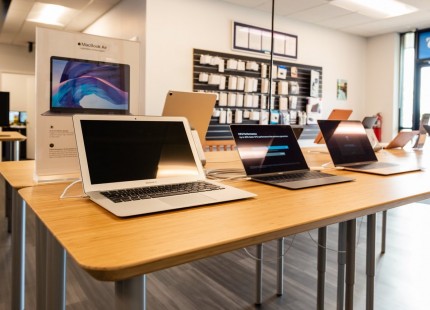
The repair counter is a trust machine
TenPlus began as Advanced Mac Solutions. The original name was almost comically specific, and therefore useful: it told Raleigh Mac owners exactly why to call. Manufacturer credentials later widened the promise. TenPlus now describes itself as an Apple authorized service provider and business partner or value-added reseller, as well as a Lenovo authorized reseller, service provider, and certified business partner.
Those badges matter because the customer is handing over an expensive device full of private material. Authorization gives TenPlus access to warranty workflows, genuine parts, prescribed diagnostics, and product knowledge that a general consultant cannot merely announce. A cracked screen or dead laptop creates urgency; a successful repair creates evidence. The person behind the counter did the thing, on the machine, when it mattered.
“Our goal is to always help customers make informed decisions.”TenPlus Systems, on its sales and consultation service
That evidence can travel. A consumer transaction ends when the machine goes home. An organizational relationship can climb into setup, deployment, asset management, software licensing, network security, backups, cloud services, and project work. TenPlus calls its managed offering PRIORITY Service and describes it as a “complete IT department.” The service includes a local helpdesk, remote and on-site support, preventive maintenance, scheduled visits, procurement, solution engineering, and personal attention.
What it costs when the screen goes dark
Small service businesses often hide prices behind a form. TenPlus publishes useful anchors. Its current repair terms list a $70 inspection and evaluation fee for an out-of-warranty Mac or Lenovo computer. An iOS-device inspection is $35. General labor is listed at $140 an hour, billed in half-hour increments for computers and quarter-hour increments for iOS work unless the service order says otherwise.
| Public price point | What it covers | Listed cost |
|---|---|---|
| Mac / Lenovo inspection | Evaluation and required diagnostics for non-warranty issues | $70 |
| iOS inspection | Evaluation for non-warranty iPhone, iPad, and related-device issues | $35 |
| General repair labor | Labor unless a service order states another rate | $140/hr |
| One-to-one training | An older public service sheet lists reserved personal instruction | $120/hr |
These are published reference prices, not universal quotes. Warranty status, parts, accidental damage, third-party components, data work, and the specific service order can change the bill. TenPlus says customers receive an estimate and may approve or decline the repair.
The repair terms also reveal what fails first operationally: certainty. Data recovery is best effort. Parts availability can stretch a repair. A third-party component can eliminate an authorized repair path. TenPlus explicitly tells customers it is not responsible for data loss and may decline machines that have been tampered with. This is not charming copy, but it is adult copy. The shop sells competence without pretending hardware is predictable.
The market changed the assignment
There is no public conversion story in which management suddenly abandoned a sacred belief. The documented change is more practical. A company that began with Mac solutions now supports mixed Mac and PC environments, Apple and Lenovo fleets, servers, networks, cloud tools, security, audio and video systems, and device retirement. The customer problem grew around the computer.
That expansion answers a common weakness in local repair: the shop can fix the object but not the system containing it. A school does not merely own iPads. It has Wi-Fi capacity, mobile-device management, warranties, classroom downtime, pickup and delivery, replacement policy, user accounts, and budget cycles. A law firm does not merely own laptops. It has confidential files, backups, security, remote access, and lawyers who bill by the hour while waiting for help.
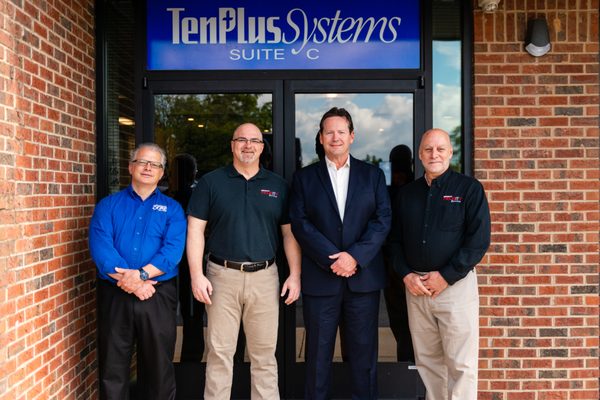
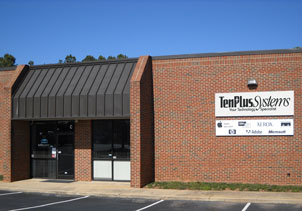
The company’s differentiation is the overlap. Apple Stores can offer Apple retail and support. Independent shops can repair devices. MSPs can manage networks. Direct vendors can ship boxes. TenPlus puts authorized Apple and Lenovo work, physical retail, mixed-platform support, and managed services under one local roof. Its defensibility is not a secret algorithm. It is accumulated permission: certifications, vendor processes, customer history, local response, and the willingness to handle small operational chores alongside larger infrastructure work.
The useful bit you can copy
The TenPlus model offers a four-part playbook for a service company. None requires pretending every customer should buy everything.
Start with a painful, legible job. Repair is easy to understand, time-sensitive, and capable of proving competence in one visit.
List what happens before and after the urgent job: advice, purchase, setup, training, maintenance, replacement, and disposal.
TenPlus explains its managed-service path: free consultation, paid full assessment, recommendations, pre-contract projects, then onboarding.
Fees, turnaround expectations, data risk, parts limits, and approval deadlines reduce ambiguity before the difficult conversation.
The sharpest move is the audit. TenPlus says a full assessment can take 10 to 40 hours. The team documents equipment, servers, workstations, software, and backups, then interviews users about their complaints. Only after that does it present recommendations and possibly a contract. The sequence separates diagnosis from the retainer pitch and gives the proposal a factual spine.
The business model then becomes a stack. Hardware resale creates a transaction. Diagnostics and labor monetize repair expertise. Training sells patience in small increments. Projects cover migrations and upgrades. Warranty work and authorized parts deepen credibility. Managed service agreements sell ongoing availability. Each layer serves a real need on its own; together they make customer acquisition less dependent on a single category.
Where the model stops working
This approach is not universal. Local density matters because pickup, delivery, counter service, and site visits consume travel and technician time. Vendor authorization matters because customers can get equivalent hardware almost anywhere. Skilled labor is the inventory, and it cannot be duplicated with a download link. A shop that adds managed services without disciplined documentation can turn recurring revenue into recurring interruption.
Choose another route when...
- Your organization needs a 24/7 global support operation across many countries.
- Your environment is dominated by specialized systems outside TenPlus's documented Apple, Lenovo, Microsoft, network, and small-business remit.
- You want the cheapest commodity hardware and are comfortable coordinating setup, warranty claims, repair, security, and disposal yourself.
- You already have a capable internal IT team with vendor relationships, spare-device capacity, and clear lifecycle ownership.
- A regulated or high-risk environment requires a specialist provider with explicitly documented controls beyond the public TenPlus offer.
For the right customer, however, TenPlus occupies a sensible middle. It is more accountable than a collection of unrelated vendors and more personal than a national queue. The company’s modest scale - the supplied data lists 12 employees, while LinkedIn places it in the 11-to-50 range - is both constraint and feature. Customers are buying proximity to people who know which machine, which user, and which cable caused trouble last time.
The larger lesson is not “open a computer shop.” It is to notice what happens after the photogenic moment. Products arrive with an ecosystem of loose ends. The business that names those ends, prices them, sequences them, and accepts responsibility for the handoffs can become harder to replace than the product itself. TenPlus Systems has been working that seam for 34 years, one repair ticket and one network audit at a time.
Continue exploring
See the current service menu, company updates, and contact details directly from TenPlus Systems.