On Christmas Eve, 1997, a Camaro enthusiast’s website acquired a place to talk. Chris Frezza had exchanged emails with a programmer named Ted O’Neill, installed his Ultimate Bulletin Board software on a small Linux machine, and switched on the message board. Frezza and a colleague took the first two accounts. Then they showed it to their partner. A website that people could visit had become somewhere they could return to one another.
There is something pleasingly modest about that scene. No launch auditorium. No crowd of investors. An enthusiast, a computer in an office, and a programmer answering email. In Frezza’s recollection, UBB soon seemed to be everywhere. Years later, even after his community had moved to different software, he remembered O’Neill and the program with affection. Software usually earns complaints; affection is a more interesting review.
O’Neill’s career has followed the consequences of that little change: give people a place to converse, and they begin to care who runs it. He created UBB, built Social Strata with his wife and co-founder Rosemary, and later helped launch Narrative, an attempt to let a content network’s members govern it and share its proceeds. The ambition grew. The underlying question remained recognizable: how much say should the people doing the talking actually have?
A conversation needed fewer obstacles
The early attraction was straightforward. O’Neill has described being fascinated in 1996 by the ability to communicate with people around the world through bulletin-board systems. He found the technology awkward. UBB was his response: make conversations easier, and make it easier for an ordinary website to offer them. Before a discussion could become a community, somebody had to get the software out of everyone’s way.
UBB belonged to the downloadable era. A site operator installed it and looked after it. Social Strata’s account of the product’s origins describes a freeware Perl message board in 1997, with a simple interface and an administration panel. Those details sound almost domestic now. Yet the administration panel mattered: a host could open the door, arrange the rooms, and decide how the gathering should work.
The program also introduced UBBCode and automatic emoticons. The little formatting conventions traveled beyond the original software. Square brackets could tell a forum how to present a member’s words; a typed expression could acquire a face. O’Neill’s contribution to internet conversation included both the machinery for organizing it and some of its punctuation. An engineer could do worse than leave people with a way to smile.
[b]Hello, everyone.[/b]Hello, everyone.The office behind the candy store
Social Strata remembers its first office with a photograph of the candy store in front of it. That is a useful corrective to the usual architectural language of technology companies. Before the imagined campus comes the actual room. The business that grew from O’Neill’s forum software would pass through the names Infopop and Groupee before Social Strata, accumulating the less photogenic experience of supporting other people’s communities.

The company moved to Seattle in 1999. Its workplace also attracted attention: Seattle Magazine recognized it among Washington’s best places to work, and O’Neill’s professional profile lists the magazine’s “25 Brightest Cyberstars” recognition in June 2000. The period vocabulary has aged more visibly than the problem his software addressed. People still need somewhere to ask a question and expect a human answer.
Eventually, the company shifted from downloads to hosted software. In January 2010, Social Strata transferred UBB.threads to Mindraven, whose owner Rick Baker had spent nine years managing its development and support. O’Neill explained the decision in practical terms: Social Strata could concentrate on its hosted platform, while UBB customers would get dedicated attention. A founder was handing over a familiar product so both businesses could pursue their next work.
“Focus on doing what’s best for your customers.”TED O’NEILL · 2018
Two founders, one well-thumbed bookshelf
Rosemary’s account of joining him gives the company a more personal beginning. Both had corporate jobs before Ted developed UBB. He invited her to become his co-founder, and she credits his respect for her marketing and communication skills with helping her make the leap. Their partnership brought together the person building the product and the person explaining why anyone should use it.
In her telling, working together was a welcome departure from writing government proposals. In his, the pleasure included sharing achievements with someone who understood what they had required. Neither account makes the arrangement sound like an exercise in keeping professional distance. They chose to build things together, and the company became one of the places where that choice took shape.
Their management reading acquired visible wear. When Social Strata introduced unlimited paid leave for full-time employees in January 2010, Rosemary described their copies of Jim Collins’ books as dog-eared, highlighted, and covered in sticky notes. She tied the decision to a culture of discipline: people could have freedom within a framework of responsibilities. Trust, in that account, required judgment from the people receiving it.
The policy drew coverage from NPR, the BBC, and the Wall Street Journal. It also makes an interesting companion to O’Neill’s product work. In the office, the founders were asking how much control employees needed over their own time. In online communities, they were dealing with the permissions and responsibilities of members. Those are different settings, but both make an administrator confront the limits of administration.
When the members were meant to own the meeting
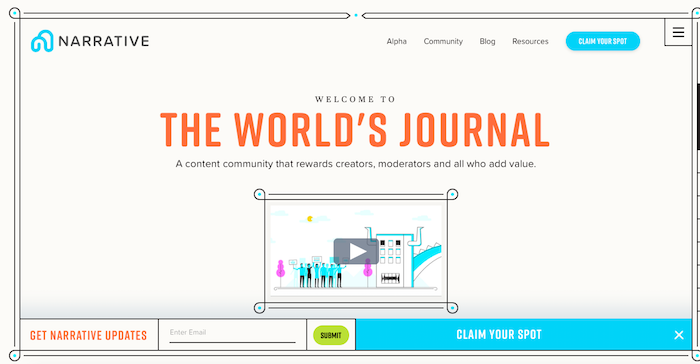
With Narrative, O’Neill tried to take the question further. He wrote a white paper in the summer of 2017. By then he had watched community owners and members disagree about content, authority, and acceptable behavior for years. His proposed network would organize posts into distinct subjects called Niches, and give participants a role in determining what belonged there.
The design carried an unusually explicit allocation of rewards. Eighty-five percent would go to network participants, with fifteen percent going to the company. Creators were assigned the largest portion, while other roles, including moderation and governance, also qualified for rewards. This was a plan to put the community’s contribution into the accounts. The percentages were part of the product’s argument.
The beta launched in April 2019. O’Neill described a network where members rated content, reputation affected influence, and a user could choose subjects and people to follow without an algorithm rearranging the feed. There were qualifications even within that ambition. In August, he acknowledged that company staff still occupied the appeals body while elections remained a future feature. A constitution and a working government are separate engineering tasks.
In a September community question-and-answer session, the team discussed Publications, another piece of the design. These would give businesses and writers a place to assemble their work, while the wider subject system connected posts to readers’ interests. The details reveal how much of the venture concerned the ordinary architecture of publishing: categories, permissions, audiences, and the route from a writer’s page to someone willing to read it.
A project can close before its question does
By December 2019, Narrative was closing. The team’s announcement, issued by Rosemary, cited market events, regulatory uncertainty, and limited resources. Operations were scheduled to end on December 30. Members were given a deadline to download their writing and redeem tokens. The final instructions were painfully concrete: a community that had been offered a future now needed a way to collect its belongings.
The ending belongs in O’Neill’s story alongside the launch. Narrative had attempted to turn an argument about fairness into a functioning publishing system. Its closure put a limit on what the team could sustain. The model’s proposed percentages remain useful for understanding the intention; they cannot stand in for an enduring outcome. A profile of a builder should leave room for the thing that stopped being built.
The option to leave the old view on
Another scene from that same autumn is smaller and, in its way, just as revealing. On October 22, 2019, O’Neill announced Card Mode for Hoop.la. Lists of content would become cards in a grid, with colors distinguishing different types of posts. Existing communities would be able to keep their current view. Customers promptly asked what would happen to the pages they had carefully arranged.
He answered in the comments. They could arrange a separate demonstration site to experiment, although the new interface could not be mixed and matched module by module. This was the daily work beneath a product title: explain the limits, offer a trial, and remember that a fresh design lands in somebody else’s established routine. A customer’s carefully curated front page deserves more consideration than a designer’s appetite for novelty.
Today, O’Neill identifies himself professionally as Crowdstack’s Chief Product Officer. The company describes itself as remote, headquartered in Charleston, and bootstrapped from the beginning. Crowdstack continues the hosted community line, with tools for organizations managing their own crowds. The product names have changed over the years; the work still involves making a shared place usable for the people who arrive.
That brings the story back to the Camaro board. Frezza supplied the enthusiasm and the members. O’Neill supplied software and answered emails. The resulting conversation belonged to the people who kept turning up. Across his career, that arrangement has proved both productive and difficult: someone must build the room, someone must look after it, and everyone inside will have an opinion about the furniture.