Tasso Argyros had a respectable problem: he was doing well at Stanford. His fellow computer science student Martin Casado remembered someone who passed his comprehensive exams on the first attempt, then did the same with his qualifying exams. The academic machinery was working. Argyros decided to step out of it and build a database company.
For Casado, watching a capable researcher trade a clear academic path for fundraising and company building was puzzling, then persuasive. Argyros helped make entrepreneurship imaginable to a friend who would later co-found Nicira and become an investor at Andreessen Horowitz. Years afterward, Casado would back Argyros’s next company, ActionIQ. An unfinished doctorate had acquired a rather interesting alumni network.
Argyros’s career has moved through database infrastructure, marketing software and, now, AI applications at Databricks. Underneath those changing job descriptions is a persistent question: once an organization knows something about its customers, how long does it take to do anything useful with that knowledge? His companies have repeatedly occupied the awkward space between having information and being able to use it.
The visitor who wanted to discuss the future
Originally from Greece, Argyros studied engineering at the National Technical University of Athens before earning a master’s in computer science at Stanford. His father was a mathematics professor. Argyros has described spending substantial college time on advanced mathematics, interested in how abstract ideas could have consequences outside a classroom. Data offered a practical answer: mathematics could turn records into information someone could use.
At Stanford, his research involved processing large amounts of data across farms of inexpensive computers. He met Mayank Bawa and George Candea, who approached related problems through databases and reliability. In Argyros’s recollection, Candea appeared in his office, barely an acquaintance, wanting to talk about startups and the future. This is an unusually ambitious opening line for an office visit. It worked.
The three co-founded Aster Data in 2005. Its approach joined database querying with distributed processing, allowing analytical work to run over clusters of commodity hardware. Argyros became chief technology officer. The attraction extended beyond cheaper machines: customers could ask more demanding questions of their data. A piece of research was becoming a product with users, budgets and expectations.
“Most importantly, you have to smile a lot!”
Argyros on persuading venture investors, 2009
The joke came after a serious answer about fundraising: a large market, a team suited to the problem and a technical advantage. It offers a useful glimpse of an engineer discussing the social business of company building. Even a database needs someone willing to enter the room and explain why it should exist.
The career choice carried a particular kind of risk. An academic result is evaluated by people trained to understand it. A product must persuade people whose main concern is whether it helps them finish their work. Argyros was moving between those audiences. The technical idea could remain sound while the explanation, the interface and the business around it all needed to change.
After the acquisition, a different bottleneck
Teradata completed its acquisition of Aster Data in April 2011. Its annual report recorded $259 million in consideration for the outstanding equity interests, excluding Teradata’s existing 11.2 percent investment. Argyros went on to become co-president and general manager of Teradata’s big data division. The work brought him further into the operations of large enterprises, where technical capacity and practical usefulness could be surprisingly distant relatives.
A database can preserve an extraordinary amount of customer history while leaving the marketing department waiting for an answer. The company possesses the information. The person responsible for making a decision still needs help retrieving, assembling and interpreting it. A successful storage system can therefore sit beside a very unsuccessful workflow. This organizational distance became the premise of ActionIQ.
Argyros co-founded the company with Nitay Joffe in 2014. Joffe had worked on Facebook’s data infrastructure. Together, they brought infrastructure experience to a business audience: people trying to identify customers, choose audiences and coordinate communications across channels. Building for marketers meant paying attention to the person on the other side of the interface, including what that person could accomplish without writing code.
- 2005Aster Data begins
- 2011Aster joins Teradata
- 2014ActionIQ is founded
- 2026CustomerLake launches at Databricks
The technical challenge mattered here. A friendly screen could only help if the system underneath could handle the depth and complexity of enterprise information. ActionIQ’s proposition brought a database builder’s concerns into campaign planning. The user wanted an audience that made sense; the software had to reconcile the data required to create it. A clean interface was the beginning of the promise.
Thanksgiving is a poor time for a two-month project
Argyros has told a story about a large customer that needed to change a marketing campaign after a competitor made a sudden move over Thanksgiving weekend. The customer completed the work in two days, he said, instead of the two months it might otherwise have taken. The company was unnamed, and the example was his account. Its significance is the deadline: a good answer delivered after the opportunity closes has little commercial charm.
That urgency helps explain his impatience with elaborate data preparation standing between a business question and an action. In 2020, he described ActionIQ’s ability to retain customer interactions and assemble profiles as needed, rather than requiring every useful attribute to be anticipated in advance. A purchase, a click and a later change of mind can all matter. Customers are inconsiderate enough to keep producing new information.
By then, ActionIQ’s customers included businesses such as Gap, Saks Fifth Avenue, Verizon and The New York Times. The list crossed retail, communications and publishing, but the recurring problem was recognizable: how to make a large body of customer knowledge available to the teams expected to act on it. The software had to accommodate changing questions, as well as accumulating records.
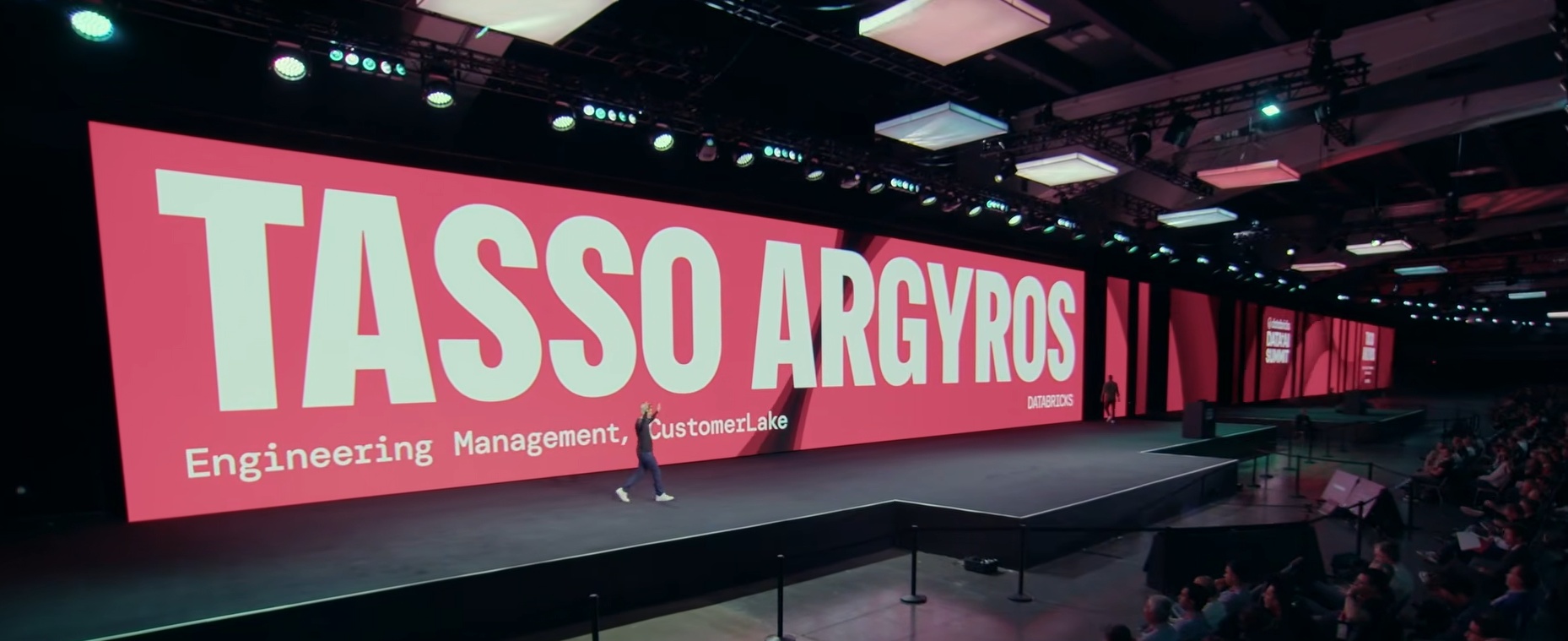
A thoughtful founder, with customers on the calendar
Asked in 2018 for one word describing his working style, Argyros chose “Thoughtful.” He explained that major decisions have long consequences and that colleagues know their own domains better than he does. He wanted their input before committing. That is a less theatrical account of leadership than the founder who is expected to have an answer before everyone else has finished the question.
His account of an ordinary working day was correspondingly practical: recruiting, speaking with customers and prospects, and understanding internal problems. He wanted employees exposed to customer difficulties, too. Meetings needed a specific purpose. Customer success, satisfaction and the return customers received from using their data were recurring measures of whether the work was worthwhile. The calendar served as a check on the product’s claims.
He also noticed what happened to people around the software. A customer getting promoted after choosing the product, or an employee becoming an executive or entrepreneur, could be a particularly rewarding result. That gives his interest in usefulness a personal dimension. The database query ends somewhere: in a decision, a working day, perhaps a career that goes a little better.
The next company was already on his reading list
In that same period, Argyros named Databricks among the companies whose work interested him, particularly its approach to predictive models and machine learning. Years later, it became his workplace. The intervening chapter ended with ActionIQ’s acquisition by Uniphore, announced in December 2024. Argyros argued then that customer data platforms would increasingly be shaped by AI and customer experience agents.
By January 2026, he was writing about joining Databricks a few months earlier and launching its New York research and engineering hub. He described being drawn to the concentration of technical talent and founders who remained involved in the work. After building companies from the ground up, he was now helping assemble a research and engineering operation inside an established platform.
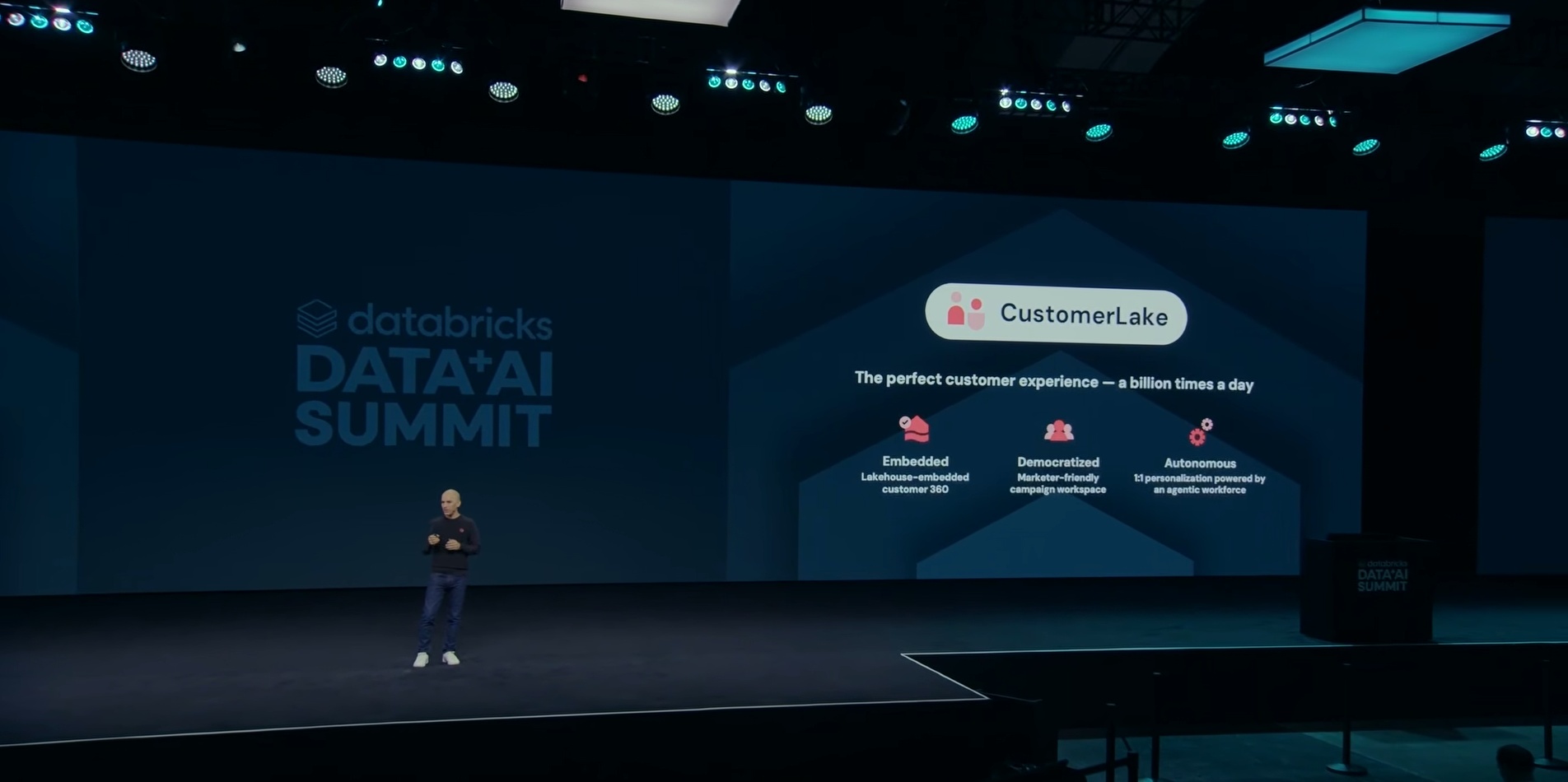
His current remit includes CustomerLake, where he is vice president and general manager. Introduced in June 2026, it places customer data platform functions inside Databricks’ lakehouse environment. Profile Agents help prepare customer profiles; Campaign Agents help build audiences and execute engagement. People supply objectives and guardrails. The proposed advantage is fewer separate systems between the data, the models and the work.
signals→Governed
context→Agent
decision→Relevant
action
Argyros calls the continuous approach “infinity campaigns”: engagement that keeps responding as customer circumstances change, rather than ending with a single launch. The phrase is expansive. The operational question remains concrete. Can a business respond to the next useful signal with the right action, while preserving control over the information that made the decision possible?
Back to the people doing the work
In October 2026, CustomerLake’s Campaign Agents advanced to beta, while Profile Agents entered private preview. Named customers described early results. HP reported having data and attributes ready for audience building within two hours, compared with two to three months using a traditional CDP. Wine.com reported launching production email campaigns 23 days after kickoff. These are customer accounts of particular implementations, with all the specificity that implies.
The New York operation was growing, too. On October 19, Argyros announced plans to double Databricks’ footprint at 5 Bryant Park to approximately 120,000 square feet across five floors. The expansion included dedicated research and engineering space. A career that began with computing across clusters of inexpensive machines now involved finding enough room for the people developing the next systems.
There is continuity in that change of scale. The early researcher wanted to extract more from data. The ActionIQ founder wanted business users to reach it. The Databricks executive wants agents to help turn it into ongoing decisions. Each version introduces new engineering work, but the test is familiar: somewhere, a person has a question, a deadline and a reasonable wish to get on with the job.
Follow the next question
Conversations, writing and the work in progress.