Tarun Chitra was eleven when he appeared on Jeopardy! The episode aired on December 26, 2000. He came from Hockessin, Delaware, and stood behind a lectern answering questions while Alex Trebek presided. Plenty of children collect facts. Relatively few arrange to have their collection audited on national television.
Years later, Chitra would build a company around asking questions that financial software would rather leave unanswered. What happens when prices fall together? What happens when everyone follows the incentive you gave them? What happens when a system works exactly as designed, and the design is the problem?
He is now the co-founder and CEO of Gauntlet, which applies quantitative research to decentralized finance. He also invests through Robot Ventures and co-hosts The Chopping Block. These occupations have different audiences, but they share a recurring activity: opening the box, examining the mechanism, and asking who benefits when it moves.
A peculiar way to discover Bitcoin
Chitra’s route into cryptocurrency began with a hardware problem. After graduating from Cornell in 2011, he joined D. E. Shaw Research, where custom chips and large simulations were part of the working environment. The equipment depended on manufacturing capacity that smaller buyers had to compete to secure.
In his account of the episode, early Bitcoin miners disrupted that supply chain by competing for chip space. Cryptocurrency arrived as an inconvenience before it became an intellectual interest. He began mining himself, then sold his Bitcoin in 2013, convinced that the enterprise looked dubious. The familiar early-adopter story usually improves with every retelling. Chitra includes the exit.
He kept reading the research. Distributed systems interested him; so did the gap between a clever technical construction and the economic behavior it might encourage. A blockchain could have an ingenious consensus mechanism and still make questionable assumptions about the people being paid to participate.
That distinction would give him a business. It also explains why his conversion never required the suspension of disbelief. His interest grew alongside his objections.
Two degrees, then a market full of experiments
At Cornell, Chitra studied mathematics and applied engineering physics, earning a BA and a BS in 2011. His student CV records modeling competitions, mathematics tutoring, and music writing. He was on a winning team in the 2009 International Mathematics Competition in Modeling. Even before finance, the combination was visible: abstract ideas, working models, and an audience to explain them to.
After scientific computing came high-frequency trading at Vatic Labs. There, simulation meant testing how a strategy might behave across markets. A proposed trade could look convincing until the environment changed. Testing meant giving the idea somewhere to fail before actual money supplied the verdict.
In crypto, he found economic designs being released into the world with considerable confidence and uneven preparation. His consulting work grew from examining those designs. Gauntlet began in 2018, with co-founders including Rei Chiang and John Morrow. Chiang brought his own experience in trading and simulation. The company’s initial attention went to proof-of-stake networks; decentralized finance soon offered a more immediate laboratory.
The trouble with perfectly sensible people
One of Chitra’s early research questions sounds almost impolite: can a network become less secure because its participants make reasonable financial decisions?
In Competitive equilibria between staking and on-chain lending, he examined a token that can do two jobs. Owners can stake it to help secure a network, or lend it to earn a return. If lending becomes more attractive, some owners may move their tokens. Individually, each decision can be sensible. Collectively, the movement can weaken the network’s security.
The paper models how different risk preferences and returns affect that choice, then uses simulations to explore the resulting behavior. The finding depends on its assumptions. Its broader lesson is easy to carry around: you can create a vulnerability without recruiting a villain. Sometimes a better offer is sufficient.
Support network security
Capital leaves staking
This is a useful clue to his temperament as a researcher. He looks for interactions that disappear when you study each component separately. A staking system and a lending market can each look coherent on their own. Put the two together, let people choose, and the interesting part begins.
Giving the experiment some mathematics
Uniswap supplied another puzzle. Its exchange mechanism was spare enough to invite skepticism, yet people were using it. Chitra joined Guillermo Angeris, Hsien-Tang Kao, Rei Chiang, and Charlie Noyes in examining why.
Their 2019 analysis studied constant-product markets, showing that under specified conditions their prices track a reference market. Large agent-based simulations explored behavior across different market conditions. The work later appeared in Cryptoeconomic Systems.
The qualifications matter. This was a mathematical examination of a mechanism, with assumptions and limits, rather than permission to pronounce every application safe. Chitra’s professional territory lies in those details: what a result establishes, which conditions it needs, and what happens outside them.
By 2022, Gauntlet had clients including Aave, Compound, and SushiSwap. A $23.8 million Series B led by Ribbit Capital valued the company at $1 billion. The headline number was conspicuous. The underlying work was less theatrical: assessing collateral, monitoring markets, and recommending changes to the settings that govern financial risk.
Cornell degrees; joins D. E. Shaw Research
Gauntlet begins
$23.8M Series B
$125M Series C announced
A later collaboration tested another attractive assumption: that more competitors necessarily make a market better for users. In An Analysis of Intent-Based Markets, Chitra, Kshitij Kulkarni, Mallesh Pai, and Theo Diamandis modeled solvers competing to fulfill user orders. Searching for a better execution costs effort. When that effort also creates congestion, the model produces circumstances in which limiting entry can improve user welfare.
It is an awkward conclusion for anyone hoping to settle market design with a slogan. Competition still matters; the particular costs and rules matter too. The paper does not offer a universal argument for fewer participants. It offers a reason to inspect the mechanism before deciding what increasing their number will accomplish. For Chitra, that inspection has become a recurring line of work.
The founder who keeps reading the code
Asked how he spent his time in a 2023 conversation with Axelar co-founder Sergey Gorbunov, Chitra put running Gauntlet at 95 percent. Investing occupied part of the remainder. He described himself as “a founder who invests in other founders.”
He also described reading other people’s code and papers in search of mathematical problems appearing under different names. There is something appealingly unglamorous about this version of entrepreneurship. The founder’s special equipment includes a willingness to read the appendix.
“a founder who invests in other founders”
Tarun Chitra, 2023
Robot Ventures puts him alongside Robert Leshner, the founder of Compound. In August 2024, the firm raised a $75 million fund for early-stage crypto projects. Chitra announced the news on LinkedIn with a small administrative observation: Robot did not have its own LinkedIn, so he was posting it himself. Even venture capital eventually becomes somebody’s social-media chore.
His appetite for exchanging ideas predates both firms. He helped start NYC Salon in 2015, describing it as “TED with friends.” Talks ranged across art, economics, science, technology, and comedy. Afterward, attendees broke into small groups to work through the material. The discussion was part of the event, rather than something to squeeze in near the coat rack.
When the machinery sends you a bill
By late 2025, another market mechanism had Chitra’s attention: autodeleveraging. On perpetual-futures exchanges, it is a last-resort way to deal with losses when ordinary liquidations fail. It can involve forcibly closing other traders’ positions. Someone discovers that a profitable trade has become part of the exchange’s emergency arrangements.
Chitra described an unexpected autodeleveraging event on his own low-leverage position as an impetus for studying the process. The resulting paper models trade-offs among exchange solvency, revenue, and fairness to traders. It argues that familiar queue-based approaches can impose avoidable costs, and develops alternatives.
His personal encounter makes the research less remote. It is one thing to examine an obscure rule because it looks theoretically interesting. It is another to have that rule close your position and then decide it deserves an impossibility theorem.
In 2026, his attention also extended to AI inference markets. His essay Caching Cheaters on OpenRouter examined how quoted token prices can diverge from the cost of repeated conversations when caching behavior changes. The experiments describe observed pricing patterns; they do not establish providers’ intentions. The question is familiar from his crypto work: what does the mechanism reward, and what does the customer actually pay?
A week in a suit
In July 2026, Gauntlet announced a $125 million Series C led by SBI Holdings through its US subsidiary. At the announcement, Gauntlet said it curated more than $1.5 billion in supplied vault assets. Those are different quantities: money raised by the company, and assets supplied to strategies it curates.
The stated plans included broader stablecoin coverage, a larger global team, and capital for new onchain offerings. Chitra’s ambition had widened from testing crypto mechanisms to helping institutions use them. He compared the potential of vaults and tokenization to the way exchange-traded funds expanded participation in equities, presenting that as his expectation for the years ahead.
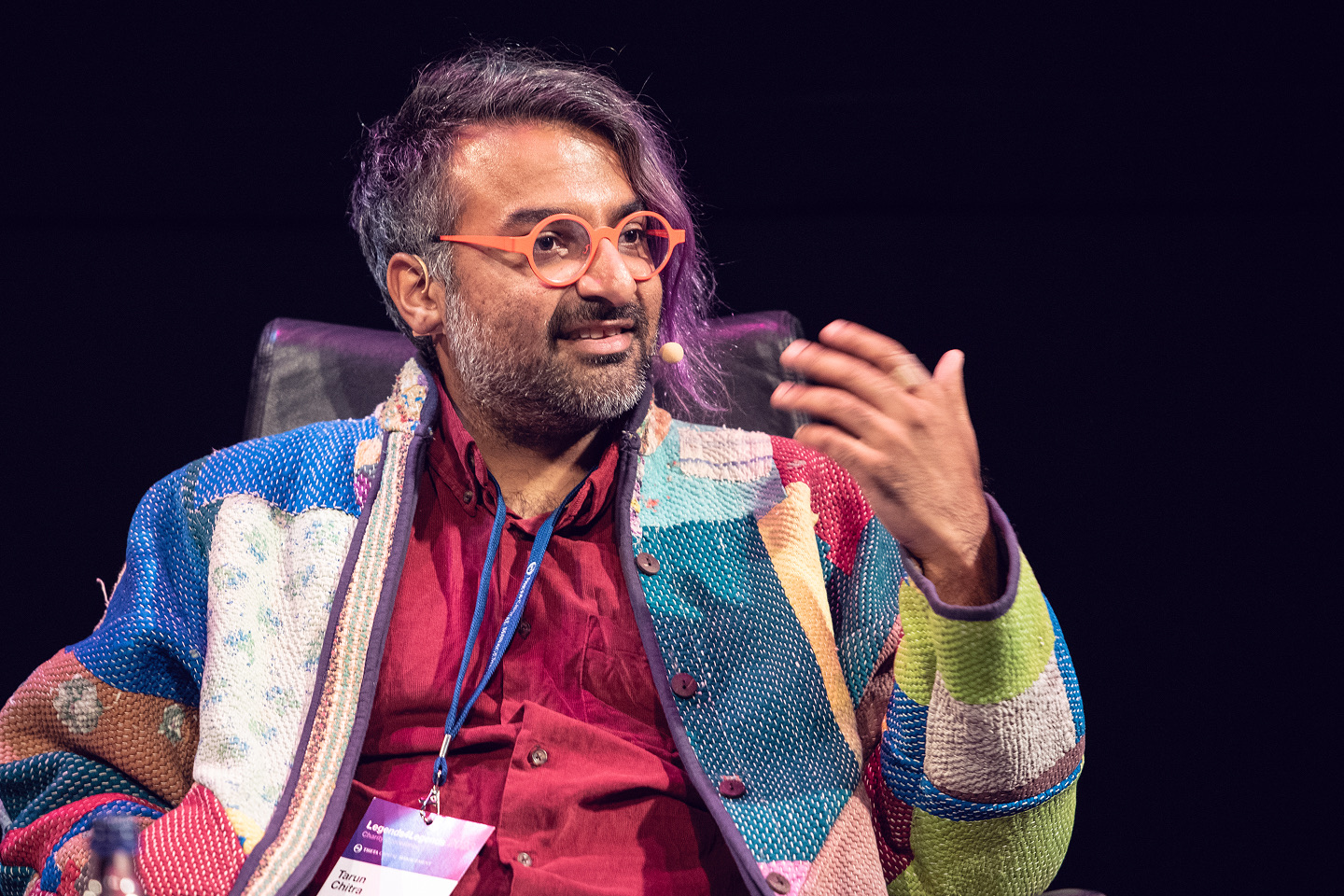
There were practical concessions. On The Chopping Block, the fundraising discussion included suits and seven consecutive days of staying shaved. For someone whose public wardrobe includes exuberant patterns and bright round glasses, the detail deserved its airtime.
The clothes can change with the meeting. The question underneath has remained remarkably consistent, from a chip-manufacturing surprise to a trading rule to an AI bill: what happens when the participants discover exactly how this thing works?
Keep the questions coming
- Watch: Chitra discusses Gauntlet’s SBI fundraiseTHE CHOPPING BLOCK / JULY 2026 / YOUTUBE
- Watch: why autodeleveraging mechanisms need an updateTHE BIG BRAIN PODCAST / DECEMBER 2025 / YOUTUBE
- Read: Caching Cheaters on OpenRouterTARUN CHITRA / AUGUST 2026
- Read: Gauntlet’s $125 million financing announcementGAUNTLET / JULY 2026
- Read: a conversation with Sergey GorbunovAXELAR / JANUARY 2023
The incentives file / Tarun Chitra