Kristen Irwin’s nursing team at RHA Health Services had a pharmacy problem that looked, at first, like a collection of chores. Packages needed sorting. Refills needed chasing. Medication arrived in inconsistent formats. Each task seemed manageable. Together, according to Tarrytown Expocare’s account of the partnership, they consumed hours of the nurses’ day.
- Tarrytown builds pharmacy services around IDD and behavioral health care teams.
- Scheduled packaging, refill coordination and a customer portal tackle recurring administrative work.
- Regional acquisitions have carried the model beyond its Austin beginnings.
The team’s change came through standardized packaging, color-coded organization and digital refill management. Irwin’s verdict was wonderfully concrete. Her customer testimonial, published by the pharmacy, identifies the company’s proposition with unusual clarity. The medicine matters. So does everything a nurse must do before administering it.
“It literally gave me hours of my day back.”Kristen Irwin / RHA Health Services
01 / The work around the pill
Tarrytown Expocare Pharmacy serves people with intellectual and developmental disabilities, or IDD, and behavioral health needs. Its immediate working partners are provider agencies, nurses and direct support professionals. In a group home, dispensing a prescription is one step in a longer process involving authorization, packaging, delivery, records and administration.
The company’s own origin story starts in 2007, when Tarrytown Pharmacy began serving 150 people around Austin. Those customers exposed needs that ordinary pharmacy arrangements were not meeting. The current company history dates the dedicated Expocare operation to 2012. Founder Mark Newberry’s business grew by concentrating on that care environment. By 2019, the company says, it supported more than 6,000 individuals.
That progression suggests a useful business lesson: watch which jobs customers repeatedly finish themselves. A pharmacy can supply medication while leaving an agency to coordinate the surrounding work. Tarrytown made that surrounding work central to its service.
02 / Put the routine on a clock
The operating model has two clocks. Routine medicines run on a monthly cycle: prescriptions are aligned, packaged and delivered on a schedule. Refill coordination starts before the next supply is needed. Care teams gain a predictable rhythm for recurring orders.
Other medicines follow demand. As-needed prescriptions, acute treatments and topical products are filled on request to avoid waste and overstock. Their labels remind staff to reorder three business days before depletion. It is a modest piece of design, almost comically unglamorous. It also addresses a precise question: who remembers the next order?
Prescription management extends to prior authorizations, coverage concerns and billing support. Delivery uses national distribution networks and local couriers; urgent needs can involve coordination with a local pharmacy for pickup. After hours, an on-call team remains available. These are connected parts of the offer, because an orderly package is less useful when the authorization or delivery has stalled.
Align → package → deliver on cycle
Request → fill → reorder before depletion
03 / A screen with a practical job
The Expocare Portal makes the service visible. Existing customers can view prescriptions, track orders, receive automated alerts, generate reports, store lab results and manage medication holds. Mobile apps provide another route into the same system. Access depends on being a pharmacy customer.
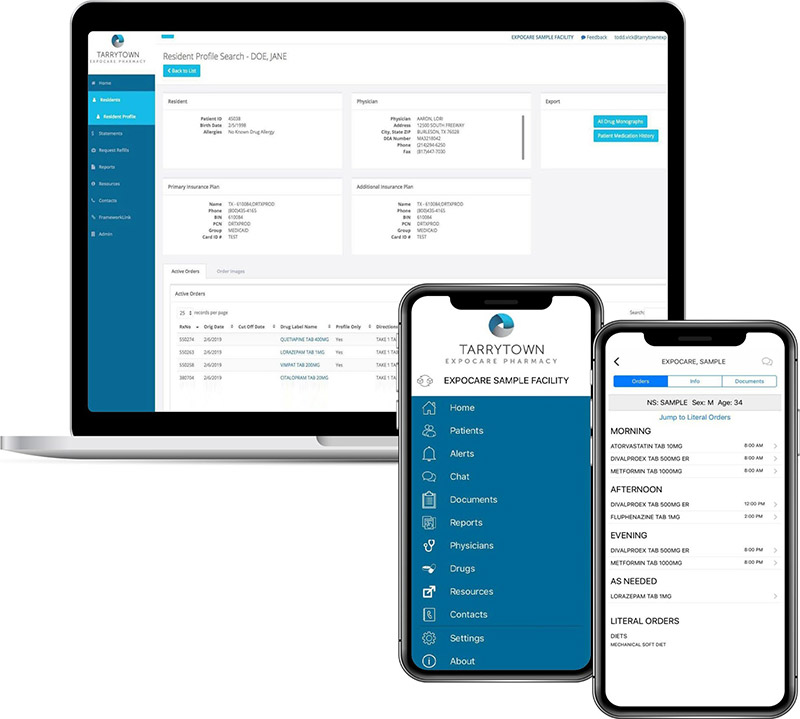
This makes Tarrytown a pharmacy operation with supporting software. The portal’s role is to help people manage the prescriptions and information moving through that operation. The company also offers medication administration records, physician order forms and support for integration with electronic medication administration record systems.
Ray Graham Association’s published customer account describes a familiar cluster of headaches: after-hours needs, billing issues, limited prescription visibility and laborious medication check-ins. Its reported improvements involve responsive support and easier tracking. Alongside RHA and AHRC New York City, it shows who buys into the model: organizations coordinating care across people, staff and locations.
For an agency, that visibility changes the questions staff can answer without another call. Has an order moved forward? Which record needs printing? What information belongs with a medication change? A shared view can shorten the distance between noticing a problem and reaching the person who can resolve it. The value comes from fitting those answers into the working day.
04 / The narrow focus gets a bigger map
Specialization does not mean an empty competitive field. PharMerica also serves IDD and behavioral health customers, alongside several other care markets. Regional long-term care pharmacies offer alternatives. Tarrytown’s positioning rests on focusing its organization on IDD and behavioral health, with packaging, support and education built around those settings.
Its expertise includes clinical pharmacists and developmental disability nursing experience. Education director Deb Maloy is a registered nurse with more than 38 years in IDD, according to her company biography. Training and webinars sit alongside dispensing. Internally, the company’s 2025 leadership program graduated six employees from functions including claims, distribution and customer experience.

Expansion has combined investment and acquisitions. Sheridan Capital Partners announced its investment in January 2020. Tarrytown acquired Greater Boston Long Term Care Pharmacy in December 2024, reporting approximately 30,000 individuals served. Carlyle acquired the company in November 2025, with Sheridan retaining a minority stake. That announcement described 12 regional pharmacies serving 36 states. In April 2026, buying Embrace Healthcare established Tarrytown’s first physical pharmacy presence in Ohio.
Buying regional pharmacies adds a practical challenge: keeping the service recognizable as the network grows. A provider experiences the business through a delivery, a billing answer or an urgent request. The acquisition strategy therefore puts weight on the ordinary operating details that made the original proposition attractive. The next pharmacy has to make those details work locally.
05 / Count the interruptions
For a provider evaluating this model, the useful comparison is the whole medication workflow. Ask how routine refills arrive, how urgent prescriptions are handled, whether records fit existing systems and who answers at night. Compare the commercial proposal with the staff work it would actually remove. Savings depend on that fit.
The fit is strongest where medication coordination repeats across a care organization. A person seeking an occasional retail prescription has a different job to accomplish. For an agency, a useful evaluation begins with its own interruptions: the refill calls, the sorting, the records and the unresolved questions. Those are the tasks against which a proposed pharmacy relationship can be judged.
Regular cycles need exceptions; software needs current information; care teams still need clinical judgment. The lesson another business can copy is quite specific: identify the recurring coordination work around your product, then decide which parts you can reliably take over. Tarrytown’s opportunity lives in those handoffs. A nurse’s afternoon is a persuasive place to start counting.