Consider the restaurant that opens a second location. To a customer, it is another place to eat. To a lender, it may be a business looking for capital. To an insurer, it may be a policy that needs another look. To a food distributor, it may be tomorrow’s account. The same event has several commercial meanings. Tarci built its proposition around translating between them.
- The idea: identify changes in small businesses, then connect them to a plausible need.
- The buyers: enterprises selling financial, insurance and other services to SMBs.
- The turn: a $17 million funding round in 2022; a website reported offline in June 2025.
A business directory gives you a noun: restaurant. Tarci wanted to supply a verb: expanding. That is a useful distinction for anyone who has ever received a sales pitch whose only apparent qualification was possession of a telephone. A reason to call can be more valuable than another name to call.
A list with a clock attached
Founded in 2019 by Leetal Gruper and Sergey Bahchissaraitsev, the company began as Leadgence. Its central product became the Continuous Intelligence Engine: an AI-based system for turning external business information into changing SMB profiles. Company announcements described weekly profile refreshes. The appeal was information that could follow a business through its life, rather than preserve it in the condition in which somebody first entered it.
That distinction also disciplines the company’s language. Tarci promoted real-time insights, but its published weekly refresh schedule is the more concrete description. Freshness is a cadence, not a magic trick. A change still has to be detected, attached to the correct business and interpreted before a commercial team can use it.
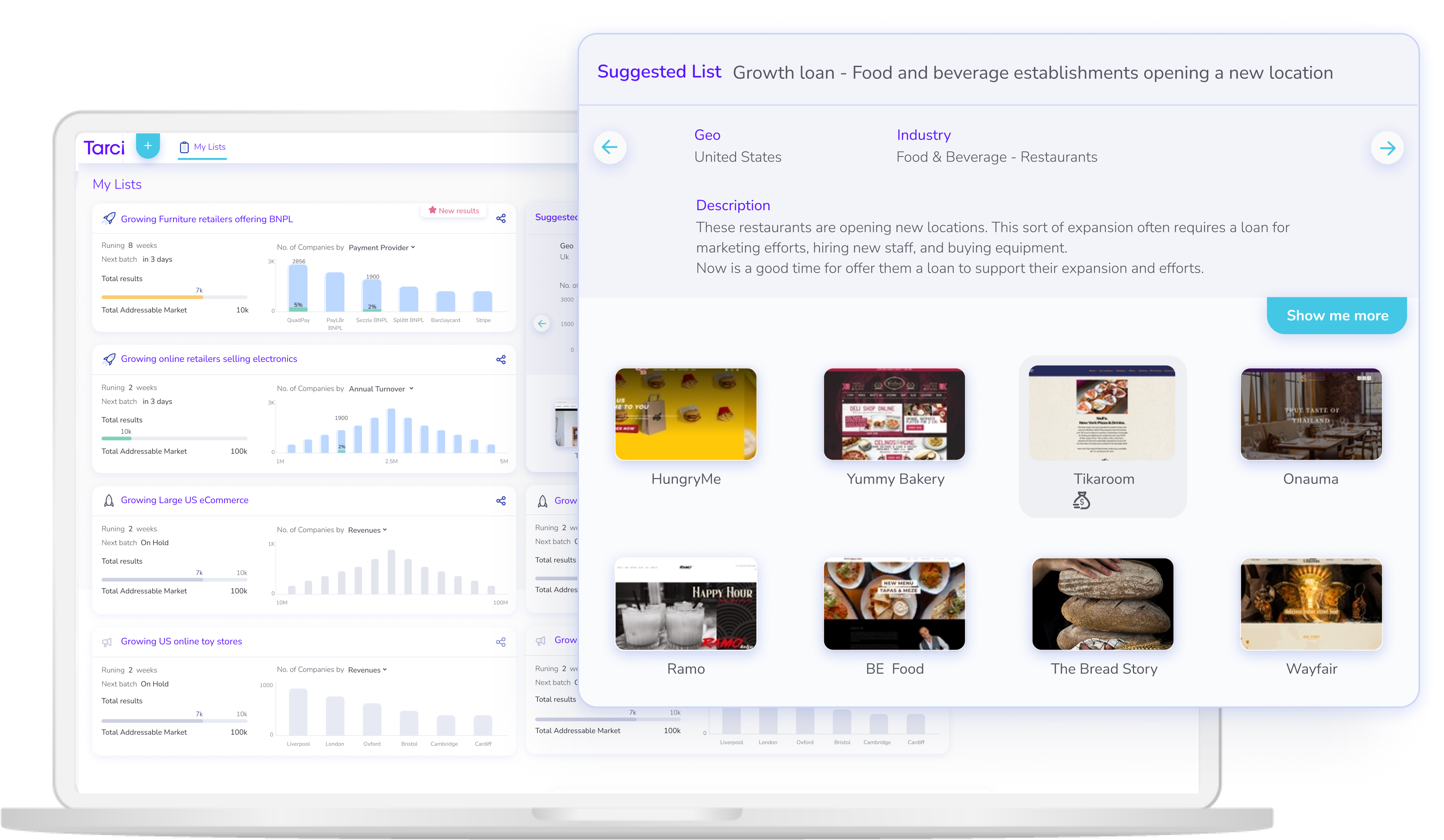
The product image makes the argument unusually legible. A suggested list identifies food and beverage establishments opening a new location, then explains why expansion could create a financing need. The software is doing two jobs: selecting businesses and proposing a commercial interpretation. Neither job, by itself, proves that the owner wants a loan.
One event, several buyers
Tarci’s customers were the organisations serving small businesses. Its market was enterprise data and sales intelligence, with applications extending into risk and retention. Its 2022 funding announcement described commercial teams at Fortune 200 companies using its intelligence. The business being watched and the business paying to watch were usually different organisations.
In March 2023, Tarci introduced a financial services suite developed through a year of collaboration with bank and financial-institution data teams. Its modules connected business circumstances to potential borrowing, merchant services, foreign exchange and payment needs. A growing company and a newly established company might both need banking services, but the appropriate conversation would differ.
“We know we’re helping our clients better serve their clients.”Leetal Gruper · financial services announcement, 2023
The insurance version arrived that June. Tarci said it followed two years of work with major-carrier underwriters and industry specialists. It addressed four policy categories: business owner, general liability, professional liability, and directors and officers. Changes could prompt an agent’s coverage review or help an underwriter assess an account.
This was the more interesting extension of the idea. The event that makes a business attractive to a salesperson can also make yesterday’s insurance assumptions questionable. The data does not have one meaning until somebody supplies a job for it to do. Industry expertise matters because expansion, exposure and financial need are related without being interchangeable.
- 01Business changes
- 02Profile updates
- 03Need is inferred
- 04Team reviews action
Foodservice followed in September 2023. Alongside growing restaurants and licensed establishments, the suite included indicators of business stability or decline to inform credit terms. Suppliers could use the same intelligence to look for new accounts and reconsider existing ones. Selling more and getting paid are close relatives, though they occasionally refuse to speak.
The conversation gets cheaper
Tarci’s positioning centred on change detection and industry-specific interpretation. In the wider market, sales prospecting and business-risk databases provide overlapping alternatives. Its practical claim was that a profile becomes more useful when it tells a commercial team why this business deserves attention now.
By 2025, AskTarci put a conversational interface over the database. Gruper’s public posts advertised access to more than 32 million profiles. A subsequent update described lists of up to 10,000 records at $0.10 per record, with searches by employee range and number of locations. Those were historical product claims and pricing, not a present-day offer.
At the advertised rate, 10,000 records would cost $1,000. A list’s price is easier to calculate than its usefulness.
Chat changed how someone asked for a list. It did not settle whether the list deserved a salesperson’s afternoon. Record accuracy, timing and the fit between an inferred need and a seller’s product still determined the value. Making retrieval pleasant is worthwhile; it leaves the difficult questions intact.
Then the watcher went dark
In 2022, Tarci raised a $17 million Series A led by Sound Ventures, with Liberty Mutual Strategic Ventures, Global Founders Capital and other strategic investors participating. Its funding announcement said the money would support growth and hiring. The rebrand borrowed its name from the nocturnal tarsier, a creature chosen for the metaphor of seeing in the dark.
On June 6, 2025, Coverager reported that Tarci’s website was offline, roughly three months after AskTarci’s introduction. The report also said Gruper had moved on to building a stealth startup that May. These are the documented events. They do not establish which operational problem arrived first, or why the business stopped appearing online.
Give the lead an expiry date
The useful lesson is available without a subscription: attach a reason, a date and a next action to every prospect. Verify the event before treating it as intent. Review a small batch against actual outcomes before buying a larger one. This is an editorial inference from Tarci’s approach, not a claim about a customer’s results.
It works only when there is an observable change, a relevant offer and someone able to respond while the information still matters. A quiet business may leave little evidence. A busy sales team may leave good evidence untouched. Tarci’s question remains a fine test of any prospecting system: why this business, and why today?