vision-care
(9)
The $43 Million Shortcut: How KITS Turned Contact Lenses Into a Million-Customer Eyewear Machine
KITS bought a working contact-lens engine, gave away the first pair of glasses, and spent years teaching a low-margin retailer to manufacture loyalty. The useful lesson is not the discount - it is the machinery behind it.

The Nursing-Home Healthcare Company That Put the Clinic on Wheels
Aria Care Partners built a national business by taking four easily neglected specialties to residents who are difficult to transport. The clever bit is not the van - it is the paperwork, insurance, scheduling, and follow-up wrapped around the visit.

The Eyewear Chain That Turned a Mall Counter Into Malaysia’s Vision-Care Network
Focus Point sells frames and lenses, but its larger bet is that the optical shop can become the front door to preventive eye care. More than 200 stores, an expanding clinical toolkit and a knack for serving different budgets have turned one small counter into a national network.
National Vision Inc.
National Vision built a nearly $2 billion business by treating an eye exam, a pair of frames and the lab behind them as one connected system. Now the value retailer is widening its aperture - toward insured customers, premium lenses and remote care - without abandoning the price-conscious shopper who made it big.

VSP Vision
VSP Vision is the largest not-for-profit vision benefits and eye care company in the United States, founded in 1955 by a group of Northern California optometrists who pioneered the idea of prepaid vision insurance. Headquartered in Rancho Cordova, California, VSP now operates a vertically integrated portfolio spanning vision insurance, eyewear brands (Marchon, Altair, Marcolin), lens technology (VSP Optics), retail (Visionworks, Eyeconic), and practice-management software (Eyefinity). Backed by roughly 85 million members and a network of tens of thousands of independent eye doctors, the company frames its mission as empowering human potential through sight, and funds one of the industry's largest charitable arms, VSP Eyes of Hope.

Eyebot
Eyebot builds contactless, self-serve AI vision-testing kiosks that deliver a doctor-verified eyeglass prescription in about 90 seconds - no appointment, insurance, or optometrist visit required. Placed in malls, pharmacies, and retail vision centers, the roughly five-foot kiosks measure refraction with touch-free infrared technology while licensed tele-doctors review and approve each prescription. Founded in Boston in 2021 by optics engineer Matthias Hofmann, the company aims to make vision care as easy as buying shoes, and has raised roughly $29.6M including a $20M Series A led by General Catalyst.

Barti
Barti builds an AI-powered electronic health record and practice management platform built specifically for eye care providers, replacing the patchwork of legacy tools optometry and ophthalmology practices use for charting, scheduling, billing, phones and payments with a single connected system.
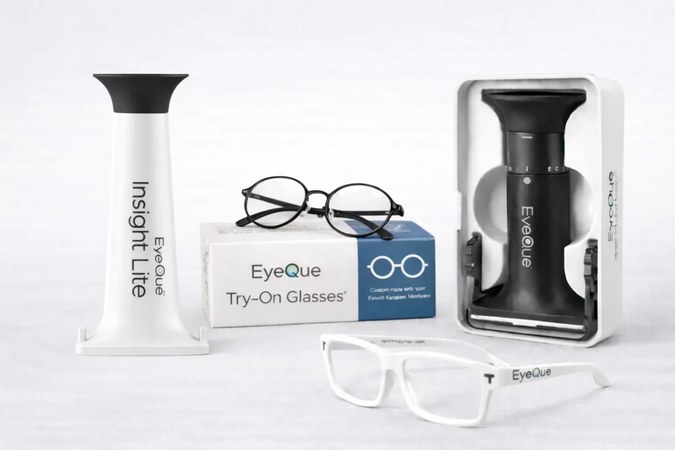
EyeQue Corporation
EyeQue Corporation is a Newark, California digital-health company that turns an ordinary smartphone into a personal vision-testing lab. Built on optical technology licensed from MIT, its small clip-on devices and apps let people measure their own refractive error, pupillary distance and reading numbers at home for a fraction of the cost of a clinic visit, then use those results to order glasses online. Founded in 2015 by physicist John Serri and Zenni Optical's Tibor Laczay, EyeQue has won multiple CES Innovation Awards and raised more than $57 million to make eye care accessible to people who can't easily reach an eye doctor.
La Clínica de La Raza
La Clínica de La Raza is one of the largest community-based primary health care providers in the San Francisco Bay Area. Founded in 1971 in Oakland's Fruitvale district by UC Berkeley students and community activists, it is a federally qualified health center (FQHC) delivering culturally appropriate medical, dental, behavioral health, vision, and pharmacy services to roughly 90,000 patients a year across more than 35 sites in Alameda, Contra Costa and Solano Counties - regardless of a patient's ability to pay.