Company Profile / Digital Health
EyeQue Corporation
The eye exam that fits in your pocket. Clip a small lens onto your phone, merge a red line into a green one, and read your own eyes.
The eye exam that fits in your pocket. Clip a small lens onto your phone, merge a red line into a green one, and read your own eyes.
Somewhere right now, a person who is nowhere near an eye doctor is holding a phone to their face. On the screen, a green line and a red line drift apart. Thumb on a side button, they nudge the two until they snap into a single yellow stripe. Eight times for one eye, eight for the other, and in under three minutes a number appears - a measurement of exactly how their eyes bend light. That device costs less than a tank of gas. That is EyeQue.
EyeQue Corporation builds smartphone-attached optical devices and apps that let ordinary people measure their own vision at home. Headquartered in Newark, California, the company has turned the autorefractor - the intimidating chin-rest machine in every optometry office - into a clip-on gadget and a free app. The result is what it calls your EyeGlass Numbers: the figures you need to order glasses online without ever sitting in a waiting room.
Most of the planet needs vision correction at some point. Far fewer people live within easy reach of someone qualified to measure it. For decades the only way to learn your prescription was to physically travel to a clinic, sit behind a machine the size of a microwave, and pay for the privilege. For a billion-plus people, that machine may as well be on the moon.
The irony is hard to miss. We carry supercomputers in our pockets, track our steps, our sleep and our heart rate by the second - and yet the single number that decides whether the world looks sharp or blurry still required an appointment. EyeQue's founders looked at that gap and saw not a medical problem but a logistics one. The optics were solvable. The access was the hard part.
In 2015, at a biotech networking party thrown by their wives, two friends got to talking. One was John Serri, a physicist with an MIT PhD in atomic physics and a career spanning Bell Labs, Lockheed Martin and Trimble Navigation. The other was Tibor Laczay, CEO of the online eyewear company Zenni Optical. Serri had been thinking about retirement. Then someone said the famous last words of every great hardware company: how hard could it be to build a little piece of plastic?
Hard, as it turned out - but not impossible. The pair licensed optical refraction technology patented at MIT, opened a small office in the Bay Area, and built the Personal Vision Tracker. Their first bet was contrarian: skip the venture capital and self-fund. Their second was bolder still - take it to Kickstarter and let the crowd decide whether at-home vision testing deserved to exist. The crowd said yes.
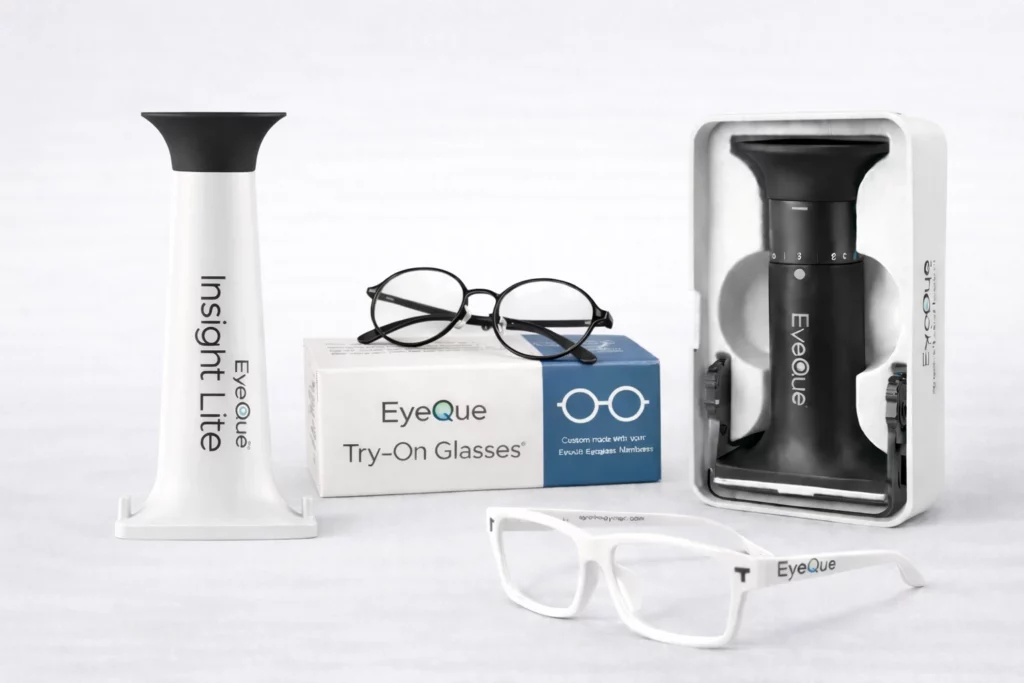
The flagship is VisionCheck - and later VisionCheck 2 - a small refractometer that straps over your phone's screen. Pressed to your eye, it shows two colored lines you align by feel. Repeat the dance across the lens, and the app calculates how light refracts into your eye, covering nearsightedness, farsightedness and astigmatism. What used to demand a trained technician now takes a curious adult and a few quiet minutes.
Around that core, EyeQue built a small constellation of tools - because a prescription is only half of buying glasses online.
The clip-on autorefractor that turns your phone into a vision test for refractive error.
Measures pupillary distance - the number you need so online lenses sit in front of your actual pupils.
Finds the right strength for over-the-counter reading glasses, no guessing at the pharmacy.
Low-cost lenses to sanity-check your at-home results before buying the real pair.
EyeQue is careful with its language. It never says “prescription,” because the test is self-administered. It says EyeGlass Numbers. That single word swap is the difference between a regulated medical claim and a consumer measurement - and it tells you everything about how seriously the company takes the line between empowerment and overpromising.
Skepticism is the correct response to any gadget that promises to replace a professional. EyeQue knows this, which is why the receipts matter. Five CES Innovation Awards across 2019-2021 say the industry took the engineering seriously. More than $57 million raised - capped by a roughly $40 million Series C in 2021 - says investors did too.
Reviews, to be fair, are mixed in the honest way real products are. Many users report sharper glasses than before; at least one optometrist told a reviewer the device struggled with severe astigmatism. EyeQue's own framing is the responsible one: it complements eye doctors, it doesn't retire them. A comprehensive exam still catches glaucoma and cataracts that no phone lens can see.
Figures approximate, drawn from public funding announcements (Business Wire, Vision Monday).
And it isn't going it alone. EyeQue partnered with EyecareLive in 2021 to put a licensed eye doctor on the other end of the app, and its measurements flow naturally into online eyewear - a path Laczay knows well from Zenni Optical. The customers are exactly who you'd expect once you stop assuming everyone lives near a clinic: parents keeping tabs on a child's changing eyes, online glasses shoppers who need a pupillary-distance number, travelers, students, and people in places where the nearest optometrist is a serious commute. EyeQue has reported device sales in the tens of thousands and an app footprint that spans well beyond the United States.
Independent reviewers tend to land in the same place. The gadget press calls it clever and genuinely useful; clinicians call it a helpful first read, not a substitute for a dilated exam. Both can be true. A tool that gets a reasonable number into the hands of someone who otherwise had none is, on balance, a win - even if it occasionally sends a tricky case back to a professional, which is rather the point.
Strip away the awards and the funding and you're left with a fairly stubborn idea: that your eyesight is your data, and you should be able to check it without an appointment, an insurance card, or a long drive. EyeQue treats vision the way fitness apps treat steps - something you measure, log, and watch change over time, on your own terms.
That's a quietly radical position in healthcare, where the default is to centralize. EyeQue decentralizes. It hands the instrument to the patient and trusts them to use it. The company isn't trying to abolish the optometrist; it's trying to reach the enormous number of people who never see one at all.
As EyeQue layers AI into its measurements and expands telehealth links to real doctors, the trajectory points somewhere bigger than glasses. Vision becomes a tracked vital sign. A blurry change over months becomes a data point you can act on - and, increasingly, share with a clinician on the same app.
Back to that person holding a phone to their face, nowhere near an eye doctor. A decade ago they'd have squinted through another blurry year, or driven hours for an exam, or simply gone without. Now the green line slides into the red, the yellow appears, and a number lands in their pocket. The clinic didn't come closer. EyeQue just made the distance stop mattering.