security-analytics
(14)
Uptycs and the art of asking what happened before
An alert tells you something happened. Uptycs sells the missing backstory - joining cloud, container and endpoint evidence so security teams can decide what deserves their afternoon.
NIKSUN and the case for keeping every packet
A missing sliver of network traffic can explain a bad trade, a dropped call or a stolen file. NIKSUN has built its business around saving the evidence before anyone knows which evidence matters.
Anomali wants your security team to stop collecting clues
A threat feed can tell you what looks suspicious. Anomali’s wager is that connecting those clues to your own systems - and giving AI carefully bounded authority - can turn intelligence into a decision.

Trackforce and the Case of the Expensive Clipboard
A security guard checks a door. Somewhere else, three people retype the result. Trackforce has built a business around closing the distance between the patrol and the payroll.

The Most Expensive Log Is the One Nobody Reads
Abstract asks a pointed question of security teams: why send every event down the most expensive road? Its answer is a streaming layer that decides what matters before the SIEM bill arrives.
The Alarm Was the Problem
Arista Security began with a blunt confession from an enterprise security chief: the alarms were ringing, but the investigators could not see the intruder. Awake built a way to turn network traffic into a case file; Arista bought it and put that view inside the network itself.
NitroSecurity Taught the Alarm to Ask Why
The Portsmouth company turned security logs into a live ranking of danger. McAfee bought it in 2011 after three years as a partner - and after trying the technology on its own network.
Securonix Is Teaching the SOC to Stop Chasing Alerts and Start Doing the Work
The security industry sold companies more alerts than their analysts could handle. Securonix built its next act around a different unit of value: completed investigations, governed automation, and less time spent feeding the machine.
Graylog Bet That Lean Security Teams Want Answers, Not Another Expensive Data Habit
Born when one engineer refused an absurd log-management quote, Graylog now sells the grown-up version of that refusal: searchable evidence, predictable costs and automated investigations for security teams that cannot hire an army.
Evolv Sold the End of Security Lines. Then Reality Walked Through the Scanner
The Boston-area company turned the security checkpoint into a subscription business used by schools, hospitals and stadiums. Its next act depends on proving that speed, detection and sober claims can finally travel together.

WireX Systems
WireX Systems is a cybersecurity company building network detection and response (NDR) and forensics technology under its EvidenceOps platform, powered by Ne2ition. Its patented Contextual Capture engine translates raw network packets into human-readable intelligence, retaining months of full payload data so security teams can investigate, prove, and respond to threats in minutes instead of days. Founded in 2010 by veterans of Israel's intelligence community, the company serves SOC teams across finance, healthcare, manufacturing and retail.
Auguria, Inc.
Auguria is a cybersecurity AI company that builds the Security Knowledge Layer (SKL), a vector-based platform that ingests the flood of logs, events, and telemetry that security teams collect, then denoises, classifies, and prioritizes it - filtering out roughly 99% of the noise so analysts can focus on the ~1% of events that actually matter. Founded in 2022 by Keith Palumbo and Chris Coulter and emerged from stealth in March 2024 with $6.5M in seed funding from SYN Ventures and SentinelOne's S Ventures, Auguria plugs into existing SIEM and data-lake infrastructure to cut security data costs and surface threats others miss.
Vega
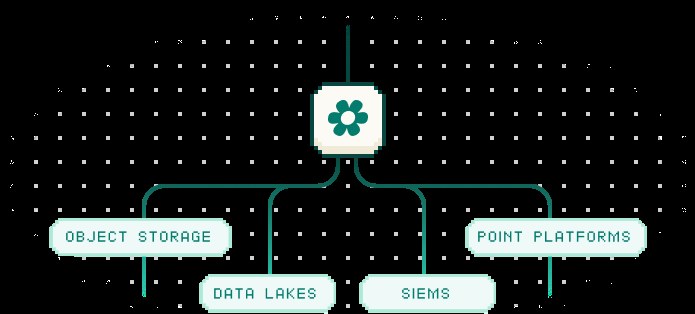
Vega is an AI-native cybersecurity company building a federated Security Analytics Mesh that lets security teams detect, search, and investigate threats directly where their data already lives - cloud platforms, data lakes, SIEMs, and cold storage - without forcing expensive centralized ingestion. Founded in 2024 by Unit 8200 and Intel Granulate veterans Shay Sandler and Eli Rozen, Vega raised $185M across three rounds in under two years and reached an ~$800M valuation, while signing multimillion-dollar contracts with global banks, healthcare giants, and Fortune 200 firms.

Corelight
Corelight is a San Francisco-based cybersecurity company that pioneered the commercial Open NDR (Network Detection and Response) platform, built on Zeek - the gold-standard open-source network security monitor created by co-founder Dr. Vern Paxson at Lawrence Berkeley National Lab. By transforming raw network traffic into high-fidelity, structured logs and pairing them with AI-powered analytics, Corelight gives enterprise security teams and government agencies the evidence they need to detect, investigate, and respond to threats faster. With $309M in total funding, 40%+ ARR growth, and recognition as a Gartner Magic Quadrant Leader for NDR, Corelight is widely regarded as the most trusted platform for network-based threat detection.