model-context-protocol
(21)
CData Built the Boring Plumbing. Now 10,000 Companies Need It for AI.
The enterprise AI race has produced a very old problem: the useful data is scattered everywhere. CData spent a decade standardizing those connections, and its unglamorous specialty has become the layer everyone suddenly needs.
Runlayer Wants Your AI Agents Working - Just Not Running Wild
Employees were connecting AI to company systems faster than security teams could count the connections. Runlayer turned that mess into a control plane - and persuaded Gusto, Jane, Homebase and other large companies to let the agents in.
The 'Where to Buy' Button Grew Up and Learned to Talk to Robots
PriceSpider spent 20 years turning a little 'Where to Buy' button into a business. Now, rebranded as Wayvia, it is wagering that the next shopper won't be a person at all - it will be an AI agent doing the buying.
Corsair
Corsair is an open-source integration layer for AI agents. Its TypeScript framework lets developers connect their agents and apps to hundreds of third-party services - Gmail, Slack, Stripe, Notion, GitHub and more - while Corsair handles the messy parts: OAuth, token refresh, webhook verification, rate limiting, permissions and multi-tenant credential isolation. Agents never touch raw API keys; Corsair resolves them internally and can require human approval before destructive actions. Founded in 2024 by Dev Jain and part of Y Combinator's Winter 2025 batch, the project is offered as a free self-hosted library, a hosted hub with a drop-in MCP URL, and a managed cloud SDK.

Golf
Golf is a Y Combinator (X25) startup building the security and governance layer for AI agents and Model Context Protocol (MCP) servers. It began as GolfMCP, an open-source Python framework for shipping production MCP servers without boilerplate, and grew into an enterprise control plane that discovers every AI agent and MCP connection in an organization (including shadow AI), enforces granular policies with sub-millisecond latency, and maintains compliance-ready audit trails. Founded by high-school friends Wojciech Blaszak and Antoni Gmitruk, who both dropped out of university to build it full-time.

Metorial
Metorial is agentic infrastructure that connects AI agents to more than 1,200 tools and data sources through the Model Context Protocol (MCP). Its serverless runtime hosts MCP servers that boot in under a second and hibernate when idle, while handling OAuth, permissions, RBAC/SSO, and full tracing so companies can ship customer-facing agents without building integration plumbing. Founded in 2025 by Karim Rahme and Tobias Herber, the open-source, Apache-2.0 project is part of Y Combinator's Fall 2025 batch and is often described as the 'Vercel for MCP.'
OneGrep
OneGrep (YC W24) is a New York-based developer-tools startup building AI agent infrastructure for DevOps. It began as a DevOps copilot that fine-tuned models on real-time telemetry to help engineers resolve incidents faster and cut observability costs, and has since expanded into tooling that lets AI agents discover, correlate, and safely operate the many SaaS and MCP-based tools engineering teams rely on. Founded by ex-Disney, Amazon, and Coinbase engineers Achintya Ashok and Brian Cripe, it went through Y Combinator's Winter 2024 batch.

Orthogonal
Orthogonal is a San Francisco startup building the discovery, orchestration, and payment layer for AI agents. Through a single SDK, REST API, MCP server, or CLI, agents can find, call, and pay per-use for 35+ third-party APIs - from data enrichment to search and scraping - with no subscriptions, no key management, and no sales calls. Founded in 2025 by Christian Pickett and Bera Sogut, the company raised a $4.3M seed round led by Pantera Capital and is part of Y Combinator's Winter 2026 batch.
Osmosis
Osmosis is a San Francisco reinforcement learning platform (YC W25) that helps companies fine-tune open-source models to beat foundation models on cost, latency, and reliability. Founded by Kasey Zhang and Andy Lyu, it lets teams train task-specific AI agents with multi-turn tool use over the Model Context Protocol, then export or self-host the weights they own.
Rowboat
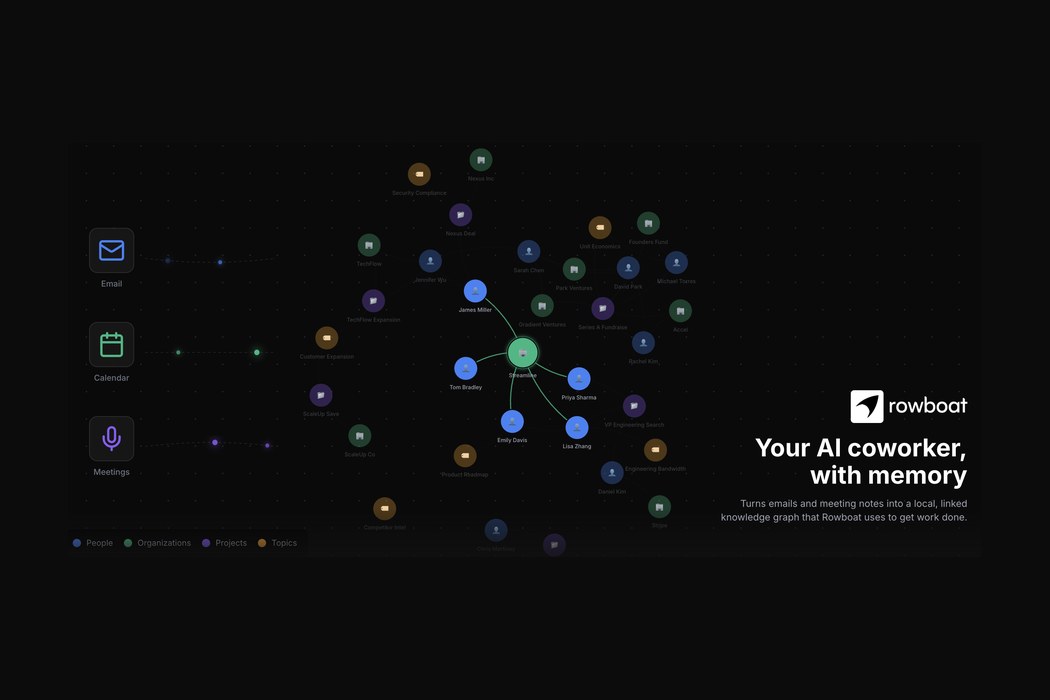
Rowboat (YC S24) is a San Francisco and Bengaluru startup building open-source AI agent software. It began as a pre-trained customer-support LLM agent, grew into a widely starred open-source IDE for building multi-agent systems on the OpenAI Agents SDK, and is now 'your AI coworker, with memory' - a local-first desktop app that turns your emails, meetings, and notes into an editable knowledge graph so agents can actually get work done. Founded by the team behind Agara (acquired by Coinbase in 2021).
Vespper
Vespper (YC F24) builds infrastructure that lets AI agents produce real Microsoft Word documents. Its product is a docx MCP (Model Context Protocol) server that turns raw agent output into clean, tracked, review-ready .docx files - aimed at regulated, legal, and compliance workflows where the final artifact has to be a Word doc with tracked changes, not a chat window. The two-person, Tel Aviv-based team originally launched an open-source, 24/7 AI on-call engineer for incident triage before pivoting into agent document infrastructure.
Axoniq
Axoniq is a Dutch-founded enterprise software company that builds the backend infrastructure for event-sourced systems and, increasingly, for enterprise AI. Born from the open-source Axon Framework created by Allard Buijze in 2009, the company provides an event-sourcing platform - Axon Framework, Axon Server, and an agent runtime - that gives applications a complete, replayable memory of every decision they make. That memory is the foundation for auditability, explainability, and observability that regulated industries need before they trust AI in production. Axoniq's tools are downloaded 70 million+ times and used by more than 65,000 organizations worldwide.
8090
8090 is an AI-native software factory that helps regulated enterprises build and modernize production software using teams of people working alongside AI agents. Founded by Chamath Palihapitiya in January 2024 and headquartered in the San Francisco Bay Area, its flagship Software Factory platform runs the full software development lifecycle - from business intent to production code - through five modules (Refinery, Foundry, Planner, Assembler, Validator) while preserving the documentation, oversight and audit trails that regulated industries require. The company raised a $135M Series A led by Salesforce Ventures in June 2026, with Chamath stepping in as full-time CEO.
Arcade.dev
Arcade.dev builds the secure action layer for production AI agents. Its platform gives agents delegated, per-user authorization to act inside real business systems - Gmail, Slack, GitHub, Salesforce and thousands more - by handling OAuth, token management, policy enforcement, tool execution and audit logging. Founded in 2024 by former Okta VP Alex Salazar and ex-Redis engineer Sam Partee, Arcade offers 8,000+ agent-optimized tools and authored the MCP authorization specification adopted by Anthropic. The company has raised $72M total, including a $60M Series A in June 2026.

Cline
Cline is an open-source, autonomous AI coding agent that runs inside VS Code and other editors. It reads a codebase, plans changes, edits files across a project, runs terminal commands, and drives a browser - asking for the developer's approval at each step. Built to be transparent and model-agnostic, it lets teams bring their own API keys or run local models, and has grown into one of the most-installed AI coding tools with a Fortune 500 enterprise offering, Cline Teams.

MarcoPolo
MarcoPolo is a Santa Clara, California company building governed AI infrastructure that connects agentic AI - Claude, Cursor, ChatGPT, Copilot or any MCP-enabled assistant - to a company's internal data across 50+ systems like Snowflake, PostgreSQL, MongoDB, S3, Salesforce and Jira. Instead of building fragile one-off integrations, teams route through a single secure Model Context Protocol connection with isolated execution, scoped credentials, encrypted secrets and smart context management, so AI can query, correlate and act on enterprise data without leaking it. The product pairs a governed Sandbox, a Cost Plane for token visibility and routing, and a unified Connections CLI. MarcoPolo is the pivot of Immersa, a RevOps data-intelligence startup that raised about $16M from investors including Mayfield's Navin Chaddha.

Sleuth
Sleuth is a San Francisco software company founded by former Atlassian engineers who helped build Jira and Bitbucket. It began as a 'mission control' platform for continuous delivery, giving engineering teams automated DORA metrics and deployment tracking, then expanded into governing AI inside organizations. Its current product, Sleuth Skills, lets companies define agent skills, rules, prompts and MCP servers once and distribute them - with approval workflows, audit trails and access controls - across AI clients like Claude Code, Cursor, GitHub Copilot, Gemini and Codex. Sleuth has raised roughly $25M, including a $22M Series A led by Felicis in 2022.
Speakeasy
Speakeasy is a San Francisco developer-infrastructure company that turns an OpenAPI specification into production-grade, type-safe SDKs across ten-plus languages, then keeps them in sync automatically as the API changes. Founded in 2022 by Sagar Batchu and Simon Yu, it has expanded from SDK and Terraform-provider generation into an AI control plane for the Model Context Protocol - products like Gram and the MCP Gateway let companies expose their APIs as governed tools for AI agents. Speakeasy has raised roughly $26 million, including a $15M Series A led by FPV Ventures in 2024, and counts Vercel, Mistral AI, Clerk, Kong, Fivetran, Airbyte, and SolarWinds among its customers.

Credal.ai
Credal.ai is a New York-based enterprise AI startup building a control plane for company AI agents. Founded in 2022 by two former Palantir engineers, its platform connects internal company data - from Google Drive and Slack to Salesforce - to large language models while strictly enforcing existing user permissions, redacting sensitive data, and logging every prompt and action. Credal lets regulated enterprises build, govern, and deploy AI agents and MCP servers without leaking data or breaking compliance rules.

Teramot
Teramot is an AI-powered data infrastructure company that connects any AI model - Claude, ChatGPT or Gemini - to a company's real data in under an hour, with no technical team required. Its system of specialized AI agents inspects existing databases, warehouses, ERPs, CRMs and APIs, detects data-quality issues, proposes transformations and generates transparent, auditable SQL that produces a production-ready, queryable data layer called a Gold Table. Founded in 2022 (formerly Halley) and led by CEO Bruno Ruyu, the company is based in San Francisco with roots in Cordoba, Argentina.
Pipedream
Pipedream is a developer-first integration and automation platform that lets engineers connect more than 3,000 APIs and 10,000+ pre-built actions to build workflows, products, and AI agents without managing infrastructure. Founded in 2019 in San Francisco, it grew to more than one million users on the strength of a serverless model that mixes drag-and-drop triggers with full Node.js, Python, Go, and Bash code. In 2025 it became the connective tissue for AI agents through its Model Context Protocol (MCP) servers, and in late 2025 it agreed to be acquired by Workday.