copallet
(4)
The Robots Learned to Do the Paperwork
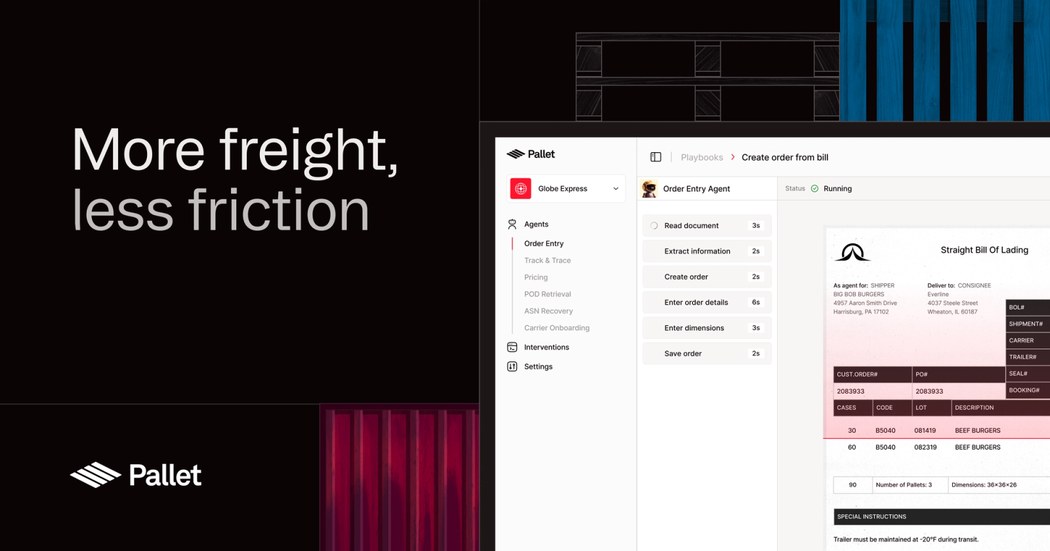
An AI workforce for logistics is a system of AI agents that autonomously execute the repetitive administrative work that runs freight and supply chain operations — order entry, quoting, tracking, billing, customs filings and customer service. Pallet's platform deploys these agents across email, voice, documents, APIs and remote desktops, encoding a company's operating procedures so agents can run workflows from quote to cash. The goal is to automate the roughly $1 trillion in annual coordination work that keeps the physical economy moving, freeing human teams to focus on judgment, relationships and growth.
The Bot That Reads the Room: Why Logistics Is Trading Scripts for Judgment
A plain-English breakdown of the difference between AI agents and traditional robotic process automation (RPA) in logistics. RPA runs rigid, rules-based scripts that break the moment a portal button moves or a document arrives in the wrong format; AI agents reason toward a goal, read unstructured email and PDFs, and handle the exceptions that make up the bulk of real freight work. The piece uses Pallet (pallet.com) and its CoPallet AI workforce as a lead example, and surveys other players in the space including HappyRobot, Vooma, and FleetWorks.
The Brokers Who Taught a Machine to Move Freight
Pallet builds an AI logistics workforce that automates the manual back-office work at the heart of freight brokerages. Its AI agents handle load entry, appointment scheduling, driver document processing, proof-of-delivery, and invoice auditing directly inside existing systems like McLeod and DAT, keeping humans in the loop for oversight and edge cases. The company says brokerages process loads up to 10x faster, cut processing errors by 30%, and save 50% on back-office labor. Founded in 2022 by former Retool engineers Sushanth Raman and Andrew Spencer, Pallet has raised $50 million to date, including a $27M Series B led by General Catalyst.
Pallet
Pallet is a San Francisco AI startup building an 'AI workforce' for the physical economy. Its flagship product, CoPallet, automates back-office freight workflows - order entry, quoting, document parsing, portal updates - that have historically required armies of human operators, working inside systems like McLeod, Revenova, Turvo and even legacy AS400 stacks. In 2026 it added Atlas, a data-intelligence layer that surfaces hidden revenue opportunities across a supply chain network.