An inbox looks like a private room. Someone has a key, someone owns the building, and someone must fix the plumbing when it fails. Most of us consider only the first of these arrangements. Synacor has made a business out of the other two.
The Buffalo software company owns Zimbra, an email and collaboration platform that lets organizations choose where their communications live. It also runs Cloud ID, which helps streaming and television businesses establish who a viewer is and what that viewer may watch. Neither job lends itself to dinner-party conversation. Both become fascinating the moment the wrong person gets in, or the right person cannot.
- Two principal products: Zimbra for organizational email; Cloud ID for media identity and access.
- The buyers: institutions, enterprises, communications providers and media platforms.
- The distinction: deployment choice for email and an existing partner network for streaming authentication.
- The useful lesson: control has a price, whether you surrender it or take responsibility for it.
The inbox has a landlord
Start with a university. Students arrive, graduate, change departments and forget passwords. Researchers share documents. Administrators need records. An email system must accommodate this traffic without turning every change into a small engineering project.
Université de Lorraine’s Zimbra case study describes an installation of 110,000 mailboxes. Its previous collection of open-source tools had become inadequate for the scale and variety of its users. The requirements were wonderfully unglamorous: better logs, easier account creation, dependable backups, private access and integration with the university’s Ceph storage.
The reported result included backups reduced from more than twelve hours to minutes through Ceph snapshots, along with account migration between stores without interrupting service. That is a result from this installation, with this storage design. It is not a promise that buying an email license will make every university’s backups equally quick.
“All user operations are tracked, which is reassuring for an email administrator.”Frédéric Nass / Université de Lorraine
The telling word is “reassuring.” The purchase was about being able to account for a system. An attractive inbox is welcome; an administrator who can understand what happened inside it is useful every day.
A business built behind other brands
Synacor’s origins suit this temperament. Incorporated in January 1998 as Chek, it supplied messaging technology. In December 2000 it acquired MyPersonal.com, a maker of branded internet community portals. The Synacor name followed in July 2001. George Chamoun and Darren Ascone founded the predecessor Chek business; Chamoun later became a visible sales and marketing leader at Synacor.
The combination joined email infrastructure to the internet’s front door. A communications provider could put its own name on an experience assembled and operated by another company. Subscribers got news, search, email and access to content. The provider kept the relationship; Synacor supplied machinery underneath.
When the company went public in 2012, this backstage role had commercial appeal. Its earlier prospectus described revenue generated largely through search and display advertising, alongside substantial reliance on Google and major customers. The advantage and the exposure occupied the same paragraph of the business model: a partner brought an audience, but that partner could also leave.
The contract that exposed the risk
In 2019, AT&T’s portal business did leave. Synacor completed the ATT.net wind-down during the third quarter. The fourth-quarter comparison gives the event a useful scale: total revenue fell from $39.4 million in 2018 to $26.8 million in 2019. The previous year’s quarter had included $12.1 million from the AT&T portal contract.
Historical total company revenue. Q4 2018 included $12.1m from the AT&T portal contract. These figures precede the 2021 divestiture.
The portal relationship failed before the later restructuring was complete. It would be too neat to say this single loss caused every decision that followed. Synacor had already bought Zimbra in 2015 to expand internationally and into enterprise software. But the lost contract made the distinction between rented audience and licensed software rather less abstract.
The next proposed answer was a merger with enterprise video company Qumu, announced in February 2020. By June, both boards had agreed to terminate it, saying continued combination and integration would not be prudent. The boards chose to stop the combination. Qumu belongs in Synacor’s history as an abandoned deal.
Buying a different revenue engine
Zimbra was a completed transaction, with a real bill. The 2015 announcement valued it at approximately $24.5 million. Consideration included $17.3 million in cash, shares, warrants and possible performance payments. Synacor acquired an email business, its people and technology, and a distribution network stretching beyond its existing US-focused base.
At the time, the company described more than 1,000 value-added resellers and 500 hosting partners coming with Zimbra. Such a network matters because enterprise software needs someone close enough to answer the telephone, understand procurement and handle installation. A reseller in the customer’s market can be a more persuasive feature than another button in the application.
In 2021, Centre Lane Partners acquired Synacor in a transaction valued at approximately $92 million, paying $2.20 a share. That was a purchase of the company, rather than a $92 million venture round. The board’s stated rationale was shareholder value and the opportunity to scale with Centre Lane’s capital and expertise.
Another boundary moved in July: iMedia Brands acquired Synacor’s portal and advertising business. A present-day description that still sells Synacor primarily as a portal advertising company misses that sale. The current corporate website gives the foreground to Zimbra and Cloud ID.
Two ways to sell access
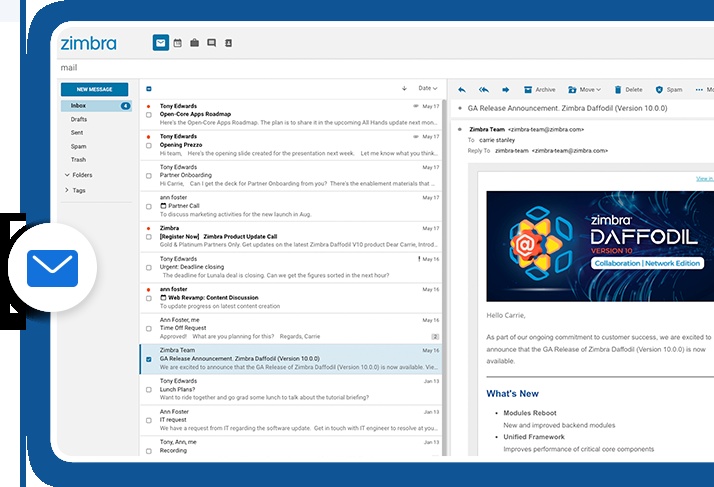
Zimbra offers email, contacts, calendars, file sharing and collaboration capabilities, with features depending on edition and configuration. Its commercial model includes subscription and perpetual licensing, support and partner-hosted services. Organizations can deploy it on their own premises, in private cloud infrastructure or through hosting partners. The proposition is especially relevant where data location and administrative control influence the buying decision.
Microsoft 365 and Google Workspace are obvious alternatives for many email buyers. Choosing Zimbra means assessing the value of deployment choice against the integrations, familiarity and bundled applications available elsewhere. Open-source roots should not be confused with an assurance that every component or production deployment is free; the current commercial administrator guide specifies purchased licenses for production use.
Where does our email live?
Institution → chosen infrastructure → inbox
Who may watch this content?
Viewer → identity + entitlement → playback access
Cloud ID addresses a different tangle. Identifying a viewer and confirming viewing rights are separate tasks. A successful login alone does not establish that a subscription includes a particular game or channel. Media companies also have to connect these decisions across distributors, devices and streaming services.
Cloud ID sells a managed layer for those connections. Its website reports more than 600 integrated partners and 9.5 billion annual authentication requests. Those are vendor-reported measures of network and traffic, not a count of paying customers. Its appeal is partly accumulated integration work: a new buyer can use relationships and interfaces already built.
A 2023 sports-league deployment shows the problem in miniature. Synacor announced that an unnamed major US professional league would use Cloud ID to standardize access across streaming partners including Peacock, Paramount+, ESPN+, YouTube TV and Amazon Prime. The league could add partners through a common interface and handle the surge of authentication requests as games began.
A media buyer might also evaluate Adobe Pass, a general customer identity platform or an internal build. The practical comparison is partner coverage, entitlement handling, monitoring and service obligations. The number of connections on a website becomes valuable only if the connections your business needs are among them.
Control needs an operator
There is a catch to owning more of the arrangement: someone must operate it. On-premises email demands patching, backup validation, monitoring and migration planning. A hosting partner can take on much of this work, but the responsibility still needs a name and a budget.
Zimbra’s September 24, 2026 release, version 10.1.21, illustrates both sides. It added internal mail recall within a configurable window and per-domain identity-provider routing, while also closing security vulnerabilities and fixing platform issues. A feature announcement is also a maintenance appointment.

For buyers, the copyable habit is to begin with the constraint. A university might need local storage and auditable administration. A streaming aggregator might need several partner subscriptions to activate smoothly. Specify that problem, then compare systems, partners and the cost of running them. A small team wanting an ordinary hosted inbox may have little reason to assume extra infrastructure work. A media business outside Cloud ID’s relevant partner ecosystem must examine how much custom integration remains.
The door is the product
Synacor’s history is useful because its lesson is uncomfortable. Dependence can bring an audience and then take it away. Control can solve a procurement problem and create an operations problem. Neither arrangement exempts the buyer from thinking.
The company now occupies the space between institutions and their communications, and between media businesses and their viewers. Its work succeeds when the arrangement is legible to the people responsible for it and barely noticeable to everybody else. The viewer presses play. The professor opens an email. Someone, somewhere, has checked the key.
Synacor · Zimbra · Cloud ID · Product news · Zimbra on GitHub
Zimbra videos · Cloud ID videos · Rocket.Chat integration demo