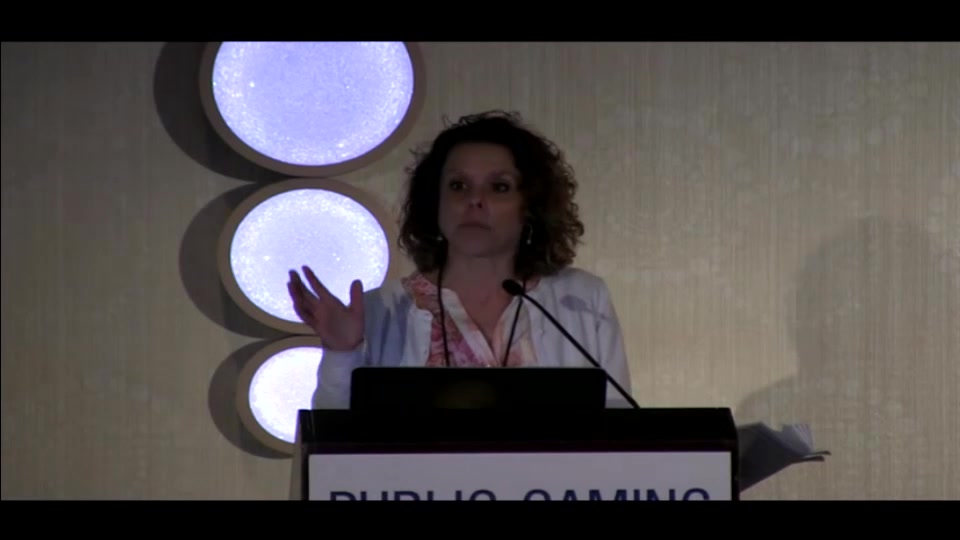
On a conference stage in New York in 2015, Susan Golightly had a giant screen, a lectern, and a message that could ruin a software sales pitch. More reports would not fix an organization. More analysts would not necessarily fix it either. The missing piece was usually the connective tissue: people able to frame useful questions, interpret what arrived, and change what they did next. The room was filled with lottery executives. The argument was much larger than lotteries.
Golightly had already spent years watching numbers travel through organizations. Some became decisions. Some became charts. Some became a kind of corporate wallpaper, admired briefly and then ignored. Her career has followed that journey from the supermarket aisle to the statehouse, from a consulting practice to laboratory software. The scenery changes sharply. The practical question does not: how does information become action?
Nine years in the aisle
Before the public-sector job and the founder title, there was retail. Golightly spent nine years at MARC USA as vice president and director of promotion. Her work put large brands such as GE and Procter & Gamble into conversation with Target, Lowe's, Rite Aid, Kroger, and other national retailers. She also worked on a proprietary loyalty program for Simon Malls.
Shopper marketing is a useful apprenticeship for anyone tempted to confuse intention with behavior. A customer can admire an advertisement, remember a brand, and still reach for something else. The shelf is an unsentimental judge. Price, placement, habit, convenience, timing, and a dozen barely noticed cues convene at once. The work taught Golightly to look beyond what people said toward what a system revealed.
It also gave her a habit of looking at the whole route. A national campaign means little if the store execution collapses. A loyalty program is more than a database if it changes how a customer is understood. The point is not to possess information. The point is to connect it across a business without sanding away the human being inside the row.
Six years with the numbers in public
In 2007, Golightly became the Hoosier Lottery's director of marketing and joined its executive staff. Lottery marketing is commerce with public consequences. Revenue matters. So do player behavior, retail relationships, public confidence, and the distribution of proceeds. The familiar image is a jackpot number. The job beneath it is a lattice of products, locations, media, contracts, and probabilities.
During her six-year tenure, Golightly led what she later described as a data-driven, customer-centered transformation. The organization added business intelligence, product management, and customer relationship management. It launched a new Hoosier Lottery brand, developed a store-branding program with Scientific Games, and deployed an ExactTarget email platform that received industry recognition. An account published after her departure credited the period with double-digit improvements across several measures, including playership, net income, sales, media efficiency, and instant-ticket performance.
The more revealing part was not a victory lap. It was the testing. Digital jackpot signs could produce double-digit incremental gains, Golightly wrote, but only stores with sufficient sales could justify their cost. Radio jackpot alerts returned their investment in testing; television created lift, but not enough to pay for the buy. The nuance is the point. A result can be positive and still be a poor decision.
A lift is not automatically a return
The bars show the type of finding, not a quantitative comparison. Golightly's published account did not provide directly comparable magnitudes.
The symptom wore a jackpot
After leaving the Lottery in 2012, Golightly founded CODEI, a consultancy built around data-driven, customer-centered marketing. In Public Gaming International, she returned to a softening Powerball business and challenged the diagnosis of “jackpot fatigue.” Promotions, couponing, signs, and media could move a week or a segment. They could not reverse an aging play experience competing with mobile games and a thickening menu of entertainment.
“The problem isn't ‘jackpot fatigue,’ but it is ‘product fatigue.’”Susan Golightly, 2015
That distinction captures her method. Symptoms invite tactics because tactics are available. Causes demand a less comfortable look at the product, the operating model, and the customer's changed expectations. A campaign can be purchased this quarter. Rebuilding how an organization learns is harder to put on a media plan.
No wizard behind the curtain
Golightly's essays from the CODEI years have blunt titles. “So...?” asks readers to push a fact toward relevance. “I'm Sorry, I Don't Know” examines the false precision of market research. “The Way It's Always Been Done” treats habit as a competitive liability. In “Much Like in Oz,” she uses the yellow brick road to tease leaders waiting for a hidden expert to reveal a simple transformation recipe.
“It's not easy, it's not quick and it's not simple.”Susan Golightly, 2016
Her skepticism is not gloomy. It is practical. Organizations need technology, structure, rules, training, and new ways to collaborate. They also need to decide where rigidity protects quality and where it merely preserves habit. Transformation crosses departments and lasts longer than the launch presentation. The people doing the work need access, context, and permission to think.
Her market-research argument is equally direct. Memory is unreliable. People struggle to explain past decisions and predict future ones. Ask a question anyway and someone will usually provide an answer, which can lend weak evidence the costume of certainty. Research remains valuable, she argues, but as one set of pixels in a growing picture. It must be integrated with other evidence and interpreted in context.
There is a sly confidence in making “I don't know” the title of a marketing essay. Golightly treats uncertainty as the start of investigation. The alternative is to perform certainty, make a plan from a convenient answer, and discover later that the customer never read the script.
From customers to instruments
Golightly now serves as Chief Marketing Officer at Indigo BioAutomation in Carmel, Indiana. Her portfolio spans brand, demand generation, product marketing, communications, research, data and analytics, and the customer journey. Indigo builds software for complex laboratory workflows, including chromatography, mass spectrometry, and PCR analysis. Its products connect instruments, apply quality rules, surface exceptions, and help laboratories move from samples to reviewed results.
The technical nouns are specialized; the organizational challenge is familiar. Information arrives from multiple instruments. Rules must be applied consistently. People need exceptions made visible and context shared. Speed matters, but so do confidence and repeatability. The software has to fit the way a laboratory actually works, not the way a sales diagram wishes it worked.
Golightly has said she was drawn to Indigo's scientific commitment, its long view, and a collaborative team willing to take on difficult problems with rigor and persistence. That description could double as a compact statement of her own career. Her role is to connect leadership, message, product value, market reach, and commercial performance. In other words, to keep the story from separating from the system.
The executive who kept taking the class
In 2022 and 2023, after decades in marketing, Golightly added credentials in data strategy, enterprise design thinking, digital marketing analytics, and data analysis. The detail is easy to miss beside the executive titles. It may be the most revealing. A person who writes about learning organizations kept returning to the classroom herself.
Her work outside the office follows a similar pattern of capability-building. She has served on the Noblesville Parks Foundation board, worked on strategy for Friends of Indianapolis Dogs Outside, advised an animal shelter on marketing and communications, and joined committees supporting youth technology education. The through-line is less about lending a famous name and more about plans, systems, and the organizations that must carry them.
Former colleagues describe both the analytic edge and the human one. A former direct report credited Golightly with teaching her how to ask better questions and develop professionally. Another recommendation praised her ability to move a business away from hunches while bringing stakeholders around a shared objective. Data, in these accounts, is not a weapon for winning a meeting. It is a way to help a group see the same problem.
After the dashboard
The modern executive is offered an impressive supply of answers. Dashboards update by the minute. Models summarize the customer. Software promises visibility. Golightly's body of work keeps a small, stubborn space open for the question that follows: so what?
That question can be irritating. It can also save a company from celebrating a lift that does not cover its cost, treating a symptom as a strategy, or buying a platform before deciding what anyone needs to learn. It asks the chart to earn its place in the room.
From retail promotions to lottery modernization to laboratory automation, Golightly's subject has remained the distance between knowing and doing. She does not pretend the distance disappears. She maps it, equips people to cross it, and insists that the work continue after the vocabulary becomes fashionable. The dashboard is allowed to be handsome. It is simply not allowed to have the last word.