Supermaven was built for the moment when an AI suggestion is either already there or already annoying. Its great obsession was latency. You typed; pale code appeared; you kept moving. No side quest into a chat window, no tiny committee meeting with a robot. That narrow focus made the product unusually easy to understand and, among developers who clicked with it, unusually easy to miss.
Here is the answer a prospective customer needs before the backstory: do not plan a fresh workflow around Supermaven in 2026. Cursor acquired the company in November 2024. A year later, Supermaven announced that it was sunsetting the standalone service, refunding unused subscription time and ending its newer agent conversations. Existing customers were promised free autocomplete inference “for the foreseeable future.” VS Code users were told to migrate to Cursor. That makes this less a normal review than a field guide to a clever product’s afterlife.
If you already have access through Neovim or a JetBrains IDE, the old plugin can still be a pleasantly quick completion layer. If you are choosing today, buy into an active product. Cursor is the direct descendant; GitHub Copilot and Windsurf are broader alternatives; Continue appeals when control and open tooling matter. Supermaven is now useful as a lesson: the smallest pause in a programmer’s day can be a whole product.
- 1Mtokens in Babble’s paid context window
- 40K+developers reported in September 2024
- $12Mfunding announced before the Cursor deal
Who it was for, and why people cared
Supermaven’s natural customer was not someone asking a chatbot to invent an app from a paragraph. It was the programmer already halfway through a change. The model watched the recent sequence of edits, closer to a live git diff than a static folder tour, and tried to infer the next insertion, deletion, or jump. That mattered during repetitive refactors, test writing, type plumbing, and work in private frameworks whose naming conventions were not scattered across public tutorials.
The other target was the neglected editor loyalist. VS Code arrived first, but Supermaven quickly added the JetBrains family, then Neovim and Zed. For people who did not want to move their desk into a new AI-native editor, an extension promising unusually long repository memory had obvious charm. In September 2024 the company said those plugins were actively used by more than 40,000 developers. It was a small company with a conspicuously large appetite: five engineers, a million-token context window, and plans to build an entire editor.
The trick inside the Tab key
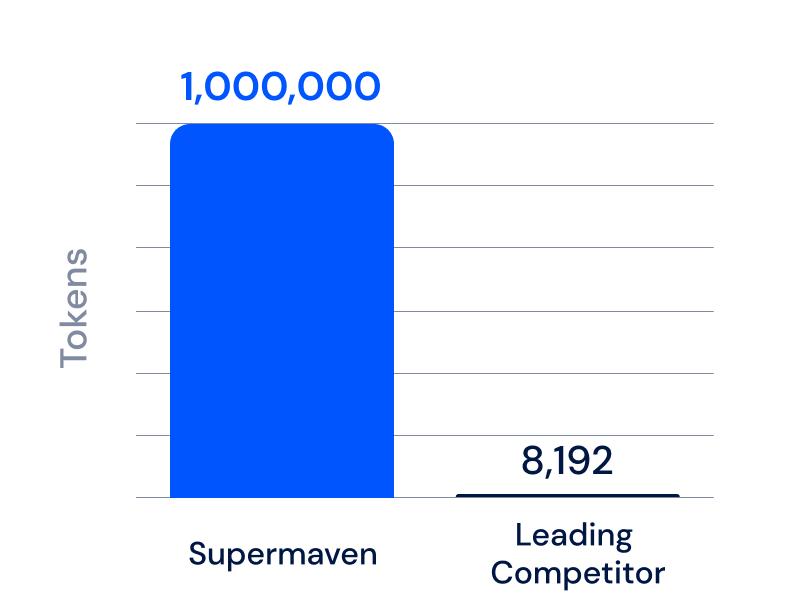
At launch in February 2024, founder Jacob Jackson described a neural-network architecture trained from scratch and designed to integrate much longer context more efficiently than a conventional Transformer. The first model offered 300,000 tokens. Supermaven 1.0 arrived in July with Babble, a model the company said was 2.5 times larger, trained on more code, served with lower latency, and able to use one million tokens for Pro customers.
A giant context number is a billboard, not a guarantee. Supermaven at least published retrieval tests intended to show that the model used the extra room. In its original dense-retrieval benchmark, accuracy dipped in the middle of a 300,000-token sequence; Babble later achieved the company’s reported 100 percent recall in a simpler million-token needle test. These were internal benchmarks, useful for understanding the design goal but not independent proof that every suggestion would be correct.
The launch-day stopwatch
Supermaven’s own February 2024 test, measured from a deliberately changed loop variable to the displayed completion. It is a historical company benchmark, not a neutral 2026 comparison.
What you could actually do with it
Finish the thought
Accept single-line or multi-line inline completions while staying in the editor and keeping your hands on the keyboard.
Reach across the repo
Use indexed project context to complete code against types, functions, and conventions that are not in the open file.
Read the edit trail
Use recent changes to infer the refactor in progress instead of treating each prompt as a cold start.
Chat beside the code
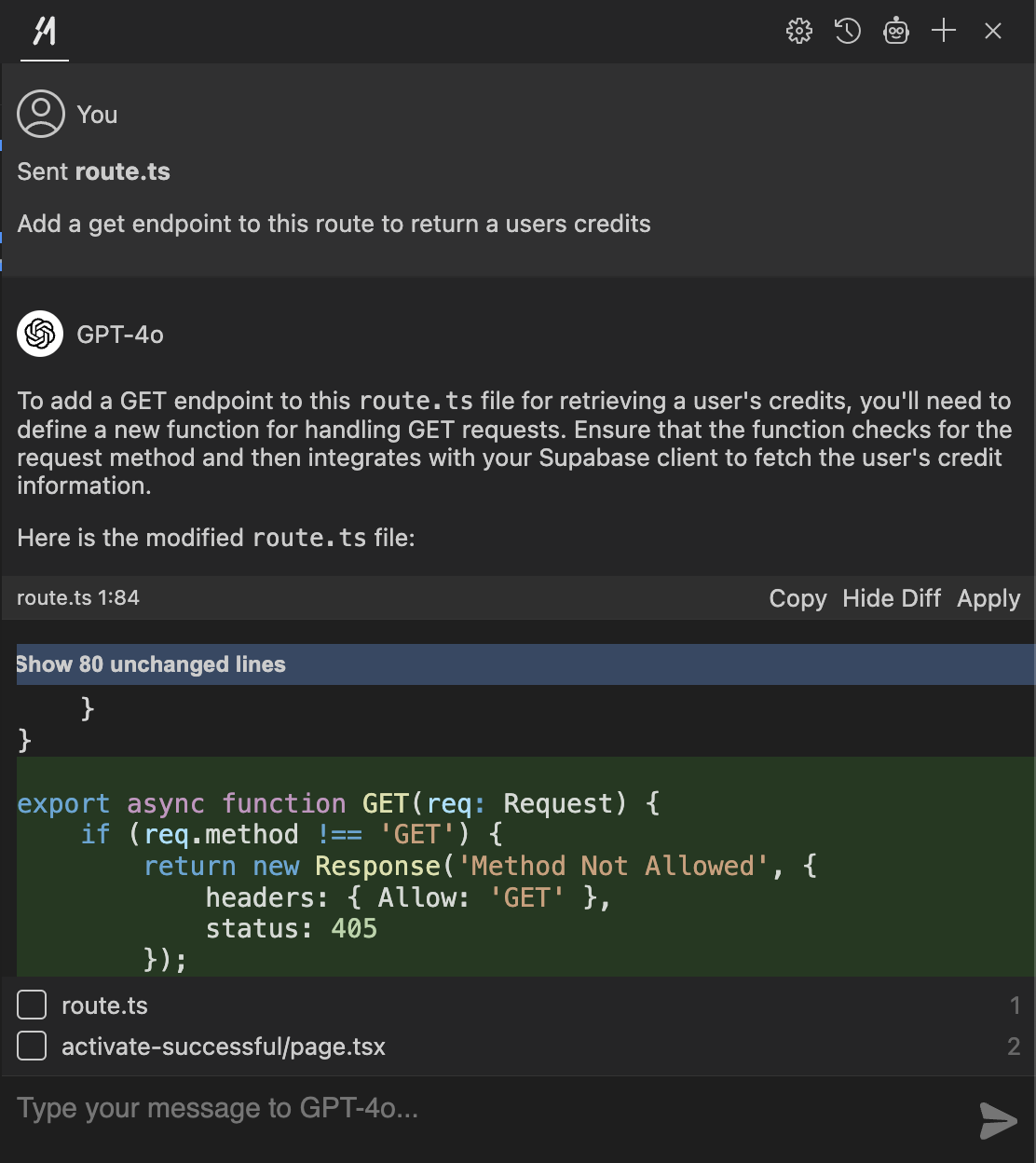
The retired chat UI could call OpenAI or Anthropic models, attach files, show diffs, fix diagnostics, and apply edits.
The completion loop was the clean part. Chat was more complicated. Pro accounts once received monthly chat credit; free users could bring an OpenAI or Anthropic key. Code sent through chat went to the selected third-party model provider, so its handling depended on that provider’s policy. Supermaven’s own June 2024 Code Policy promised that editor-uploaded code would be deleted within seven days and would not be used to develop its products. Companies evaluating any successor should still review the live policy rather than inherit comfort from an old one.
The price was tidy. The ending was not.
Historically, the ladder was simple: Free at zero dollars, Pro at $10 a month, and Team at $10 per user per month. Pro unlocked Babble’s million-token context, coding-style adaptation, the larger model, and $5 in monthly chat credit; Team added central billing and user management. Those figures remain visible on the old site, but they belong in a museum label. The November 2025 notice says subscriptions were refunded and existing access became free.
The transition also explains the mixed public mood. In 2024, Reddit threads repeatedly praised speed. One Neovim user called it “faster and cleverer” than Codeium. Another JetBrains user said “nothing beats it” for autocomplete, then noted that Cursor’s full editor experience was smoother. By 2025, complaints concentrated on stale plugins, compatibility, billing, and unanswered support. Trustpilot has only one review, so its low score is not a useful aggregate, but that review’s billing complaint echoes a Reddit report. Sparse evidence should not become a sweeping verdict; it does reinforce the wisdom of avoiding a sunset service.
| Choice in 2026 | Best fit | What to know |
|---|---|---|
| Supermaven legacy | Existing JetBrains or Neovim customers who still receive inference | No new roadmap to bet on; agent conversations ended. |
| Cursor | Developers willing to adopt an AI-first VS Code-based editor | The closest continuation of Supermaven’s team and long-context ideas. |
| GitHub Copilot | Teams wanting broad IDE coverage and GitHub integration | A more established suite; compare current plans and enterprise controls. |
| Windsurf | Developers comparing agentic editing with inline completion | Evaluate the current editor workflow, limits, and model choices. |
| Continue | Developers who value open tooling and model flexibility | More setup and choice; useful when vendor control matters. |
How a promising editor became a feature
Jackson had unusually specific history for this race. He created Tabnine while studying computer science at the University of Waterloo, sold it during his final exams, and later worked at OpenAI. With Supermaven, he returned to the problem from the serving side: a compact model could run on every keystroke if its architecture and infrastructure were ruthlessly tuned. TechCrunch reported that the product reached $1 million in annual recurring revenue in 2024 and had more than 35,000 users by September.
That month, Bessemer led a $12 million funding round with participation from OpenAI co-founder John Schulman, Perplexity co-founder Denis Yarats, and Intercom founder Eoghan McCabe. The money was supposed to fund a dedicated editor. The logic was sound: extension APIs could not draw every interface needed for predictions that jumped elsewhere or deleted code. But Supermaven was already talking with Cursor, which owned the editor surface it needed. Two months later the companies joined forces.
Cursor said the plugin would remain maintained; Supermaven said the same. The 2025 sunset revised that promise. Cursor had incorporated Supermaven features into Cursor Tab and now recommended migration. Existing Neovim and JetBrains customers received a carve-out because, according to the company, they had been vocal about loving the product. It is a generous technical aftercare plan and a poor foundation for procurement. “Foreseeable future” is not a service-level agreement.
Remember the feel. Don’t buy the ghost.
Supermaven’s achievement was making repository-aware completion feel quick enough to become muscle memory. Existing users can enjoy the free coda while it lasts. Everyone else should test active descendants and competitors, beginning with Cursor, against a real week of work.
A practical test before choosing the replacement
Ignore the heroic demo and use your least glamorous repository. Open a type defined far away. Rename a method across several files. Write repetitive tests. Interrupt a completion halfway through and see whether the tool follows the new direction. Measure annoyance as carefully as accuracy: how often does a suggestion cover code you need to read, steal Tab, or make you pause? Fast wrong answers still collect a cognitive toll.
Then inspect data retention, model-provider terms, admin controls, and cancellation. Supermaven’s story contains both halves of software trust. Its code policy was unusually direct about seven-day retention and no training on customer code. Its sunset period drew public complaints about support and billing. The tool in your editor touches valuable code every minute; the checkout page deserves the same scrutiny as the neural network.
Quick answers
Can I subscribe to Supermaven now?
No active standalone subscription is advertised in the sunset notice. Existing customers keep free autocomplete for the foreseeable future; VS Code users are directed to Cursor.
What was its final model?
Babble, launched in July 2024 with Supermaven 1.0. The company described it as 2.5 times larger than its previous completion model, with a million-token Pro context window.
Does it still work in JetBrains and Neovim?
Supermaven promised continued free inference for existing customers on those editors. That is a legacy commitment, not a guarantee of fresh sign-ups or indefinite compatibility.
Where did the technology go?
Into Cursor’s work on Cursor Tab. Both companies said the acquisition would bring Supermaven’s long-context technology and product ideas into Cursor’s autocomplete.
Was it only autocomplete?
No. It added chat, diff application, diagnostic fixes, commit-message generation, and predictions for jumps and deletions. Autocomplete remained the defining feature.