At the 2018 International Mathematical Olympiad, Arvid Lunnemark faced six problems and two long days of proof. He scored full marks on four of them, found enough of the other two to collect four more points, and finished with 32 out of 42. That placed the Swedish teenager 27th in a field drawn from around the world, good for a gold medal. The arithmetic of the result is neat. The path behind it is delightfully untidy: mathematics, informatics, physics, chemistry and, before long, a code editor that tried to guess what its user meant to do next.
Lunnemark grew up in Malmö and attended Malmö Borgarskola. By the time he left for the Massachusetts Institute of Technology in 2018, he had already represented Sweden across an improbable spread of academic competitions. There was a silver medal with a Swedish team at the 2016 European Union Science Olympiad. In 2017 came bronze at the mathematics olympiad and silver at the International Olympiad in Informatics, where he finished 46th among 304 contestants. He also competed in physics and reached Sweden’s final selection for the chemistry olympiad.
Competition mathematics teaches an odd mixture of ambition and restraint. You must believe a forbidding problem will yield, then distrust the first elegant answer that walks through the door. A proof must survive inspection before it is finished. That habit would become useful in a field where impressive demonstrations often arrive several stations before reliability.
The medal also resists the convenient myth of a single-track prodigy. In the spring of 2018, the Swedish Chemical Society listed Lunnemark among ten students invited to its national chemistry final. That followed the Nordic-Baltic Physics Olympiad the previous year, where he earned bronze, and the first European Physics Olympiad, where he was one of Sweden’s two entrants. His record looks less like narrow optimization than a prolonged tour through the available kinds of hard question.
There was play in it too. Competitive programming placed him behind the handle ArVID220u, a name he kept for GitHub and X. Years later, the projects pinned to his GitHub profile would include the Cursor repository and Priompt alongside MIT Battlecode and “zkmao,” a peer-to-peer, trustless implementation of the card game Mao. The last of these is an especially mathematical joke: Mao is traditionally played without explaining all the rules, while the software promises a game nobody can cheat.
Four friends, one changing ceiling
At MIT, Lunnemark studied mathematics and worked on cryptography, game theory and performance engineering. He joined MIT Battlecode and taught through the university’s Educational Studies Program. His 2020 class concerned Sperner’s lemma, a result in combinatorics with applications to fair division. The course description promised to show how the theorem could split desserts fairly, because even topology benefits from cake.
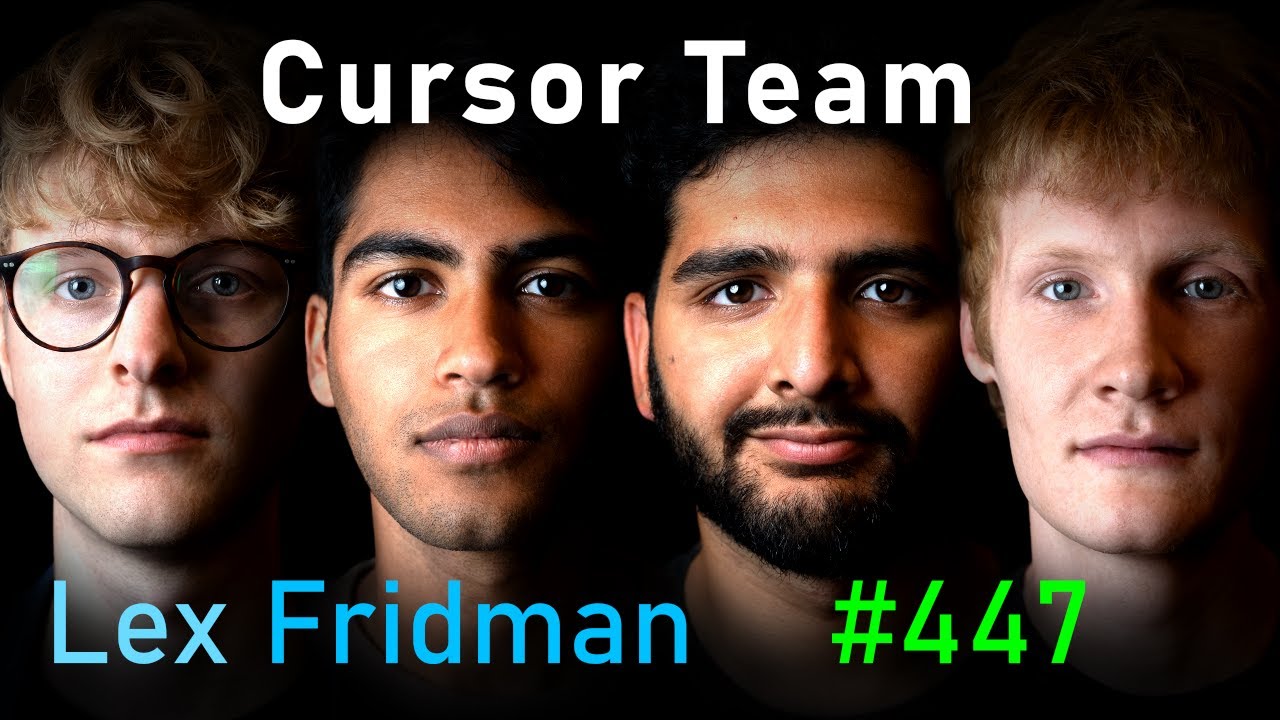
He also met Michael Truell, Aman Sanger and Sualeh Asif. The four friends watched language models improve and argued about what those gains would mean. Their early experiments included tools for financial professionals working in Jupyter notebooks and attempts to use models for static analysis. Internships had taken Lunnemark into software engineering at Stripe and quantitative trading at Jane Street. The useful question was becoming less abstract: if models kept improving, what kind of working environment would programmers need?
They founded Anysphere in 2022. Late that year, access to GPT-4 made the upward jump in model capability tangible. Rather than build a small add-on, the team forked Visual Studio Code and began reshaping the editor itself. Cursor launched in 2023. Forking a familiar editor was the conservative part of the wager: keep the ecosystem developers knew, then alter the relationship between programmer, codebase and model.
The founders had all used Vim before AI-assisted coding pulled them toward VS Code. Their decision to own the editor gave them control over pieces an extension could not comfortably reach. It also collapsed the usual distance between model work and interface work. Lunnemark explained that the same group developed how users interacted with the model and how the model found context or produced better answers. The person shaping the interface might sit a few steps from the person training the model. Sometimes, it was the same person. Naturally, they used Cursor to build Cursor.
“Fast is fun.”Arvid Lunnemark, on how Cursor chose what to build
The line sounds like a slogan found scribbled on a startup refrigerator. In Lunnemark’s telling, it was closer to a test. The team built experiments, tried them and threw some away because they were not enjoyable to use. Speed mattered because delay breaks concentration. A suggestion could be wrong without becoming intolerable, provided the user could type another character and immediately steer the system toward a better one.
That distinction explains why Cursor’s “Tab” feature reached beyond autocomplete toward the next edit, the next place in the file, perhaps the next file, or a terminal command implied by the work already done. Lunnemark called the broader idea “next action prediction.” Sometimes the helpful action would involve looking rather than changing code. It might take the programmer to a definition, supplying enough knowledge to judge whether the following suggestion deserved acceptance.
There is an ethic tucked inside the interface. Prediction should remove the low-information motions after intent is clear while preserving the person’s capacity to understand the consequence. Cursor’s diff views made that bargain visible: the machine proposed; the programmer inspected red and green changes and decided.
Prompting, with the mysticism removed
In June 2023, Lunnemark published an essay arguing that “prompt engineering” was better understood as prompt design. His analogy was web design: the work involved clear communication, dynamic inputs and continual inspection of what the system actually rendered. He described a prompt as communication with a time-constrained human. The comparison was imperfect, he freely admitted, which made it more useful than a manifesto.
The essay introduced Priompt, an open-source, JSX-based library used inside Anysphere. Its components let developers assign priorities to parts of a prompt, reserve token space, choose fallbacks and inspect prompts against real data. In plain English, it treated the context window as scarce editorial space. Important instructions stay; expendable material leaves first. The library’s own documentation notes where the abstractions fail and where too many priorities become an anti-pattern. Certainty, in this corner of Lunnemark’s work, is expected to carry tests.
Priompt gave the analogy machinery. A developer could build a prompt from reusable components, preview the result on recorded requests and see which material survived a token limit. The system could reserve room for a model’s response or swap in a shorter fallback when context grew crowded. Its key promise was formal enough to please a contest mathematician: find the lowest priority cutoff that still fits. Yet the documentation also warned that a perfectly neat abstraction can create caching and performance trouble. Design had to answer to the machine.
That same year, he was also one of three Anysphere authors on a paper presenting a formal security definition for metadata-private messaging. The subject seems distant from an AI editor, yet the connective tissue is clear enough: specify precisely what a system promises, identify where an attacker can break the promise, and prove what remains.
Choosing the next problem
Cursor’s business rise was unusually compressed. In 2024, investors valued Anysphere at $400 million. By 2025, annualized revenue had reached a reported $1 billion and the editor was used by millions of developers, including teams at Nvidia, Adobe, Uber and Shopify. In August 2026, SpaceX acquired Cursor in a reported $60 billion transaction. The figures are striking, although they explain little about why a product becomes a daily habit. “Fast is fun” gets closer.
Lunnemark had already changed course. In October 2025, he left his operating role at Cursor to focus on Integrous Research, a San Francisco company developing systems for safer AI. His departure note held both sides of the decision at once: sadness at leaving the team and product, excitement about the ideas ahead. Leaving a company at that point is not an act that needs embroidered language. The timing supplies enough drama.
The move also gives his earlier work a new frame. The teenage competitor solved problems with known rules and verifiable answers. Cursor worked in a murkier territory, where a model could be useful while wrong and where interface design helped contain the error. Safer AI raises the stakes again. The system may be capable, the next action may be predictable, and the proof of good behavior may still be missing.
Lunnemark’s public profile is spare. His personal site begins, in lowercase, “hi, i’m arvid,” adds a smiley and offers a commonplace book, posts, principles and questions. There is something fitting about the last item. His work has moved from finding exact answers to designing how machines offer provisional ones. The interesting constant is not certainty. It is the discipline of asking what the machine should do, what the person must still know, and which difficult problem deserves the next attempt.