Sunny Reddy came to Detroit to study engineering and forgot his winter clothes. As an introduction to Michigan, it was admirably direct. Decades later, accepting an engineering Hall of Fame honor at Wayne State University, he recalled that first winter. The detail is more revealing than the usual polished account of an entrepreneur’s arrival: ambition had made the journey; the wardrobe had failed to keep up.
By April 2026, Reddy had several reasons to be back on campus. He was the founder and CEO of VoIP Office, a telecommunications business based in Troy. He was also an elected member of Wayne State’s Board of Governors. The former student now helped govern the institution that had educated him. The engineering college’s recognition added another return to a life that keeps finding its way back to Detroit.
He has described Wayne State as the place where he built his life. That attachment gives his career a useful center of gravity. There is a business crossing national borders, a home in Bloomfield Hills, community work stretching from Michigan to India, and an increasingly visible Republican political role. Wayne State remains a place where those separate chapters meet.
“Most people graduate from Wayne State, but I built my life here.”
Sunny Reddy · April 2026
His academic training was in chemical engineering. The university’s engineering college lists him as M.S. ’95. His later business would concern a different kind of connection: helping companies conduct conversations through internet-based communications. A degree can provide a starting point without prescribing the destination. Reddy’s career makes that distinction unusually easy to see.
A company built around the everyday call
VoIP Office dates its beginning to 2004. By its fifteenth anniversary in 2019, it was describing a business with offices in India as well as the United States. Reddy’s title was CEO, and his message was pointed toward the work still ahead. “We have got a long way to go, we have got a lot to do,” he said. Fifteen years in business apparently had not exhausted the to-do list.
The company’s business sits close to an ordinary office frustration: people need to reach one another, and the equipment should cooperate. Its services bring business calling together with tools such as conferencing, messaging and mobile access. Behind the vocabulary of cloud communications is a fairly human transaction. Someone calls a colleague or a customer and expects the conversation to happen.
That places Reddy in a corner of technology where usefulness has to survive the working day. A phone service is part of the machinery of a business, used in the middle of other tasks. The attraction of combining communications with business applications is practical: fewer separate places to manage a conversation and the work attached to it. VoIP Office’s anniversary description emphasized precisely that integration.
In a 2020 conversation with Michael Rogers for the Small Business Association of Michigan’s weekly podcast, Reddy urged business owners to reconsider what their telephone could do. “People look at the telephone as a telephone,” he said. His point was that newer communications tools offered uses beyond the familiar call. It is a useful glimpse of the executive explaining his own trade: start with an object everyone recognizes, then ask the business owner to look at its possibilities again.
The geography mattered, too. Troy gave the business its Michigan base, while India became part of its operations. Reddy’s public identity consequently grew across more than one setting. He could appear as a telecommunications executive in Michigan and as a business leader involved in educational giving in Hyderabad. Those are documented parts of the same career, rather than separate biographies sharing a name.
A smaller city enters the plan
In December 2019, Reddy discussed opening a call-center base in Mahbubnagar, Telangana. His proposed beginning was modest and specific: a team of 15 to 20 people, with expansion to follow. He explained the choice by saying he belonged to that place. In an industry often described through enormous markets and abstract networks, the argument was pleasantly local.
The proposal formed part of a wider interest among overseas Indians in setting up operations beyond Hyderabad. Reddy’s contribution to that discussion was a proposed workplace with an initial headcount. It deserves to be remembered as a plan, with the scale he actually described. A proposed office does not become a completed expansion simply because the sentence sounds better that way.
What the episode does establish is his interest in linking a cross-border business to a place with personal significance. Mahbubnagar was being considered as somewhere work could happen, with employees serving clients from outside the usual metropolitan center. The detail adds texture to a founder profile that might otherwise stop at the location of the headquarters.
Education becomes a shared project
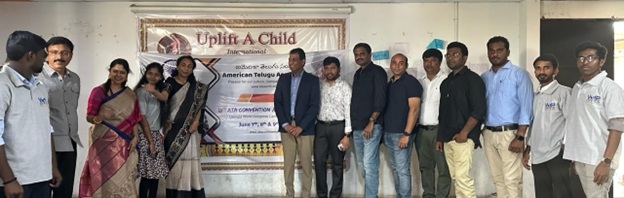
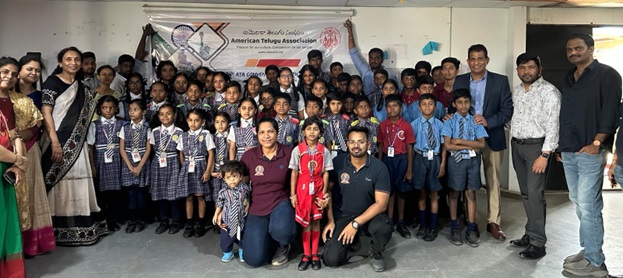
The educational thread also runs through his work with the American Telugu Association, where Wayne State identifies him as a Board of Trustees member. In Hyderabad, VoIP Office and the association came together at Bharthi Vidhyalaya High School to support Uplift a Child International. Employees, association representatives, students and teachers took part. The photographs show a crowded gathering, with school uniforms rather than corporate branding doing most of the visual work.
A donation was presented to support children’s education. Reddy spoke about childhood memories and about helping families secure opportunities for their children. The occasion brought his company into a project alongside a cultural association and an educational charity. Its significance lies in that arrangement: several groups using their connections to support something they could do together.
Education is a recurring subject in his public commitments, from that school gathering to his university role. The settings differ greatly. Supporting children’s schooling in Hyderabad and overseeing a public university in Detroit involve different institutions, different responsibilities and different scales. Both belong in his story because he has participated in each, with identifiable organizations and people involved.
His community activity has also included disaster fundraising with the American Red Cross. Wayne State records his involvement in relief efforts following Hurricane Harvey in Houston in 2017, the Kentucky tornadoes in 2021 and hurricanes in Florida in 2024. These episodes sit across several years. They show an ongoing place for fundraising in his public life, alongside the company and the campus.
The alumnus takes an eight-year seat
Michigan voters elected Reddy to Wayne State’s Board of Governors in November 2024. His term began on January 1, 2025, and runs through December 31, 2032. The dates give the return to campus a practical dimension. This is an eight-year responsibility, with a much longer horizon than an alumni appearance or an acceptance speech.
His stated priorities include accessible and affordable education, stronger student opportunities and alumni participation. He has emphasized mentorship and career guidance as ways for graduates to help current students. There is an appealing specificity to that last idea. Alumni engagement becomes more useful when it means a student can speak to someone who knows a profession, a workplace or the first difficult steps into a career.
His campaign positions also favor investment in science, technology, engineering and mathematics, and admissions based on individual merit. These are his stated positions, part of the platform on which he presented himself to voters. They locate his educational ambitions within a recognizable conservative outlook while keeping the focus on what he says universities should offer students.
Reddy’s engineering background and experience running a communications company give him professional reference points for those discussions. They also make the campus return more interesting than a tidy success story. A graduate once depended on the institution for an opportunity; a governor takes part in decisions affecting opportunities for other people. The relationship changes, even while the attachment to the place remains.
The 2026 engineering Hall of Fame induction sits beside that governing role. One recognizes a graduate’s career; the other asks him to participate in the university’s future. Held together, they explain why Wayne State occupies so much space in a profile of a telecom founder. It is both an early chapter and a continuing commitment.
January 1, 2025 to December 31, 2032
Wayne State University Board of Governors
Another kind of network in Michigan
Reddy’s political responsibilities expanded during 2025. In April he was elected treasurer of the Michigan Republican Party. In December he became its co-chair, working with party chairman Jim Runestad. VoIP Office publicly acknowledged the appointment, identifying its founder and CEO with a role reaching well beyond the business.
The sequence matters. His university election, party treasury role and co-chair position were separate developments with separate responsibilities. Together they placed him in Michigan’s public life as an entrepreneur, an elected university governor and a party official. The list is busy enough without pretending that each title describes the same job.
His political website puts fiscal accountability, STEM education and community outreach among his priorities. Heading into the 2026 elections, it also emphasizes party unity and organizing. Those ambitions are overtly partisan. His position at Wayne State belongs to a public university. Reading his career accurately means keeping the responsibilities of each institution in view, even when the same person appears at both meetings.
There is a quieter continuity in the geography. Reddy lives in Bloomfield Hills, runs a company associated with Troy and serves a university in Detroit. His work with Telugu organizations and educational giving also reaches India. The distances vary, but the career remains attached to actual places: a Michigan campus, a business office, a school gathering, a community meeting.
For a founder in communications, the temptation is to make every achievement a metaphor about connecting people. His story has enough particulars to spare us that speech. There is the chemical engineering degree. The proposed 15-to-20-person team in Mahbubnagar. The school event in Hyderabad. The board term ending in 2032. And, at the beginning, a student arriving in Michigan without the proper clothes. The winter got his attention. The university kept it.
Follow the next conversation
Business, campus, community and public life.