In September 2022, Sunlune had just raised a reported tens of millions of dollars from Intel Capital to help develop chips and expand internationally. Two days later, Ethereum completed its Merge and stopped using proof-of-work mining. For a company known for Jasminer mining machines, the timing had the manners of a practical joke. The machines did not all become useless: Ethereum Classic and other compatible networks remained. But the biggest stage for an Ethereum miner had disappeared.
- Sunlune designs specialized chips and sells Jasminer crypto mining equipment.
- Its X4 chip put DRAM directly on logic, a construction independently examined by TechInsights.
- It has described an AI inference chip, SUNMMIO A4, and a 2025 development agreement with Tekcore.
- The opportunity is shorter data travel; the unanswered question is commercial AI performance.
The interesting thing about Sunlune is that the trick inside its miner may have a life beyond the market the miner was built to serve. Chips are often discussed as if their value were a single number: operations per second, or perhaps watts. Sunlune's story is about another number, the distance a bit of data must travel before a processor can use it.
First, put the memory upstairs
Sunlune is a fabless chip designer. It designs the silicon and relies on a manufacturing supply chain to make it. Founder and CEO Fuquan Wang's company dates to 2009; company profiles describe a sharper focus on high-throughput, computing-in-memory chips from 2018. The result most people can actually point to is the Jasminer line of application-specific integrated circuits, or ASICs, for crypto mining.
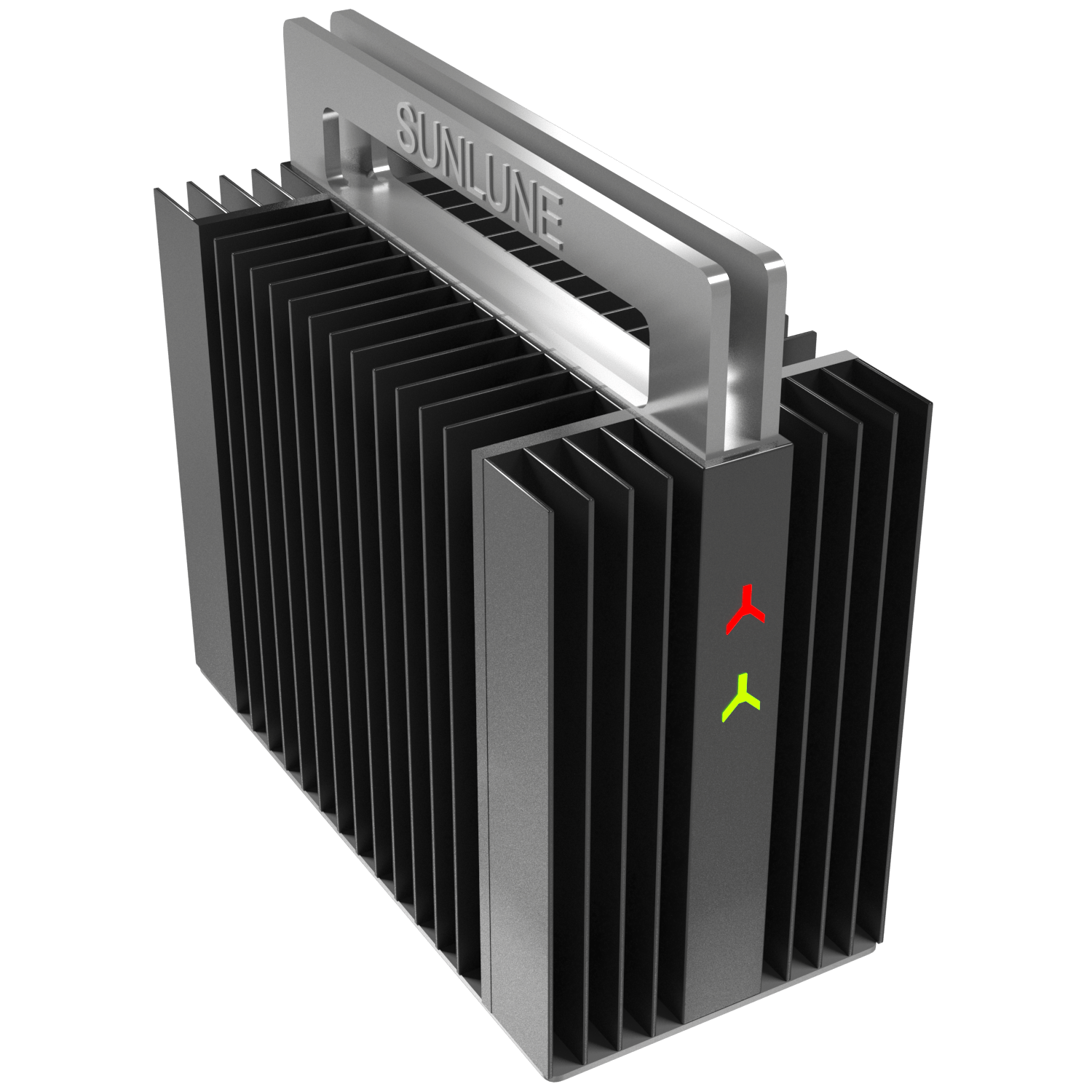
An ASIC does one family of jobs by design. A GPU can be reprogrammed for many workloads, but that flexibility costs area, power, and often memory traffic. Jasminer's X4 family pursued a simpler bargain: bring a large pool of data close to the calculation it serves. In 2023, analysts at TechInsights opened the X4 and identified direct bonding between DRAM and the logic die. SK hynix's technical newsroom later used the chip as a commercial example of the method.
Conceptual section, not a manufacturing drawing. Direct bonding shortens the route between storage and calculation; the exact benefit depends on the workload and chip design.
That difference is more physical than magical. Traditional systems place memory farther from the compute engine and spend energy shuttling bits across an interface. Bonding layers together provides many short connections. TechInsights reported Sunlune's own claims for the X4 of 1 TB/s memory-access bandwidth, 5 GB of storage, and up to 65 million hashes per second at 23 watts. Those figures describe a mining chip, not an AI benchmark, and the performance claims come from Sunlune. The observed bond is the sturdier fact.
The first market proved the package. It did not guarantee the next product.What the X4 can, and cannot, tell us
Then Ethereum changed the arithmetic
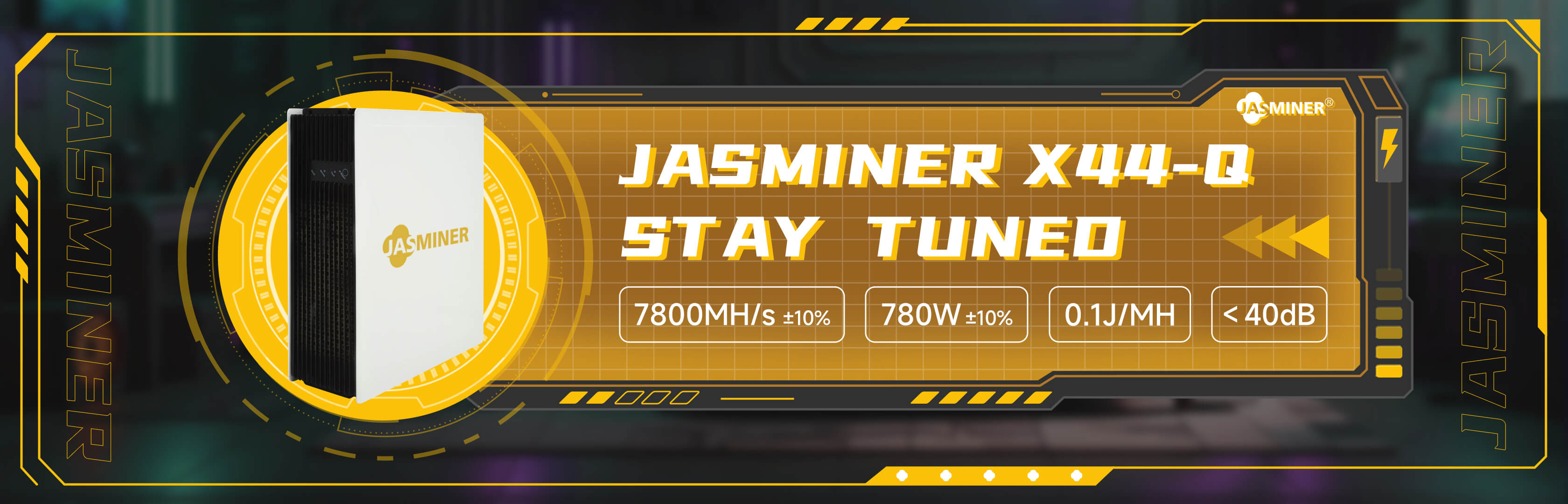
Mining economics are unforgiving. Revenue depends on network rules, coin prices, competing machines, and electricity bills. The Merge removed Ethereum mining itself from that calculation in 2022. Sunlune's hardware could still serve compatible proof-of-work networks, and Jasminer continued to market new equipment. At CES 2024, it showed the X16-Q and X16-P. The company listed the X16-Q at 1,950 MH/s and 620 W, with a 40 dB noise specification, all subject to its published tolerances.
There is a useful cost lesson in that specification. Run a 620 W machine continuously and it uses about 446 kilowatt-hours in a 30-day month. At an illustrative electricity price of 15 cents per kilowatt-hour, power alone is about $67. That is arithmetic, not a profitability forecast; the machine price, network difficulty, and coin revenue still decide the outcome. It also shows why a lower-energy design matters to a buyer who runs racks of these devices.
The Merge did not prove that crypto mining was a bad engineering target. It proved that an excellent answer to one network's problem can be stranded by a rule change. What survived was the underlying skill: designing a specialized processor around a memory bottleneck. Sunlune's public pitch increasingly applies that skill to transformer inference, where models repeatedly fetch weights and other data while producing answers.
A second job for the same idea
At CES 2024, Sunlune discussed an A4 chip under its SUNMMIO brand, describing high bandwidth, large on-chip memory, and an optimized tensor processor. Later company posts called it an AI inference accelerator in development. In May 2025, Taiwanese company Tekcore announced an agreement with Sunlune to work on an AI chip and a new crypto chip, both using hybrid-bonded 3D DRAM. The firms said the designs were largely complete and targeted a tape-out that year. A target is not a shipment or a benchmark.
Who would buy the next chip? Sunlune points to operators serving AI inference in data centers and at the edge, where energy, memory bandwidth, and response time influence the cost of every request. Mining customers buy machines to generate hashes. An AI customer needs far more: software support, model compatibility, reliable supply, and measured performance on the models it actually serves. No named A4 deployment or broad shipment count appears in the public material reviewed for this profile.
Its alternatives are formidable. Nvidia and AMD GPUs bring broad software ecosystems; cloud providers build their own application-specific silicon; independent AI chipmakers also promise better efficiency. Sunlune's distinction is concrete but narrow: it can point to a commercial ASIC in which independent analysts found DRAM bonded to logic. That makes its packaging claim more substantial than a rendering. It does not settle whether an inference system built around that package beats an established option after software, manufacturing yield, availability, and price are counted.
What can travel from here
For another hardware company, the copyable move is not to imitate Sunlune's bond. It is to choose an early market with a brutal, measurable bottleneck, build something that can be inspected, and carry the verified engineering result into the next market. Sunlune's miner supplied physical evidence that its memory and logic could be joined in a working product. TechInsights' teardown made that evidence legible to people outside the company.
There are limits to the analogy. A mining algorithm is fixed; AI models and deployment software keep changing. A vertical stack can save data movement yet still be expensive to fabricate, hard to cool, or awkward to program. If the workload is compute-bound rather than memory-bound, shortening the memory path may do little. If a buyer values flexibility over efficiency on one task, a general-purpose GPU may remain the sensible purchase.
That is the real test ahead for Sunlune. The company has shown that it can turn an unusual chip structure into mining hardware. It has announced a path toward AI and a partner to pursue it. The next persuasive artifact will be less photogenic than a miner: repeatable inference results, software people can use, and a price that makes the watts worth saving. The memory sits on top. The burden of proof sits everywhere else.