There is a pleasing complication in Sunil Sharad Kolhekar’s career: after helping build a company, he went on to study management, and then put his name to a book about the business of government contracting. Experience had already given him a subject. He gave that subject more homework.
The chronology does much of the telling. Creative Information Technology, known as CITI, was founded in 1996. Kolhekar completed his Doctorate of Management in 2011. Three years later came Entrepreneurial Success in Federal Government Contracting, published by Scholars’ Press. Fifteen years into the life of a company is an interesting time to acquire another qualification. Eighteen years in is an interesting time to publish a book.
Those dates suggest a useful way to read his working life. Company leadership, formal study and sharing knowledge have occupied the same career. The executive title supplies one line of the biography. The recurring interest in education supplies another, taking the story from a university award to a fundraising gala and, eventually, a group of high-school students visiting an IT office.
A business worth studying
Before CITI, Kolhekar held assignments at CACI, Orkand and CBSI. His education crossed several disciplines: electronic engineering at Indore University, business administration at Punjab University, and computer systems management at the University of Maryland. The doctorate followed at University of Maryland, University College. Engineering and management make sensible companions in an IT business. A system can be elegantly designed and still require someone to organize the people responsible for delivering it.
His book’s subtitle is more revealing than a motivational slogan: The Importance of Critical Success Factor Analysis to the Long-term Growth of Small Contractors. It locates the question beyond the excitement of starting a company. Winning work and building an organization that can continue winning work are related problems, with different demands on the calendar.
The 248-page paperback appeared on January 27, 2014. Its title is admirably candid about its intended reader. Anyone searching for a breezy account of entrepreneurial glamour might find the words “critical success factor analysis” rather firm about the terms of admission. For someone trying to sustain a contracting business, the same words promise a recognizable subject.
The book belongs beside two earlier distinctions. Kolhekar received the Small Business Administration’s Entrepreneurial Success Award in 2009. In 2012, his university recognized him with an Alumni Achiever Award. Business experience and academic recognition appear close together in this stretch of his career, with the doctorate between them. The sequence makes the book feel like a continuation of an established concern: how organizations learn to last.
Five years on the revenue ledger
A dated view of CITI’s early business gives that concern some scale. Its 2006 Fast 50 entry placed the company at number 39 and named Kolhekar president and CEO. Revenue rose from about $3.5 million in 2001 to $27.1 million in 2005. The entry recorded 250 employees and identified the State and Transportation departments as major customers.
Read those figures with their dates attached. They describe a particular period of growth, rather than a present-day valuation or a claim about the founder’s wealth. They also show why the management question matters. More work brings more people, more obligations and more opportunities for the distance between a promise and its execution to become expensive.
Government IT gives those obligations a practical setting. Software, facilities support and agency operations require delivery long after a contract announcement has enjoyed its brief moment in the light. A growth chart can show the size of the business. The work of making the business function takes place between its annual markers.
The work behind the announcement
In January 2013, CITI participated in the launch of the State Department’s Program and Project Management Community of Practice. The initiative sought to improve practical understanding of program and project management, encourage professional knowledge and share standards. It is a less theatrical subject than a product unveiling, but organizations have good reasons to care about how work gets organized.
Kolhekar’s response put the emphasis on employees helping a customer: “It is just another example of our people furthering the success of our customers.” The phrasing is conventional; the choice of emphasis is useful. Project management makes the relationship between a contractor’s internal capability and a customer’s operations unusually visible.
“It is just another example of our people furthering the success of our customers.”
Sunil Kolhekar, January 2013
There is a smaller, personal example too: Kolhekar mentored former employee Rahul Nemade as Nemade built ValidaTek. That connection adds a human scale to a career otherwise easily described through institutions. Knowledge about running a business can travel through a book, a formal program or a conversation with someone trying to establish a company.
CITI’s leadership also extends beyond its co-founder. Alankar Joshi is its co-founder and executive vice president. The team includes separate responsibilities for innovation, information security, federal growth and state and local operations. Such titles describe the range of work around Kolhekar. They also keep a founder’s biography in proportion: an organization’s output belongs to many people, however conveniently a headline accommodates one name.
More recent public business records give that organization a concrete setting. Alabama’s July 2024 contract-review agenda described CITI’s payment-processing work for child-care providers and listed Kolhekar among its owners. A September 2026 agenda listed him again, this time alongside a proposed renewal for Summer EBT services. That item covered applications, eligibility, appeals and customer service. These are company responsibilities, rather than personal accomplishments to assign to a CEO. They help explain the operational world around his title: public programs with defined processes, users and deadlines, where software is one part of delivering a service.
A place at the education table
Education takes a more literal form in Kolhekar’s work with Ekal Vidyalaya. His LinkedIn profile lists an advisory role beginning in January 2017. In October 2018, he was a co-chair of the organization’s Washington-area Future of India gala, held at Congressional Country Club in Bethesda, Maryland. The event brought business and community figures together around education in rural India.
The gala’s organizing group included convener Sudhir Sekhsaria and co-convener Amit Pamecha. Kolhekar’s fellow co-chairs included Vinod Jhunjhunwala, Suresh C. Gupta, Lavina Chawla and Mulpuri Rao. These were shared responsibilities in a community effort. The public role gives a precise account of his involvement without requiring an invented philosophy to accompany it.
Sunil and Aparna Kolhekar pledged $25,000 toward Ekal’s tablet tutoring program. The program, E-Shiksha, had been launched in 180 schools across India. The Washington-area gala raised $1.1 million overall. Those figures describe the collective event and the specific pledge separately; the entire result belongs to the many people who contributed.
A tablet is a familiar object in a technology executive’s world. Here it appeared in a different setting, as part of a tutoring program. That connection makes this episode particularly apt in his biography. His professional work concerned technology inside institutions. The education effort concerned access to learning through technology. The objects were familiar; the audience was different.
Four visitors, two weeks, a working office
In July 2023, CITI hosted four students through Montgomery County Public Schools’ Summer RISE program. Over two weeks they encountered cybersecurity, capture management and practical office work. They also met Kolhekar and Shashi Roy, CITI’s CEO for state and local business. For students considering IT, the visit offered a look at the jobs surrounding the technology.
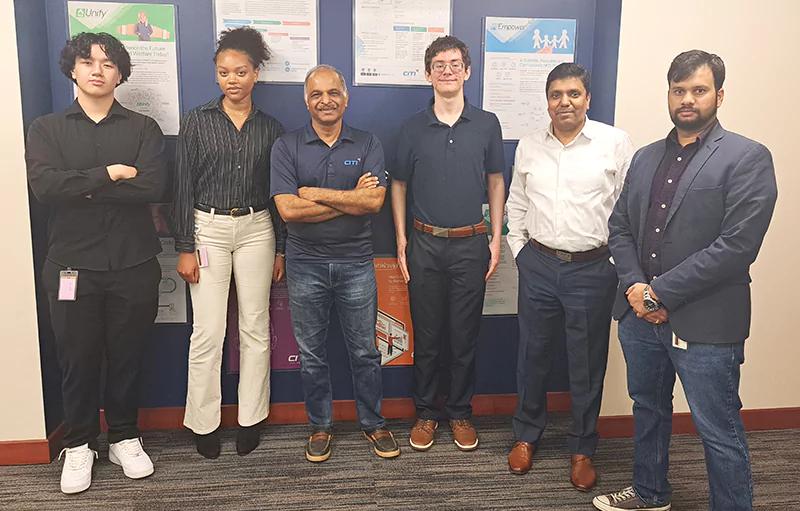
An office is an informative place to encounter a profession. It reveals the correspondence, meetings and presentations that sit beside technical tasks. School subjects acquire colleagues and customers. The glamorous answer to “What did you do this summer?” may require a little editing when the experience includes procurement documents, but learning how work actually happens has its own uses.
The visit fits a broader pattern in Kolhekar’s public activity. On LinkedIn, he congratulated a colleague for mentoring and encouraged him to “Keep inspiring younger generations.” It is a brief comment, with a clear object of praise. Put beside the student program and education volunteering, it adds a modest piece of evidence about the activities he chooses to acknowledge.
Still a subject for the classroom
There was another university connection on January 31, 2019, when Kolhekar gave a talk on innovation as the key to success. The subject fits a career spent in IT, but its location in an academic calendar matters too. Alongside the doctorate and the book, the appearance puts professional experience back into a setting where people gather to learn.
For a reader following these episodes, the connection is practical. A degree formalizes study. A book makes a question available to other readers. An office visit gives students a view of working life. Each offers a different route into knowledge that might otherwise remain inside one person’s career.
By 2026, CITI’s founding lay thirty years in the past. Kolhekar remained publicly identified as president and CEO. Longevity alone cannot explain how a business operates, but it provides room for a career to acquire several dimensions: executive responsibility, study, authorship, advice and education work.
His story is most interesting when those dimensions stay together. The founder builds a company. The student earns another degree. The author gives a specialist question 248 pages. The volunteer joins an education effort. Then a group of young visitors arrives at the office, and a long career becomes something they can ask about in person. There are less useful things to do with experience than make it available to the next person.