The useful part of a failed startup is rarely the pitch deck. For Suhail Khan, it was the appetite that remained after the applause stopped. At BITS Pilani, he and a student team built QBox, a platform meant to improve English writing through competition. The idea was easy to describe: give writing the scores, badges and competitive energy that programming contests already enjoyed. It won attention, gathered users and carried Khan to the San Francisco Bay Area in a government-backed student startup program. He pitched in rooms associated with Silicon Valley Bank and TechCode. Then QBox failed to become the durable company he had imagined.
Plenty of founders spend years editing that sentence until failure sounds like strategy. Khan has been unusually plain about his version. The startup did not take off. What mattered was the discovery underneath it: he liked making products, assembling teams and watching an idea meet people who had not been present for the brainstorm. A tidy career plan had been spoiled. In its place was something more useful, a compulsion to build.
“It didn't take off, but it made me realize one thing: I love building products and startups.”Suhail Khan, recalling QBox
The blog that became a laboratory
After graduating, Khan joined CGI as a software engineer. The job supplied the discipline of production systems, but he worried about drifting away from the startup world that had energized him. So he began writing. BizzBucket started as a place to document lessons and dissect young companies. It was modest enough to fit around a full-time job and ambitious enough to demand a real audience.
The audience came slowly, then in volume. Khan learned search optimization, studied which stories held attention and treated distribution as part of the product rather than an embarrassing chore after launch. BizzBucket reached 100,000 monthly readers. His portfolio says it generated more than $42,000 in revenue and increased engagement time by 200 percent. He organized an internship program for more than 20 students and extended the publication into games, calculators and three Android apps.
The subject was entrepreneurship, but the curriculum was product management. Search queries were uninvited customer interviews. A page that nobody finished was a failed feature. An app rating was feedback stripped of office politeness. Khan was building the bridge that would later define his work: code on one side, human behavior on the other, with storytelling holding the planks together.
A career assembled from both sides
Khan's formal résumé grew in parallel. At CGI, he worked on software and AI-related projects, including chatbot datasets and a Python rule engine for system monitoring. In 2021 he moved to Oracle, where the scale changed. His portfolio describes work on Oracle Supply Chain Management Cloud, including support for completing work orders and a mobile interface intended to reduce transaction time. Enterprise software is a stern editor. A charming prototype can survive with loose edges; a system attached to operations cannot.
That distinction matters now. The AI industry has no shortage of demonstrations that behave beautifully for four minutes. Khan's route passed through the less photogenic questions: Does the workflow fit? Can a customer understand the change? What happens when the model is wrong? Who is responsible when a promising feature meets a complicated organization?
The compounding route
The move from chemical engineering, his undergraduate subject, into software was already one act of translation. Moving from engineering into product required another. Khan describes his own combination as “the logic of a Programmer, the innovation of an Entrepreneur, and the storytelling fineness of a Marketer.” Capital letters aside, it is a precise account of the job he had been constructing before anyone supplied the title.
Carnegie Mellon, with prototypes
At Carnegie Mellon's Tepper School of Business, Khan pursued a Master of Science in Product Management, mixing business and marketing with technical study from the School of Computer Science. He did not arrive as a blank notebook. He arrived with the scribbles of QBox, the analytics of BizzBucket and the constraints of Oracle. Graduate school gave him frameworks against which to test them.
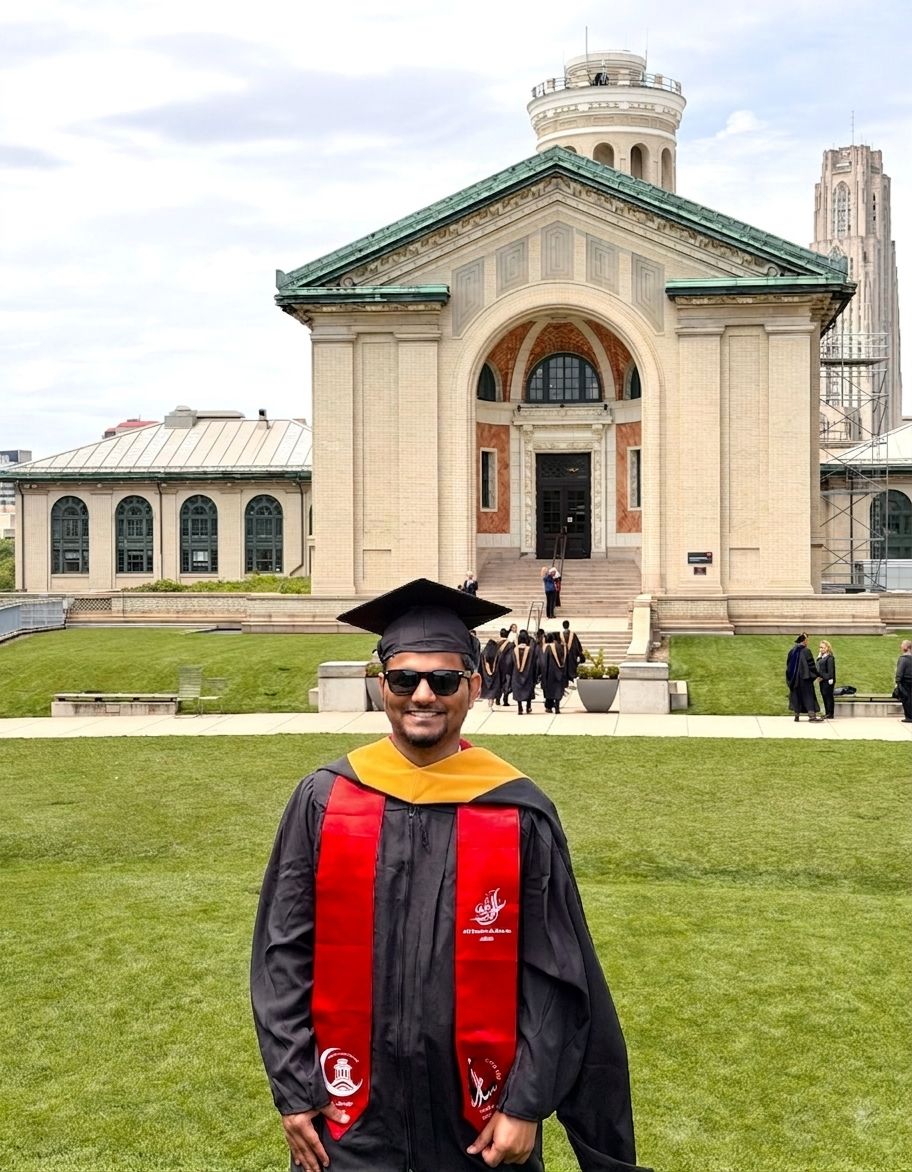
His school-year work was characteristically busy. At Walled AI, he worked on enterprise LLM safety products. A FlexGen internship involved user research and product tooling for energy-storage workflows, plus an AI chatbot for collecting internal feedback. For an American Eagle Outfitters capstone, he helped design a multi-agent shopping experience intended to guide customers from inspiration to checkout.
There was also ProdHacks 2025. Khan, Ankit Shukla and Ansh Pandey won the WealthMeUp track with a concept for personalized financial education. Their proposal used language models to reduce the burden of long onboarding forms and adapt lessons to a user's behavior and preferences. The victory fits the pattern: the technology mattered, but only as a way to remove effort from a human task.
The workbench has no single theme
Look across Khan's projects and the categories appear almost comically unruly. There is a baby-name dictionary with more than 50,000 downloads. Lafz, an app for browsing and sharing Urdu poetry. A multi-agent blog writer. A retrieval system that turns meeting transcripts into searchable knowledge. An AI support agent for a fragrance device. A comment-moderation tool. More than 60 public repositories sit on his GitHub profile.
Names
A reference app made useful through search, meaning and language.
Poetry
More than 10,000 Urdu poems gathered for browsing, saving and sharing.
Meetings
A pipeline that turns transcripts into a queryable knowledge base.
AI agents
Public experiments in orchestration, support, moderation and evaluation.
The variety is the point. Khan seems less interested in declaring a grand theory than in finding out what a system does when it touches a particular need. His YouTube channel, Suhail Insights, makes the learning public through technology breakdowns, business cases and build videos. BizzBucket does the same in articles and interactive tools. The creator and the operator are not separate characters. One documents what the other is trying to understand.
Teaching keeps appearing at the edge of this work. Khan volunteered as a teacher through the National Service Scheme at BITS Pilani. Later, BizzBucket's internship program turned the publication into a small training ground for student researchers and writers. At Carnegie Mellon, he served as a student ambassador, answering prospective students' questions about the program. The settings changed, but the gesture stayed familiar: learn a system well enough to make it legible to somebody arriving after you.
This may also explain his fondness for case studies. A case study is a machine with the cover removed. It lets the reader inspect the choice, the constraint and the consequence without pretending that business outcomes emerge from slogans. BizzBucket accumulated startup failures, business models and founder interviews. Suhail Insights moved the same impulse to video. His GitHub profile provides the executable version, where an AI agent or evaluation pipeline can be examined rather than merely admired.
None of these channels has the polished singularity that career advice usually recommends. Together, however, they make a coherent record of curiosity. Khan writes, codes, measures and explains. Each activity corrects the others. Code disciplines the claim. Analytics challenge intuition. Writing exposes fuzzy thought. An audience supplies objections that a private notebook never would. What looks from a distance like a crowded collection of side projects is, up close, one continuous feedback system.
San Francisco, the second time around
In 2018, San Francisco was where Khan arrived as a student founder on a 15-day exposure trip, carrying a pitch and the hopeful compression that every young company requires. In 2026, he returned under different circumstances. He joined Distyl as an AI Strategist, with responsibilities he describes as those of a forward-deployed AI product manager.
Distyl builds AI systems with large enterprises and emphasizes outcomes in live operations. Forward-deployed work places technical and product people close to the customer problem, where requirements are discovered in practice rather than dispatched from a distant roadmap. It is difficult work to fake. The model must function, but the surrounding decisions, data, incentives and habits must function too.
For Khan, the role gathers several strands that once looked unrelated. QBox supplied the founder's urgency. CGI and Oracle supplied engineering discipline and enterprise context. BizzBucket supplied an instinct for audience and explanation. Carnegie Mellon supplied formal product craft. His AI projects supplied the willingness to open the machinery and test it himself.
“Excited for this next chapter and looking forward to learning, building, and growing.”Suhail Khan, on joining Distyl
It is a restrained ambition, and revealing for that reason. Khan's story is not organized around one dazzling invention. It is organized around recurrence. Build, observe, explain, rebuild. The products change. The loop survives.
Failure is often treated as a heroic credential in technology, polished until it shines almost as brightly as success. QBox needs no such polishing. Its value is visible in what followed: a publication that found an audience, apps that found users, enterprise features shaped by constraints, and a career that kept moving closer to the place where technology becomes useful. The startup ended. The operating system kept running.