The book was lying on a colleague's desk. Jenn Gamble was finishing a doctorate in electrical engineering at North Carolina State University, immersed in topological data analysis, when she picked it up. The title was Machine Learning: A Probabilistic Perspective. She flipped through the pages and met a fashionable new phrase for mathematics she already knew. Machine learning, it turned out, was not an alien intelligence descending from the cloud. Much of it looked rather familiar.
It is a tidy origin story for a career spent translating between worlds. Gamble began with mathematics and statistics at the University of Alberta, moved south for her Ph.D., and then left the academic path for industry just as data science was becoming a profession people could name without adding a footnote. Her tools included network analysis, computer vision, and natural-language processing. Her real fascination was broader: how to combine a technical model, a business problem, and the people who actually understood the work.
At Ayasdi, she worked with organizations in medical and insurance fields, getting close to their data and experts. The assignment was never simply to locate an elegant pattern. It was to ask what new decision or workflow predictive modeling could enable. That distinction sounds modest. In practice, it separates a science project from a product.
The seduction of the prototype
Every technology acquires a party trick. Generative AI's is the demonstration: a prompt, a pause, then an answer polished enough to make a conference room go quiet. Gamble is interested in the morning after. Will the answer remain useful when the inputs become strange? Can it fit inside a process with permissions, deadlines, old software, and consequences? Can a user correct it? Can anyone tell why it behaved as it did?
She has described the distance plainly: “The gap between an impressive demo and a system that's reliable enough to run a business process is significant.” Her work lives inside that gap. The ingredients are unglamorous and therefore essential: integrations, testing, security, context, interface design, feedback, and a precise definition of the work to be done.
“Reliability is often the biggest blocker to cross the chasm between PoC and production.”Jenn Gamble on generative AI in the enterprise
The instinct was formed before large language models arrived. At Noodle.ai, Gamble moved from individual data science contributor to technical lead and Data Science Director, guiding teams of data scientists, data engineers, software engineers, and design technologists. Industrial AI made disciplinary vanity expensive. A model could be clever and still fail if the data meant something different on the factory floor, if the interface interrupted the work, or if software could not carry the result into a decision.
At Very, an Internet of Things engineering company, she turned those lessons into a practice. Problem formulation came before model selection. Her questions were concrete: What data exists? What claims should the application be able to make? Who will use it? Which workflow should change? What is realistically possible? They are the sort of questions that reduce the chance of applause in the first meeting and increase the chance that someone uses the product six months later.
Data science in an apron
Gamble has a useful metaphor for raw data. It is an ingredient, not dinner. Before numbers become knowledge, they must be washed, inspected for defects, augmented, seasoned, and transformed. The data scientist is part chef. The metaphor punctures two myths at once: that data arrives neutral and ready, and that a model converts it into wisdom through sheer computational heat.
Her 2020 ElixirConf keynote applied this thinking to robust data pipelines for machine-learning-driven industrial IoT. In 2021, speaking on the Elixir Wizards podcast, she argued that the foundations of machine learning matter more than chasing every fresh technique. The field moves quickly, but intuition about data, uncertainty, and useful abstractions travels well. It carried her from topology to sensors to language models without requiring a theatrical reinvention each time.
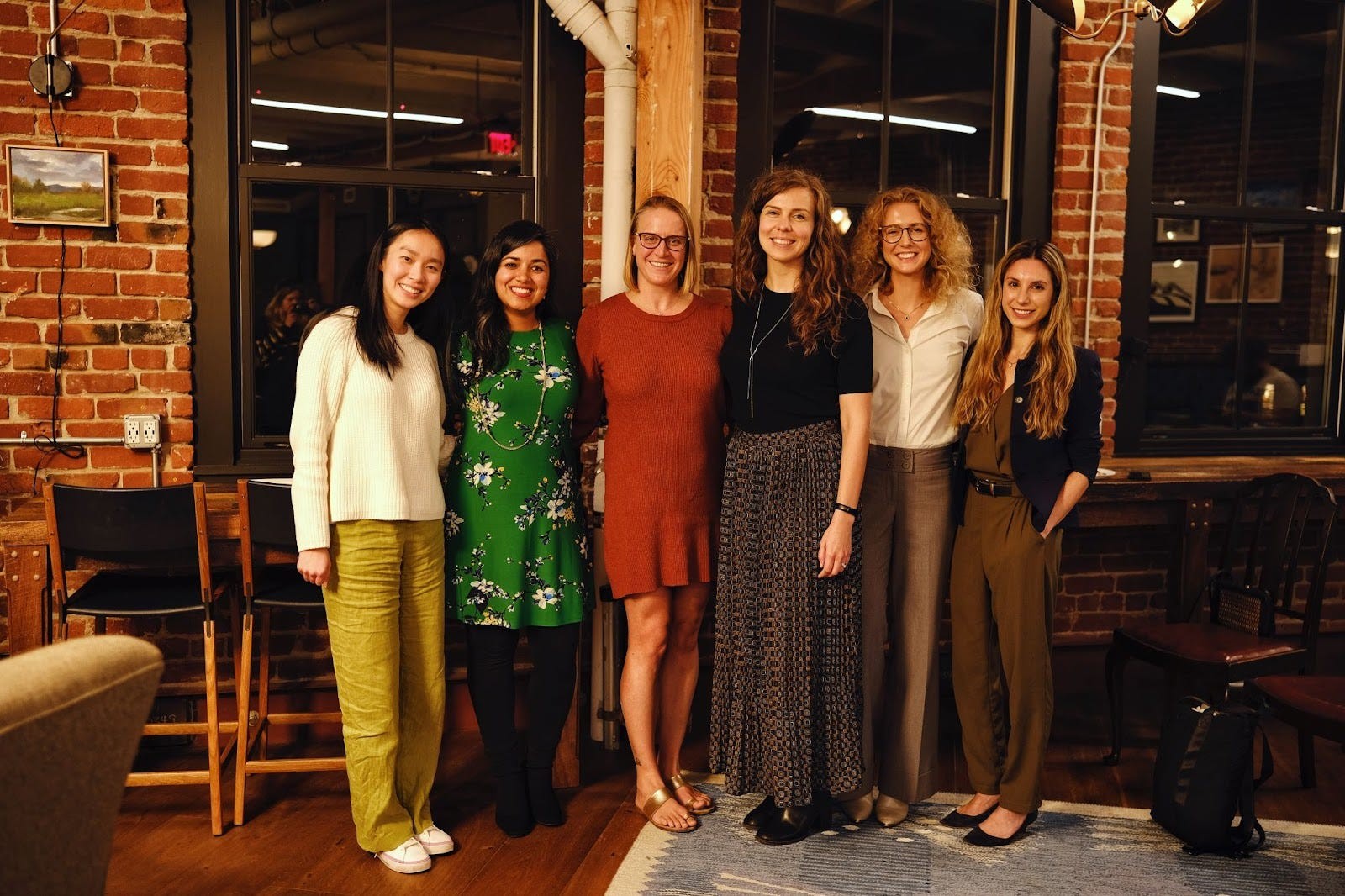
That gathering in 2024 gathered engineers, product thinkers, and operators around a question Gamble has pursued for years: how should people shape systems that will, in turn, shape work? Her answer emphasizes fast iteration, diverse teams, and software that keeps human judgment close. “As more and more work is able to be performed by AI systems,” she said, “it's enormously consequential to have software that makes it easy for humans to guide, oversee, and collaborate with AI.”
The verbs matter. Guide. Oversee. Collaborate. None treats the user as a ceremonial passenger. Gamble has also urged builders to move beyond the conversational box as the default interface. A chat window is wonderfully general, which can make it wonderfully vague. Business work tends to have structure: an approval, a comparison, a diagnosis, a handoff. Good design constrains the possible inputs and outputs until the system becomes more reliable and the user's next action becomes clearer.
Three questions before the first prompt
When choosing an early generative AI use case, Gamble applies a three-part test: value to the business, value to the user, and the present capability of the technology. Remove any corner and the project limps. A valuable corporate target that irritates its users will be routed around. A delightful tool with no operational consequence becomes a novelty. A grand ambition beyond the technology's limits becomes an expensive anecdote.
This is the use-case-backward philosophy she brought to Distyl as its founding Head of Data Science. In 2023, when the company announced an alliance with OpenAI and seed financing, Gamble explained her reason for joining: she wanted to help society deploy language-model systems effectively and reliably. The timing placed her at a peculiar frontier. The underlying models were changing monthly; the institutional machinery expected to absorb them had accumulated over decades.
The model is one component. The product is the full arrangement of context, interface, testing, feedback, and accountable human work.
Her 2024 LLMOps talk mapped that arrangement from use-case scoping through interface and architecture design, prototyping, retrieval pipelines, evaluation, tool selection, context management, and live deployment. It was less a victory lap than a wiring diagram. The excitement was permitted. It simply had to survive contact with the system.
The same practical temper appears in her approach to iteration. Working software should reach users early enough for their reactions to matter. Subject-matter experts are not summoned at the end to bless a finished machine; their feedback becomes part of how the system improves. For reversible choices, move, observe, and adjust. For consequential choices, preserve clear accountability. Speed, in this account, is not haste. It is a tighter conversation between the builders, the people who know the domain, and the people who will live with the result.
Doctoral research in electrical engineering and topological data analysis at NC State.
Ayasdi and Noodle.ai: predictive modeling, enterprise applications, and multidisciplinary technical leadership.
Joins Very to lead its data science practice and keynotes ElixirConf on industrial machine-learning pipelines.
Joins Distyl's founding team to lead data science and production enterprise AI.
Discusses the next phase of enterprise AI with Tim Davis and Parag Agrawal at the Geodesic Forum in Tokyo.
A career built around translation
Gamble's trajectory is easy to summarize as a sequence of fashionable fields: topology, data science, IoT, enterprise AI, generative AI. That misses the continuity. She has remained occupied with translation: from theory into a model, from a model into software, from software into a workflow, and from a workflow into a result that a person or organization values.
Colleagues describe her as an unusually thoughtful problem solver and teacher, someone who can grasp technical complexity without losing the human context. Her own writing is animated by questions rather than pronouncements. What does the data represent? Who is the end user? What statement should the application make? The habit is scientific, but also social. Asking the right question is a way of inviting the right person into the room.
Distyl's growth has made the room larger. In September 2025, the company announced $175 million in new financing at a $1.8 billion valuation, reporting work across telecommunications, manufacturing, financial services, insurance, and healthcare. Gamble's 2026 appearance in Tokyo focused on the widening gap between fast-moving model capability and the slower institutional work of integration and redesign. The bottleneck has moved. Intelligence is becoming easier to summon; judgment about where and how to apply it remains scarce.
There is an agreeable irony here. Gamble entered machine learning when she discovered that the dazzling new label covered familiar mathematics. She now works in a field besotted with new labels, while insisting on old disciplines: define the problem, understand the evidence, involve the user, test the system, observe the result. The future may arrive in a chat window. Making it useful still requires someone to wash the vegetables.