The most revealing thing about SugarCreek may be how rarely shoppers see its name. A strip of bacon arrives under a retailer's label. A chicken breast reaches a restaurant line already seasoned and cooked. A pouch fits a shelf, a case fits a distributor's system, and a portion behaves the same in Cincinnati as it does three time zones away. The visible brand gets the credit. SugarCreek, a family-owned manufacturer based in the Cincinnati region, gets another production run.
That is the compact at the center of private-label food manufacturing: become indispensable without insisting on fame. SugarCreek started in 1966 at Washington Court House, Ohio, with raw bacon as its flagship. It now makes raw and fully cooked bacon, deli meats, meatballs, sausage, burgers, sous vide chicken and pork, meal components and ready-to-heat dishes. Along the way it passed $1 billion in annual sales, opened six major U.S. facilities and acquired Veroni, an Italian producer with more than 600 cured-meat and charcuterie products.
Its growth is best understood not as a parade of foods, but as a collection of solved constraints. A restaurant needs fewer raw-protein steps. A retailer needs a pack that stands up and survives distribution. A brand needs a new formulation without building a plant. A buyer needs an exact slice count, predictable yield and safety evidence. SugarCreek sells answers measured in seconds, ounces, temperatures and rejected foreign particles.
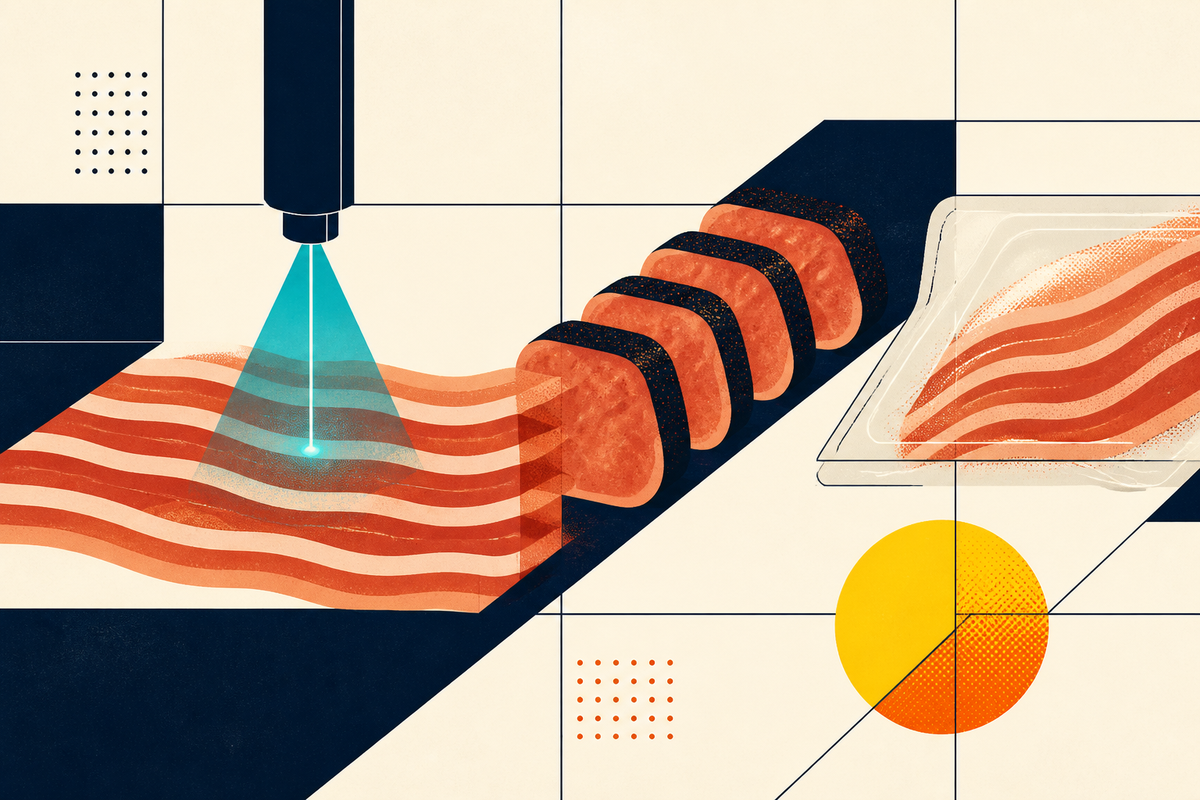
A factory that behaves like a kitchen
A typical co-manufacturer can make a recipe larger. SugarCreek's broader proposition is to help decide what that recipe needs to become before it is made large. Its culinary center and pilot plant let customers test a product, tune the flavor and texture, choose a cooking system, specify the portion and design the package. Scale is not the last step. It is a condition that shapes the product from the beginning.
The equipment list sounds like an argument against the idea that “cooked” is one process. SugarCreek uses microwave, impingement, infrared and multipurpose ovens alongside sous vide systems. It extrudes and smokes products. High-speed slicers chase exact weights and counts. Vacuum and gas-flushed packs, form-fill machines and overwrap equipment finish products in formats ranging from a 1.4-ounce retail pouch to a 35-pound industrial pack. Sister company Wingate Packaging extends the paperboard side of the job.
One product, five linked decisions
The result is an integrated chain. A packaging decision can change reheating. A cooking decision can improve yield. A precise portion can simplify a restaurant's cost calculation. A product that arrives fully cooked can reduce raw handling, training and storage in a crowded kitchen. SugarCreek competes with giant processors such as Tyson, Smithfield, Hormel, JBS and OSI Group, plus narrower co-packers. Its distinction is not that no rival owns similar machinery. It is that customers can buy the connected sequence from one operator with decades in proteins.
“Good enough is not enough.”John S. Richardson, founder
The 90-second piece of chicken
The most vivid example is Batter in Bag, SugarCreek's patented process for breaded protein. Chicken is seasoned, coated with batter, tumbled, vacuum sealed and cooked sous vide. At the restaurant, an employee removes it from the pouch, applies the final crust and flash-fries it. SugarCreek says the method removes two steps from a traditional three-stage breading process, avoids raw-protein handling in the back of the house and reduces the final fryer time from eight minutes to roughly 90 seconds.
That is a product, but it is also a business-model diagram. The manufacturer takes complexity upstream, where it can be controlled. The restaurant gains speed and consistency while preserving a fresh, hand-finished cue. The same logic applies to grilled chicken, seared pork loin, meatballs or a burger patty: do the hazardous and variable work in a monitored plant, then leave the customer only the steps that create immediacy.
For retail customers, the variables change. Shelf space is expensive, convenience sells, and the package has to communicate before anyone tastes the food. SugarCreek offers trays, cartons, printed films, stand-up pouches and custom sizes. For industrial buyers, brand protection becomes the language. SugarCreek's old site put it plainly: “Your brand is our brand.” It was not a slogan about co-branding. It was a promise to disappear responsibly.
Inspection as an ingredient
Food safety is easy to describe in broad claims and hard to execute minute by minute. SugarCreek layers metal detection, X-ray systems, magnets, visual checks, real-time video monitoring and audits inside a HACCP program. Laser sorting inspects bacon bits for foreign material. Vision systems on ready-to-eat slicing lines help control what passes. These controls solve the least photogenic and most consequential customer problem: one contaminant or inconsistent lot can damage a brand far beyond the value of the product itself.
The company applies similar engineering attention to factory inputs and outputs. Its current sustainability reporting says energy intensity has fallen 23.64 percent since 2016, near a target of 25 percent by 2029. It reports 11 percent less water use and 43 percent less annual chemical use in systems that include reverse osmosis. Organic byproducts feed anaerobic biodigesters; 37 million gallons of bacon grease have been recovered, while more than 34,000 tons of material have been diverted to energy.
The numbers come from the company, but the outside recognition is concrete: Department of Energy Better Plants honors, multiple Meat Institute Environmental Achievement awards and a regional award for water management. In 2024, the Meat Institute gave the Frontenac, Kansas plant third place for emissions reduction. Sustainability in meat processing remains a difficult, contested subject. SugarCreek's useful contribution is a set of operating measures that can be tracked rather than a mood board of green leaves.
A family company learns new appetites
John S. Richardson founded the business; his son John G. Richardson worked there as a teenager and bought the roughly $50 million company when his father retired in 1990. Under the second generation, SugarCreek moved into fully cooked bacon, new plants, sous vide and meal solutions. Michael Richardson, who joined in 2002 and rotated through transportation, customer service, supply chain, sales, quality, maintenance, finance and human resources, is now chief executive.
That biography offers a clue to the culture. In a process business, no department gets to be decorative. Sales promises meet production reality. Packaging meets transportation. Culinary ambition meets sanitation and cost. SugarCreek describes itself with three words - successful, independent, relevant - and repeats another John Richardson line about an organization's success following the success of its people. The rhetoric is familial; the operating model is deliberately cross-functional.
The family has also widened the portfolio through ownership. Cincinnati Beverage Company joined in 2022. A year later SugarCreek acquired 100 percent of Veroni S.p.A., a fourth-generation Italian charcuterie maker with six plants in northern Italy and a U.S. slicing facility. Terms were not disclosed. Veroni kept its existing managers, while the deal promised broader U.S. access for its products and a richer cured-meat assortment for the combined group.
There is a productive tension in that pairing. Veroni trades on place, tradition and a visible name. SugarCreek's American co-manufacturing business trades on flexible scale and discretion. One tells a provenance story; the other makes sure the case count arrives. Modern food companies increasingly need both.
Where SugarCreek fits
SugarCreek sits between commodity protein supply and the consumer experience. It is not primarily a slaughterhouse selling undifferentiated meat, nor is it mainly a branded-food marketer buying attention. It turns protein into a customer-specific product that can survive a truck, a shelf, a restaurant rush and a reheating instruction. The business earns its margin by reducing the operational distance between an idea and a repeatable bite.
That position becomes more useful as customers juggle labor shortages, food-safety exposure, convenience demand and an endless appetite for new menu items. A retailer can test a prepared meal without constructing a cooking line. A chain can add a protein while limiting raw preparation in each store. A consumer brand can specify the cure, thickness, count and package of bacon, then put its own identity on the result.
The danger is that large customers have leverage, protein inputs fluctuate and scale requires constant capital. A billion-dollar family company also competes against processors with far larger balance sheets. SugarCreek's answer has been adjacency: bacon knowledge leads to cooking; cooking leads to sous vide; sous vide leads to restaurant labor solutions; packaging and culinary development make the whole offer harder to separate.
After 60 years, the company is still recognizably in the bacon business. It has simply learned that the valuable part of bacon is not always the bacon. Sometimes it is the slicer that hits the count, the laser that rejects a speck, the pouch that holds through distribution or the process that gives a cook seven minutes back. SugarCreek's best product is confidence that the next case will behave like the last one - even when somebody else's name is printed on it.