Oil changes occupy a special category of American annoyance: necessary, predictable, and still surprisingly easy to postpone. The usual version asks a driver to make an appointment, surrender the keys, find a plastic chair, and watch a muted television while the clock develops a personality. Strickland Brothers 10 Minute Oil Change built its business by deleting that scene. Pull into the bay. Stay in the car. Watch the work. Leave before the errand consumes the afternoon.
The service itself is ordinary. The design of the service is the point. From Winston-Salem, North Carolina, founder and CEO Justin Strickland has expanded that narrow promise into a network the company says now exceeds 285 locations in 27 states and performs more than 1.7 million oil changes a year. It sells to commuters, parents, road-trippers, people who distrust waiting rooms, and fleet managers who would rather keep vans earning than parked.
The product is time returned
Strickland Brothers has a tidy slogan, “Quality. Quickly.” The punctuation does useful work. Speed comes second, after quality, and the two claims are not allowed to blur together. A drive-thru bay lets technicians guide the vehicle into position while the customer remains seated. No appointment is required. Because the driver can see the process, the shop makes a normally invisible service legible: hood up, oil out, filters shown, tire pressure called, fluids checked.
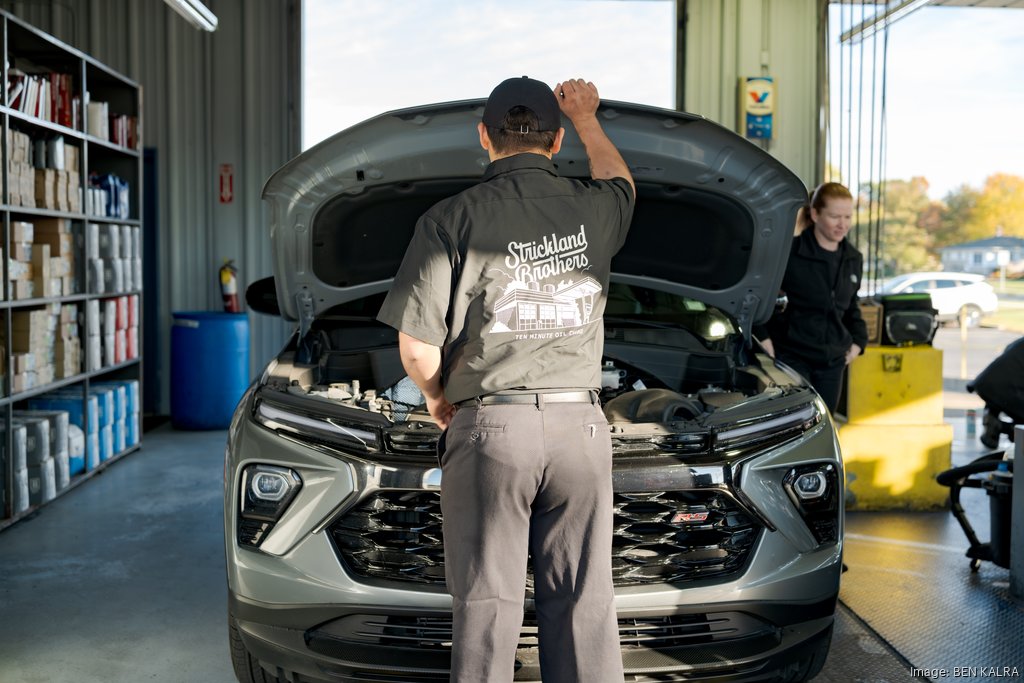
The core menu includes economy, full-synthetic, premium high-mileage, diesel, and selected Valvoline oil options. A complimentary courtesy check covers exterior lights, engine and cabin air filters, windshield-washer and power-steering fluid, tire pressure, and wiper blades. Some locations add state or emissions inspections and tire rotations. Wipers, filters, and additives can be handled while the car is already in the bay. The boundary matters: Strickland Brothers is quick maintenance, not an everything-garage with a transmission rebuild blocking lane two.
The ten-minute choreography
No appointment
Keys stay with you
Work made visible
Errand contained
First, the banks said no
The company’s origin has more grease under its fingernails than the average franchise pitch. Strickland started as a technician under Mark Agan in 2010. Two years later, they bought a gas station in Welcome, North Carolina, and struggled to keep it afloat while Strickland kept aiming at a quick-lube shop. Lenders and investors repeatedly rejected him. That was the first failure - not a clever product flop, but the old-fashioned inability to get financed.
His grandfather, known as PawPaw, changed the answer. He borrowed against the family home and surprised Strickland with a $35,000 check. Strickland and Agan opened Taterbugs Drive Thru Oil Change in Greensboro in October 2012, naming it after Strickland’s son Tate. They later sold the gas station, concentrated on quick lube, and sold Taterbugs to pursue a larger brand. In December 2016, the first Strickland Brothers shop opened in Thomasville. The name combined Tate with his younger brother, Beckett.
We’re building for the long term.Justin Strickland, founder and CEO
What changed Strickland’s mind was evidence gathered at ground level. The gas station was broad and difficult; quick lube was focused and repeatable. Taterbugs showed that the drive-thru format could carry a friendlier customer experience. The second Strickland Brothers shop did not open until May 2018, in King, North Carolina. Then came a wonderfully specific internal target: “Road to Thirty,” or 30 communities within 36 months. The company finished 2019 with 13 locations, 2020 with 24, and 2021 with more than 60.
Three engines, one brand
Strickland Brothers expands in three ways. It builds and operates corporate stores, sells franchises, and acquires existing chains that can be converted or folded into the platform. The blend is faster than relying on any one route. Corporate sites provide control and operating data. Franchisees contribute local capital and attention. Acquisitions provide immediate locations, employees, leases, and customer traffic.
The company began franchising in 2020. A strategic investment from Princeton Equity Group followed in May 2021; the amount was not disclosed, and Strickland stayed in charge. In 2022 the company acquired Trademark Car Wash and Quick Shine Car Wash. In 2023 it bought 24 Snappy Lube locations in North Carolina, taking the quick-lube footprint past 200. In 2025 it acquired Iowa-based LOF Xpress. The pattern is clear: do not wait for every perfect corner to become available when a local operator already owns the corners.
At company-operated stores, revenue comes from oil changes and add-on maintenance. On the franchise side, the franchisor collects an initial fee and a percentage of gross sales. A summary of the 2024 franchise disclosure document put the full-development investment at roughly $247,900 to $391,900, with a $54,900 initial franchise fee, a 6 percent royalty, and a 2 percent brand-fund contribution. Those figures can change, which is why any buyer should read the current disclosure document rather than an enthusiastic listing page.
Fleet accounts add a quieter recurring-revenue layer. An account can begin with three vehicles. Published discounts rise from 10 percent for fleets of three to 14 vehicles to 25 percent for 50 or more. The customer is no longer just a person late for dinner; it may be a plumber with six vans or a regional operator with dozens. The same fast bay that saves an individual an hour can preserve billable time across an entire fleet.
The expensive version of the family bet
In January 2026, Strickland Brothers closed a $360 million committed financing provided by Golub Capital and Audax Strategic Capital. Piper Sandler advised on the transaction. The money was described as support for acquisition activity and continued national expansion. It is not a public valuation, and it should not be mistaken for revenue or cash already spent. It is capacity - a much larger balance sheet for buying, building, and integrating shops.
By July, the company said it expected to open or acquire nearly 80 corporate locations during 2026 after averaging more than 50 new-shop openings annually over the previous five years. It also added a chief financial officer, a chief administrative and strategy officer, and a senior vice president of marketing. That is what changes when a founder’s story moves from one risky check to institutional capital: the main danger is no longer getting started. It is preserving the service promise while dozens of new teams learn it at once.
The constraint nobody can finance away
Ten minutes is an operating discipline, not a slogan.
A location needs the right traffic, bay layout, staffing, training, parts availability, and vehicle mix. Add too much mechanical work and the queue slows. Miss a filter, strip a drain plug, or pressure a customer and speed becomes evidence against you.
What an operator can steal
The copyable lessons are useful beyond automotive service. None requires a $360 million facility. Most require the less glamorous habit of watching where a customer loses minutes, confidence, or patience.
- Sell one measurable promise. “Ten minute” is clearer than “convenient.” A customer can repeat it, test it, and organize a day around it.
- Remove the handoff. Letting drivers stay in the car cuts a waiting-room step, keeps possessions nearby, and reduces the strange feeling of losing control of the vehicle.
- Make invisible work visible. Calling out checks and showing filters turns trust from marketing language into observable behavior.
- Bundle adjacent value without changing the job. Courtesy checks, wipers, filters, and fleet billing increase usefulness while preserving bay speed.
- Give culture a physical prop. A PawPaw bench outside each shop does more memory work than a values PDF buried in an employee portal.
Where the machine can stall
This model is not universal. It works best where enough drivers pass a visible, easy-in-and-out site; where rent and construction costs fit the number of cars a bay can serve; and where technicians can be recruited and trained to perform a narrow process consistently. It weakens in low-traffic markets, in expensive real-estate corridors without sufficient volume, or when the local vehicle mix regularly needs work that cannot fit the fast-service window.
The promise also creates its own trap. A customer may forgive an ordinary garage for taking 35 minutes. A chain with “10 Minute” in the name has put a stopwatch in the customer’s hand. Busy queues, inspections, hard-to-access filters, missing parts, and staff turnover can all bend the clock. Speed cannot excuse an error on an engine. The format works only when managers protect process quality as aggressively as throughput.
Then there is competition. Take 5 already offers a stay-in-your-car format. Valvoline Instant Oil Change and Jiffy Lube have larger networks and deep awareness. Grease Monkey, SpeeDee, Express Oil Change, dealerships, local garages, and do-it-yourself service crowd the alternatives. Strickland Brothers’ difference is therefore a bundle, not a patent: an explicit ten-minute promise, visible work, no appointment, a limited service menu, friendly scripts, and a family story reinforced at store level.
A boring business, carefully un-bored
Strickland Brothers has collected recognizable milestones: five consecutive appearances on the Inc. 5000 by 2025, a No. 16 place on the Franchise Times Fast & Serious list, and a CoStar Impact Award for a Greensboro flagship designed as both a high-throughput shop and corporate training facility. It has also attached the brand to its hometown through Wake Forest scholarships, athletics sponsorships, and a 2025 effort with Wake Forest and Atrium Health Levine Children’s Brenner Children’s Hospital that raised $12,745 for childhood cancer research.
Those programs help explain the company’s preferred word, “community,” but the stronger proof remains operational. Every location has to turn a recurring maintenance obligation into a calm ten-minute encounter. Every new acquisition has to learn the same rhythm. Every franchisee has to resist the temptation to turn a tight menu into a cluttered garage. Capital buys more bays. It does not make them trustworthy.
The enduring lesson begins with that $35,000 check. PawPaw did not fund a technological breakthrough. He funded a focused service business whose founder understood the work from beneath the hood. Strickland then changed the container around the job: no booking, no key surrender, no mysterious back room, no afternoon lost. The result is not glamorous. That is exactly why it is instructive. Millions of customers do not need automotive theater. They need fresh oil and the rest of their day.