There is a good chance you have bought something from Driven Brands without ever saying its name. You might have stayed behind the wheel at Take 5 while technicians changed the oil. You might have left a dented door with Maaco or CARSTAR, a cracked windshield with Auto Glass Now, or a complaining set of brakes with Meineke. The shop sign is the protagonist. Driven Brands is the stage machinery.
From Charlotte, North Carolina, the public company coordinates a portfolio spanning oil changes, mechanical maintenance, paint, collision work, glass, aftermarket parts and shop training. At the end of March 2026, its network contained 4,281 locations across the United States and Canada. The company says those locations service tens of millions of vehicles a year. The scale is visible on a map, but its more interesting advantage sits backstage: separate brands share procurement, marketing, consumer research, technology, training, fleet relationships and operating expertise.
A portfolio built around an inconvenient truth
Cars are durable, expensive and needy. Drivers can postpone a cosmetic repair, but they cannot indefinitely ignore worn brakes, old oil or a windshield that blocks the view. The work is also stubbornly local. Nobody ships a sedan across the country for a routine service, and trust is often attached to a nearby operator. Those conditions have kept the automotive aftermarket fragmented. Driven Brands estimates that small chains and independent shops account for roughly 80 percent of the market.
That fragmentation is the opening. A local shop may understand its customers, but it cannot easily buy media, parts, software or training at national scale. A fleet manager or insurer, meanwhile, does not want to negotiate from scratch in every city. Driven Brands gives the local operator a familiar banner and a larger back office, then gives commercial buyers a network broad enough to be useful.
The portfolio's roots are older than the platform. Sam Meineke opened his first muffler shop in San Antonio in 1972. That same year, Tony Martino opened the first Maaco in Wilmington, Delaware. The modern holding-company idea arrived in 2006, when Meineke's parent became Driven Brands. Roark Capital acquired it in 2015, and a rapid acquisition period followed: 1-800-Radiator & A/C and CARSTAR that year, then Take 5 Oil Change in 2016, with collision and glass brands added later. Driven Brands reached the public market in January 2021.
Car care is local at the counter and scalable everywhere the customer cannot see.
The operating system beneath the shop
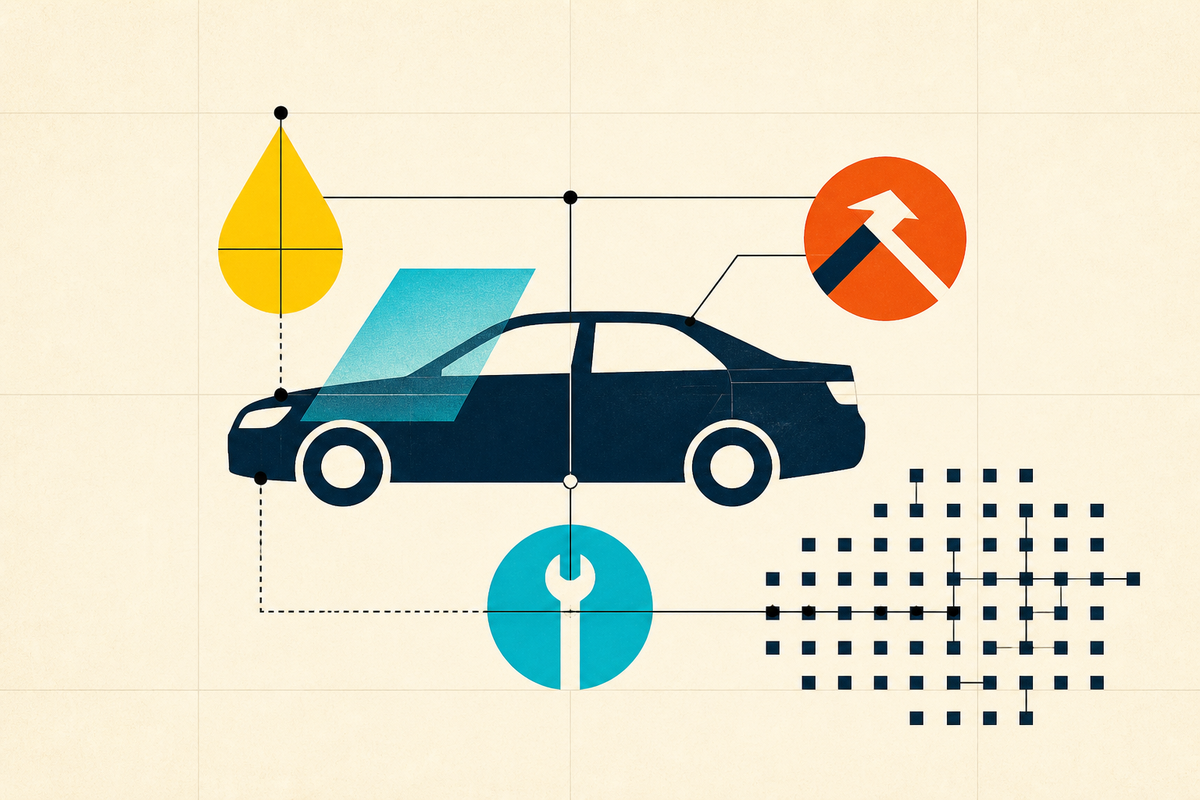
Calling Driven Brands an operating system is an analogy, but a useful one. The individual brands are applications designed for different jobs. Take 5 promises speed. Meineke covers maintenance and mechanical repair. Maaco and CARSTAR handle paint and collision. Auto Glass Now serves retail drivers, fleets and insurers. 1-800-Radiator & A/C distributes parts to repair facilities. The Automotive Training Institute helps shop owners improve the business around the repair.
The shared-services loop
platform
The central layer can turn size into practical leverage. Vendor negotiations can lower input costs. National marketing can create demand that one franchisee could not afford. Shared customer data can reveal when a driver is likely to return. Fleet and insurance relationships can send work into the network. DrivenAdvantage, a B2B ecommerce platform, extends the model into a shop's supply purchasing. Driven Fleet packages several categories into a single commercial relationship.
For franchisees, the bargain is recognizable: put up local capital and run the location, while the parent supplies a brand, playbooks and support. Driven Brands says it can help with site selection, lease negotiation, construction and equipment installation for applicable concepts. The franchise owner keeps local accountability; the platform makes the shop less alone.
The cleverest product may be ten minutes
Take 5 is the clearest demonstration of how a mundane service can be redesigned. The oil is not novel. The choreography is. Customers remain in the car while a team checks fluids, tire pressure and the filter, typically finishing the oil change in about 10 minutes. The format removes the waiting-room handoff and makes the promise easy to understand: change the oil, not the schedule.
That clarity has made Take 5 the portfolio's growth engine. It passed 500 franchise shops during 2025, after more than doubling its Northeast footprint in two years. By the first quarter of 2026, the broader Take 5 segment had 1,371 locations. Same-store sales rose 4.5 percent, its 23rd consecutive quarter of growth. The format also offers an internal career narrative - "Pit Tech to President" - that the company uses to describe advancement from the bay to ownership or leadership.
How the money moves
Driven Brands is neither a pure franchisor nor a conventional retailer. Company-operated stores record the customer's purchase as revenue. Franchised locations generate royalties, fees and advertising contributions, while supplies, parts, ecommerce, training and other services add more streams. The distinction explains why fiscal 2025 system-wide sales of $6.1 billion were much larger than the company's $1.9 billion of reported revenue. Most customer spending in a franchised system belongs first to the local operator.
The model also serves several customers at once. Drivers want convenience, competent work and a price they can understand. Franchisees want attractive unit economics and support that earns its fee. Fleets and insurers want coverage, consistency and fewer vendor relationships. Independent shops want parts in stock and advice that improves throughput. These interests can reinforce one another, but only if the shared platform produces measurable value.
Competitors attack by category. Jiffy Lube and Valvoline Instant Oil Change contest quick lube. Safelite is the obvious glass alternative. Caliber and Gerber compete in collision. Monro, Mavis, dealerships and thousands of independents fight for repair and maintenance. Few rivals stretch across as many service categories. Driven Brands' differentiation is breadth plus a common infrastructure, though breadth can become bureaucracy when the center stops helping the bay.
A narrower company after years of adding
The latest chapter is subtraction. Driven Brands sold its U.S. car-wash business for $385 million in April 2025, then completed the sale of international car-wash operator IMO for approximately €411 million in January 2026. The proceeds primarily reduced debt. Reporting now centers on three segments: Take 5, Franchise Brands and Auto Glass Now. Management's priorities are similarly concise - scale Take 5, produce stable franchise cash flow and reduce leverage.
The cleanup has a financial-reporting side as well. In May 2026 the company completed restatements covering 2023, 2024 and several interim periods, primarily for errors involving leases, cash, payables, expense classification and receivables. Management said the corrections did not reflect a substantive change in operations, while also committing to stronger internal controls. For a platform selling reliability, dependable accounting is part of the product whether the driver sees it or not.
Meineke and Maaco open
Two separate founders establish the oldest roots in today's portfolio.
The platform gets a name
Meineke's parent becomes Driven Brands and pursues a multi-brand model.
Roark, CARSTAR and Take 5
New ownership and acquisitions widen the company across parts, collision and quick lube.
Nasdaq debut
Driven Brands prices its public offering at $22 per share.
The wash exits
Two car-wash sales narrow the portfolio and help reduce leverage.
Where the machine goes next
The market position is easy to state and difficult to defend. Driven Brands sits between the independent garage and the single-category national chain. It wants the local relevance of the former, the consistency of the latter and purchasing leverage larger than either. The opportunity remains large because the market is fragmented and vehicles keep aging. The operational test is whether each extra location makes the network more useful, rather than simply harder to govern.
For customers, the practical benefit is choice wrapped in familiarity: fast maintenance, mechanical repair, glass or collision work in more places. For operators, it is a way to enter or expand in auto service with systems already assembled. For commercial buyers, it is access to multiple needs through a broad network. And for anyone studying business design, the lesson is portable: a portfolio earns its complexity only when the invisible layer makes every visible brand better.