A bronze elephant offers an unexpectedly good way into Steven Maksin’s story. For decades, Petal stood inside New Jersey’s Burlington Center Mall, carrying a laughing child on its back. The shopping center eventually closed. The elephant, happily less dependent on retail foot traffic than its surroundings, found another address. Steven and Natalie Maksin donated the sculpture for public display; its permanent home became Burlington Riverwalk.
There is something appealing about that small survival. A familiar object escaped the fate of the building around it. People could still visit it without having to revive an entire department-store economy first. For a real estate investor whose work involves distressed properties, it is also an unusually accessible illustration of a much larger question: what deserves to stay, and what needs to change?
Maksin, the founder and chief executive of Moonbeam Capital Investments, works in the space between those decisions. He also collects paintings and antique firearms, lending objects to museums. Across those activities runs a recurring interest in things with an earlier life. Their next chapter, however, requires more than an owner’s enthusiasm. A building needs occupants. A painting needs careful attribution. An object on loan needs an audience.
Brooklyn before the balance sheet
Maksin was born in Kyiv, Ukraine, and arrived in the United States in 1989 at 21. At Kingsborough Community College, he had limited English and limited financial resources. He studied liberal arts and graduated in 1992. New York University’s Stern School of Business followed in 1994, then a law degree at Cardozo in 2000 and an NYU master’s in taxation in 2002.
That sequence contains more movement than the familiar shorthand of an immigrant success story can comfortably hold. Community college, business school, law school, tax specialization: each qualification added a different way of reading an opportunity. The finished résumé looks orderly. The starting point was a student learning his way through an unfamiliar education system.
Stern also brought a personal connection. He met Natalie there as an undergraduate; they subsequently attended Cardozo. She became a lawyer and later Moonbeam’s chief legal officer. Their shared academic path became part of the business’s working structure. Maksin once put his attachment to their first American neighborhood simply: “Brooklyn is our lovely home.”
His later relationship with Kingsborough took a practical form. The Steven V. Maksin Endowed Scholarship remains listed by the college, with an award of $500 for qualifying students who demonstrate financial need, hold a 3.0 GPA and have earned 15 to 40 credits. A modest number can carry a very specific purpose when the recipient is trying to stay enrolled.
The scholarship’s criteria are worth pausing over. They focus on students already moving through college, with enough credits to show progress and more work still ahead. Education, in this arrangement, is an ongoing expense. The gift meets someone in the middle of the journey that Maksin himself began at the same institution.
- 1992Kingsborough
Liberal arts - 1994NYU Stern
Business - 2000Cardozo
Law - 2002NYU Law
Taxation
The lawyer inside the property investor
Before Moonbeam, Maksin worked in tax and business advisory roles. His company biography places him at PricewaterhouseCoopers from 1994 through 2002. He went on to practice through Maksin Legal Group and Maksin & Maksin, CPAs. The combination matters because distressed real estate comes with obligations as well as square footage.
His legal practice covers federal income tax planning, real estate acquisitions and sales, joint ventures, financing structures and tax disputes. These are the mechanics behind a purchase that can look deceptively simple from the street. The buyer may see an empty building; the transaction also contains contracts, ownership arrangements and claims that must be understood.
Moonbeam describes its objective as long-term capital appreciation through American real estate. Its remit includes non-performing properties and loans secured by real estate. In plain language, that means examining situations where an asset or its financing has stopped working as intended, then deciding whether a different arrangement can make it viable.
His executive responsibilities include acquisitions, redevelopment, property management and relationships with investors and financial institutions. That is a broad brief, but its pieces are connected. Buying cheaply is one decision. Finding the capital, permissions and occupants for the next use involves a succession of others. Each can change the outcome.
Maksin’s academic connection continues at NYU Stern, which lists him on its real estate advisory board as Moonbeam’s founder and CEO. It places the practitioner back in a setting where the questions can be examined beyond a single transaction: how capital, property and the people around a site fit together.
A mall with business to attend to
At West Oaks Mall in Ocoee, Florida, a different tenant mix made Maksin’s approach tangible. In a 2019 industry interview, he discussed bringing services and alternative uses into shopping centers, including colleges, police academies and creative offices. Restaurants and entertainment could be part of the mix, but he argued for a wider range of reasons to visit.
The same account described a 35,000-square-foot Bed Bath & Beyond e-commerce call center at West Oaks, alongside a Xerox customer service center. The irony is rather good: a building associated with shopping in person made room for work supporting shopping online. The practical point was a change in what the space could accommodate.
Another 2019 announcement set out the Orange County tax collector’s move to West Oaks. The new branch measured roughly 36,000 square feet and was due to open on January 16. It combined public-facing services with call-center and processing functions. The announcement described more than 20 new jobs and space for 100 employees.
A motor vehicle office supplies a very different errand from browsing a sale rack. Its visitors arrive with something to accomplish. That change in purpose helps explain why the tenant mix interests Maksin: the shopping center’s usefulness can extend beyond the original reason it was built.
There is a comic dignity to the idea of going to the mall for paperwork. The glamour has moved elsewhere; the parking is still useful. Yet the example carries a serious distinction. A reuse becomes concrete when an occupant has a function, a location and an opening date. The concept then has somewhere to report for work.
Separate spaces and occupants. Figures are historical, not current leasing totals.
The distance between a plan and a place
Other properties show how difficult the transition can be. At Gwinnett Place Mall in Georgia, Maksin faced questions in 2017 about redevelopment timing after earlier expectations had slipped. The discussion concerned a property whose future had been promised more readily than scheduled. For neighboring residents and businesses, the wait was part of the experience.
His response included a film reference: “I’m not your best friend. I’m your only friend.” The line comes from Other People’s Money. It is a sharp choice for a property investor addressing doubters, with a touch of theatrical confidence and a rather chilly view of the available alternatives.
Such exchanges expose the tension inside a turnaround. An investor can see a possible future while a community continues to live beside the present building. The two views do not share a clock. A redevelopment argument has to survive the time between announcement and occupation, when promises are easier to inspect than progress.
The record around Moonbeam also includes tax disputes and scrutiny of deteriorating mall properties. In November 2020, ShoppingTown Mall NY LLC announced an agreement in principle with local public bodies to resolve tax claims and other disputes, subject to a definitive agreement and bankruptcy-court approval. Moonbeam Leasing & Management assisted with negotiations; the announcement distinguished the property owner from Moonbeam’s management and parent companies.
That distinction became central in litigation over Century III Mall coverage. Maksin and Moonbeam filed a federal lawsuit against Pittsburgh-area media defendants in December 2024. They challenged statements about the relationship between Moonbeam and the mall, including a report that criminal charges had been filed against Moonbeam.
In December 2025, a judge allowed Moonbeam’s claim concerning that statement in the original WESA article to proceed, while dismissing the claim concerning the corrected version. The ruling addressed whether the claim could continue at that stage, rather than delivering a final verdict on liability. The exact entity named in a report mattered.
The lesson for reading Maksin’s career is precision. A company, its manager and a property-owning entity have distinct roles. Redevelopment plans also need to be separated from completed uses. The public stakes remain plain enough: communities want buildings that function, and accurate accounts of who is responsible for them.
A different kind of public display
In a photograph published with a 2026 account of his collecting, Maksin stands beside a large framed Mary Magdalene in Ecstasy. He wears an orange jacket; the painting occupies most of the wall. The picture offers a change of scale from a mall redevelopment, but another question of value is present.
The work belongs to the Maksin family collection and has been advanced as a Caravaggio. That attribution remains debated. A collector’s belief, an exhibition history and an accepted attribution are different things. The uncertainty is part of the object’s story, rather than a detail that a grand frame can settle.
Other parts of his museum involvement have a particularly concrete public record. The Metropolitan Museum of Art lists a Winchester Model 1866 rifle, made in 1870 and presented to the Spanish diplomat Guillermo Crespo, on loan courtesy of Steven V. Maksin. Its decoration includes gilt work and engraving by Louis Daniel Nimschke, a German-born craftsman who worked in New York.
The Met also credits Maksin alongside Ronald S. Lauder, Alejandro Santo Domingo and Arthur Ochs Sulzberger Gifts in its 2021 acquisition of an elaborately decorated 1869 Smith & Wesson revolver. The piece retains its original case and dummy rounds, details consistent with its intended role as a display object.
Here the attraction is craftsmanship: engraving, precious materials, the survival of a case, the trace of a recipient. These objects ask visitors to consider the hands and circumstances behind their manufacture. They move a collecting interest out of private possession and into a setting where other people can inspect it.
Maksin has compared art to flight: “It is like having wings.” It is a more expansive register than tax planning, although both interests require attention to particulars. With a historical object, dates and provenance become part of what one is buying and sharing.
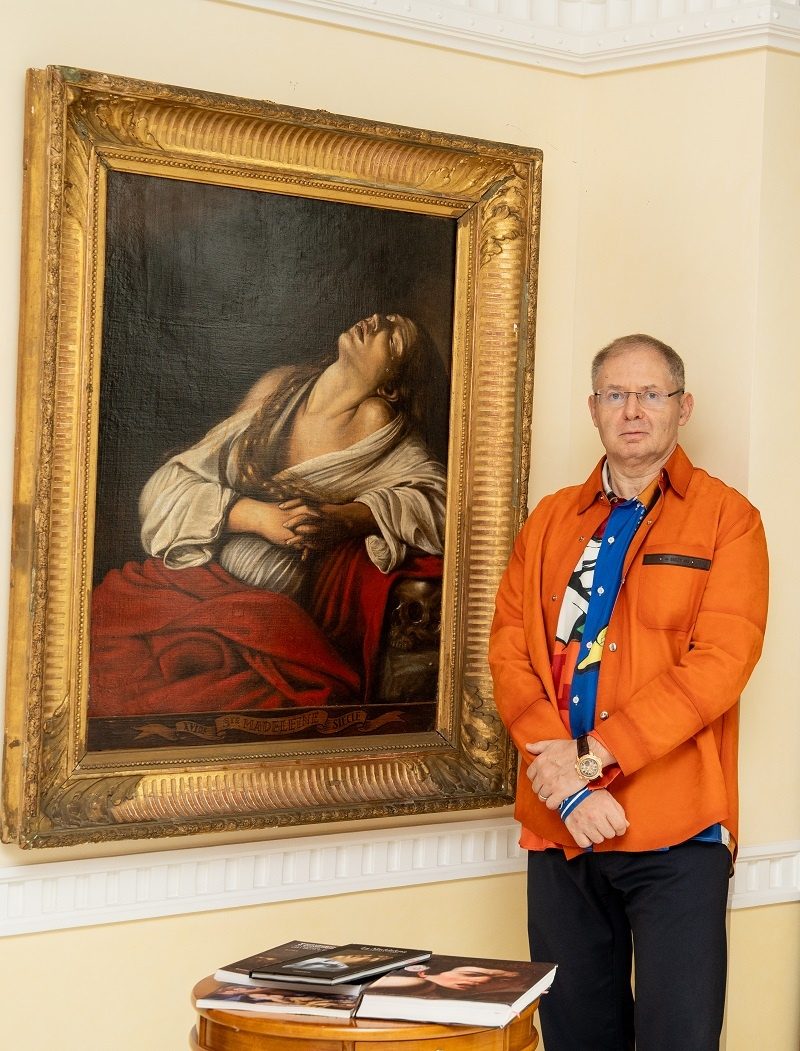
“It is like having wings.”
Steven Maksin, 2026
What remains within reach
Petal, the elephant, brings the story back down to earth. Its relocation was one small part of the former Burlington Center’s change into The Crossings, a redevelopment involving Clarion Partners and MRP Industrial with Moonbeam’s assistance. The larger project had a different set of buildings and uses to organize. The sculpture could simply keep being itself.
There are several measures of value across Maksin’s life: qualifications earned, property put to use, money made, students supported, objects available to visitors. They resist being compressed into one triumphant number. A scholarship and a mall have different obligations. A museum loan asks something different again.
His career is most interesting where those measures meet the public. Someone receives help with college costs. Someone visits a government office in a former retail setting. Someone stops in front of an engraved object. Someone recognizes an elephant from an old shopping trip. At those moments, the second life of a thing becomes an experience another person can have.
Continue exploring
- Moonbeam Capital
- Steven Maksin on LinkedIn
- The 2019 alternative-use interview
- Kingsborough’s alumni portrait
- The scholarship at Kingsborough
- The Met: Winchester loan
- The Met: 1869 revolver acquisition
- The December 2025 court opinion
- Gwinnett Place reporting, 2017
- Collecting profile, 2026 (sponsored)
- The Crossings redevelopment, 2024