Consider the surgical instrument after the operation. Its moment in the spotlight is over. Yet before it can return to another patient, it becomes somebody else’s problem: something to clean, inspect, perhaps repair, package, process and account for. STERIS has built its business around that interval. The interesting question is how much of healthcare depends on getting the interval right.
- STERIS sells readiness: equipment, chemistry, repair and processing services.
- Services and consumables generated roughly 79% of fiscal 2026 revenue.
- Its next commitments include a $600 million chemistry campus and a pending surgical products acquisition.
Its catalog wanders from surgical tables to detergents, endoscope accessories to laboratory testing. That breadth can look untidy until you follow the instrument instead of the product list. Hospitals need usable tools. Device manufacturers need a validated route to sterile products. Pharmaceutical plants need contamination control. STERIS meets these customers at several points along the same demanding journey.
The instrument that could not take the heat
The founding problem was wonderfully specific. In the 1980s, minimally invasive procedures were creating demand for heat-sensitive instruments, including endoscopes. Steam could damage those devices. Gas processing took considerable time. Microbiologist Raymond Kralovic conceived a low-temperature liquid sterilization process and founded Innovative Medical Technologies in Mentor, Ohio, in 1985.
There were five employees. In 1987, Bill Sanford secured $1.2 million in financing, became president and CEO, and renamed the company STERIS. The first SYSTEM 1 unit shipped in 1988. Those details matter because they locate the invention inside a practical constraint. A changing surgical technique had created a processing problem. Solving it gave the young business somewhere useful to stand.
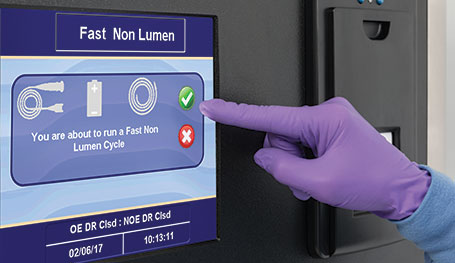
Sixteen minutes is only part of the answer
Today, the V-PRO maX 2 uses vaporized hydrogen peroxide for compatible medical devices. Its fast non-lumen cycle can process an eligible load in 16 minutes. That sounds like a simple promise until you read the conditions: properly cleaned, rinsed and dried devices, specified packaging, compatible materials and load limits. The fast cycle’s maximum load is 11 pounds. Other loads require other cycles.
This is where STERIS’s expertise becomes tangible. The company supplies sterilants, indicators, packaging and supporting equipment around the processor. Its compatibility matrix helps users check devices. A machine’s cycle time is useful information, but choosing the appropriate process and preparing the load remain part of the job. The instruction manual is doing real work here.
- 01Clean
- 02Inspect + prepare
- 03Process
- 04Document + release
The machine is the beginning of the relationship
STERIS’s economics make more sense once you stop picturing a showroom. In fiscal 2026, services brought in $2.876 billion, consumables $1.808 billion, and capital equipment $1.252 billion. Equipment represented about a fifth of revenue. The things customers replenish and the work they commission supplied the rest. Total continuing-operations revenue reached $5.936 billion.
That mix connects a purchase to an ongoing workload. Equipment needs maintenance. Reusable instruments need repair. Processing consumes chemistry and monitoring products. STERIS also offers outsourced reprocessing, training and consulting. Its stated mission is to help customers create a healthier and safer world. The commercial mechanism is considerably more concrete: support the tasks that keep coming back.
- Services
- 48.4%
- Consumables
- 30.5%
- Equipment
- 21.1%
Software extends that relationship into the record of the work. SPM tracks instruments and their status, guides configurable workflows and stores processing documentation. Its interfaces include equipment and surgery scheduling systems. This makes the business partly about coordination: knowing which instrument is where, what has happened to it, and whether it will be ready for a procedure.
One problem, several kinds of customer
The company reports three segments. Healthcare serves sterile processing departments and procedural areas. Applied Sterilization Technologies, or AST, handles contract processing for manufacturers. Life Sciences supplies contamination control products, equipment and services for pharmaceutical and related environments. A hospital reprocessing an instrument and a manufacturer preparing packaged devices need different facilities, but both require a process they can substantiate.
AST’s options include gamma, electron beam, X-ray and ethylene oxide, among other technologies. Selection depends on product design, materials and packaging. Life Sciences adds pharmaceutical detergents and biodecontamination equipment. The range helps explain STERIS’s position: it can address several related requirements within an organization, rather than offer only one processing technology.
There are capable alternatives. Getinge supplies hospital steam sterilizers; Advanced Sterilization Products offers STERRAD low-temperature systems. STERIS’s breadth is useful when a buyer wants connected services and products. It does not eliminate the need to compare compatibility, local support and workflow fit. A broad catalog cannot make an unsuitable cycle suitable.
The clearance problem that demanded a transition
The SYSTEM 1 history supplies a necessary complication. In 2009, the FDA advised facilities to move to acceptable alternatives after manufacturer modifications had not received approval or clearance. A 2010 consent decree restricted U.S. processor sales and formalized a customer transition and rebate program. Here, the consequential failure concerned regulatory clearance for changes to the system.
The agreement changed what the company could sell and how it could support users. It also exposes the limit of a tidy business lesson. Medical equipment cannot be treated as an ordinary product that improves through informal iteration. Changes, evidence, clearance and customer continuity belong together. The original insight may be clever; maintaining permission to use it is continuing work.
“Our first quarter results reflected stable underlying demand”
Dan Carestio, President and CEO / August 2026
The next bet is chemistry
In August 2026, STERIS announced a planned $600 million formulated chemistries campus in North Carolina. The company expects phased operations to begin in two to three years, starting with distribution. Manufacturing and distribution would move from existing facilities in Missouri and Minnesota. Its stated reasoning was capacity, innovation and a better manufacturing network after analyzing facilities and customer demand.
Then, on October 12, it announced an agreement to buy Xodus Medical for $2.1 billion at closing, with a possible additional earnout. The deal, expected to close by December 31 subject to conditions, would expand operating room consumables. For other businesses, the copyable idea is to follow a recurring customer task into its adjacent problems. For STERIS, that means chemistry, instruments, records and service - all the work waiting between one patient and the next.