Stephen Phillips spent years helping people find music. Then he began building ways for them to make it. Between those two ambitions sits a rather awkward question: when software can supply the notes, what does a musician still want to do? His answer has increasingly involved a stage, an audience and the pleasure of having something to show your friends.
That question follows him from We Are Hunted, the music discovery service acquired by Twitter, to Splash, the Brisbane company he founded and later chaired. A chart puts someone else's song in front of you. A music game invites you to step into the picture. Phillips has worked on both sides of that invitation, with enough abandoned experiments along the way to spoil any tidy tale of a master plan.
A computer among the cattle
He grew up on a cattle property in far northern Australia, with horses, pigs and a father who liked assembling and repairing things. Around the age of ten, Phillips started programming on a VIC-20 his father had fixed. Commodore 64, Amiga, PCs and Macs followed. The machines changed; the activity stuck.
By 1991 or 1992, programming was earning him a living. His working life took him through software development and agency websites, including front ends, back ends and payment integrations. He had also played guitar in bands in his early twenties. Music and computing occupied the same life before they occupied the same business.
The rural childhood is a useful place to begin, provided it is allowed to remain a childhood rather than a prophecy. A repaired computer did not contain a secret blueprint for Splash. It gave him something to work on. Years of making websites then gave him experience of what happens when something you have built has to work for somebody else.
Ninety-nine songs, one small doorway
The business that preceded We Are Hunted was Wotnews, a news search venture backed by Wotif founder Graeme Wood. In 2008 Phillips met Nick Crocker at a Brisbane digital networking event. Their eventual collaboration brought together a music idea and a team already accustomed to finding patterns in online information.
We Are Hunted launched in April 2009. Phillips, Richard Slatter, Michael Doherty and Crocker were part of its founding team. The site watched music discussion across blogs, social networks and other online spaces, then turned those signals into a playable chart. It offered a way to discover what people were talking about before a listener had to know which artist to search for.
Its early interface presented 99 tracks, with images and conspicuous play buttons. The machinery sampled a sprawling conversation; the visitor could simply click a song. That small doorway mattered. Music discovery was made into an activity rather than a report to be studied, which is a merciful concession to anyone who has ever opened a spreadsheet in search of a good chorus.
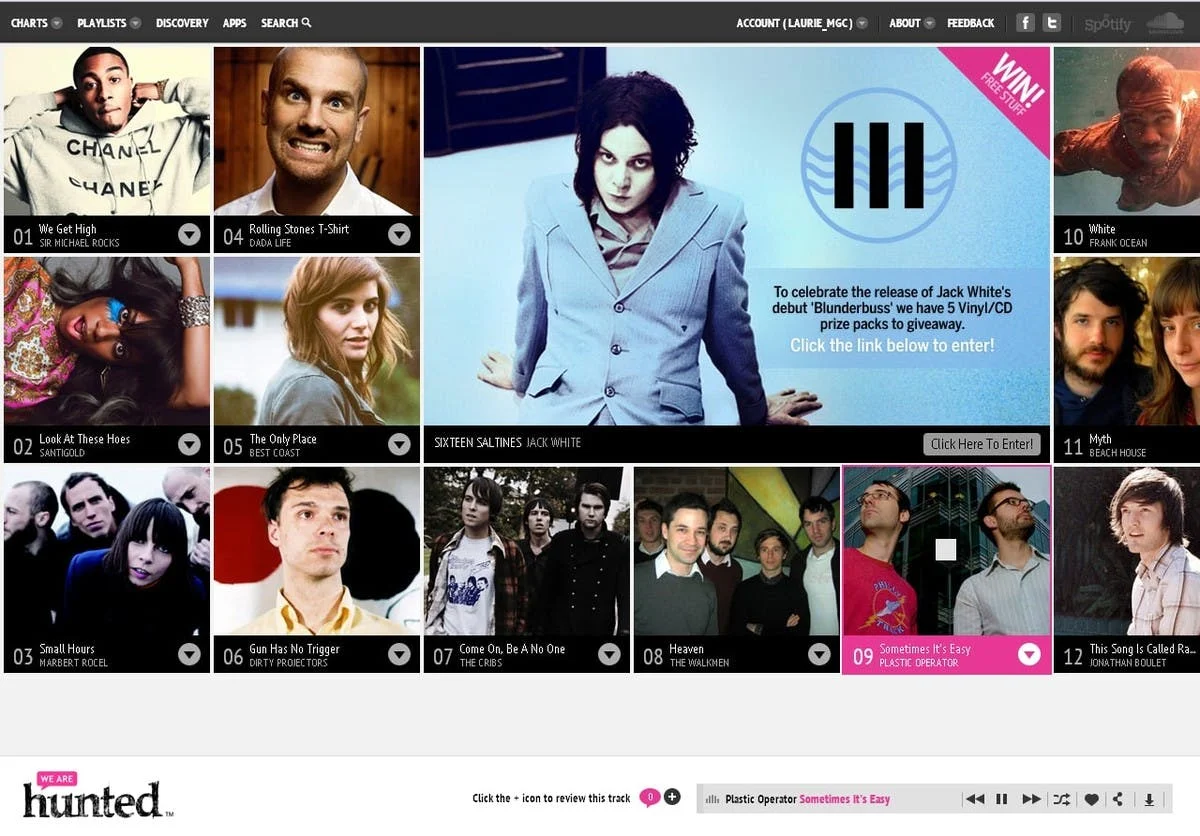
There was a group behind that apparent simplicity. The development team included engineers and designers, with interface work involving Josephmark. Phillips's career is easier to understand when the collaborators stay in the frame: a product is the accumulated work of people who solve different parts of the same problem. The user gets the lovely privilege of ignoring most of it.
Twitter bought the team. The story kept moving.
Twitter's acquisition became public in April 2013, following a deal dated to 2012 in later accounts. The purchase price was not disclosed. We Are Hunted closed its own service, and its technology and team became part of Twitter's music effort. Phillips worked in San Francisco. An Australian discovery project had acquired a much larger corporate address.
Twitter #Music also had a web version in development. Phillips worked with design studio Twofold on prototypes that pulled together artist-related tweets, videos, audio and Vines. There were proposed artist pages and streams of trending music information. The site would have gathered the conversation around musicians into somewhere fans could explore it.
That website never launched. The idea was dropped in late 2013 as Twitter concentrated on music and audio within its stream; the separate app was subsequently withdrawn. By the summer of 2014, Phillips had left and started Wonder.fm, using SoundCloud activity to surface emerging artists.
An acquisition can make a career look like a straight line because the transaction supplies such a convenient full stop. Here it is closer to a comma. Twitter bought We Are Hunted, but the next product did not become a permanent fixture. Phillips went back to discovery, still looking for ways to notice musicians earlier. The corporate chapter changed the scale of his work without settling the question that interested him.
The pitch was a pop hit
Popgun entered the inaugural Techstars Music class in 2017 with Phillips as CEO and Adam Hibble as CTO. The stated ambition was wonderfully testable: produce an original Top 40 hit. A song either gets onto a chart or it doesn't. Compared with the elastic language of technology pitches, it had the charm of an actual finish line.
The accelerator placed the Brisbane founders among eleven startups in Los Angeles, with Demo Day in May. Bob Moczydlowsky, who had worked at Twitter, led the program. Popgun's cohort included companies tackling composition, concert discovery, remixing and audio infrastructure. Music supplied plenty of problems beyond the song itself.
Later that year, Phillips and Moczydlowsky appeared at Sydney's Music Tech Summit before an audience of roughly 120 industry people. The question on the bill was whether AI could create the next hit song. Phillips demonstrated the team's work and described working with the music industry on a resource for artists. He was already taking a technical experiment into rooms where people would ask what they could do with it.
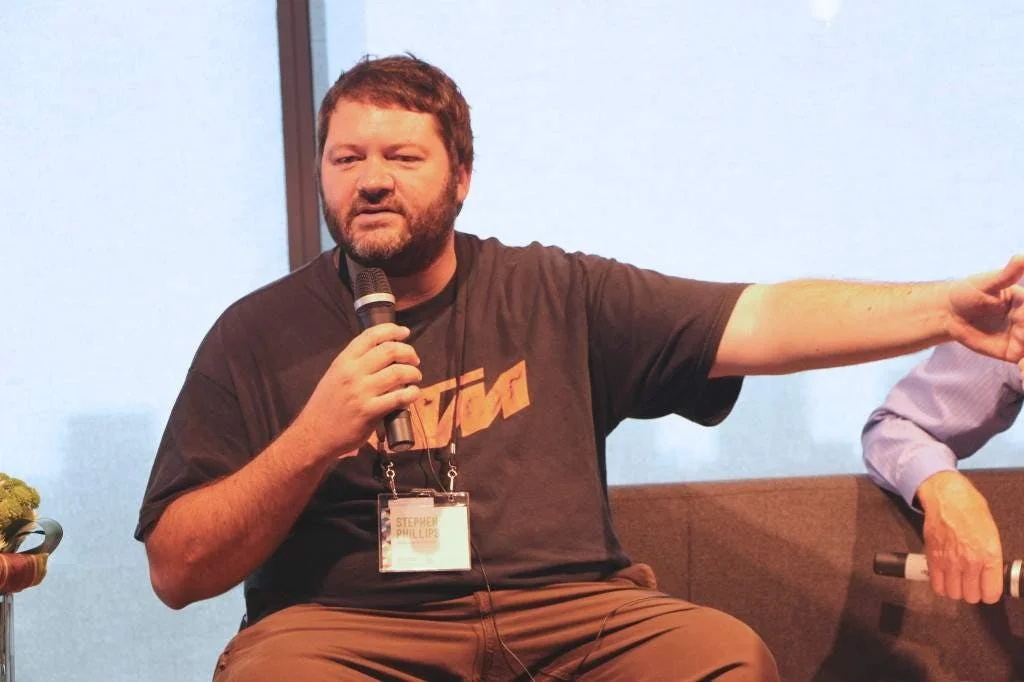
By 2019, his argument had grown beyond the chart pitch. He described the difficulty of turning generative systems into tools people could control, and imagined young creators expressing ideas without first mastering every technical step. “They entertain themselves by being creative,” he said of children growing up with games. That observation makes the later move into Roblox much less surprising.
“They entertain themselves by being creative.”
Stephen Phillips, 2019
A nightclub inside the game
Splash's Roblox game launched in May 2020. Its setting was a virtual nightclub: players could perform from the stage and dance to each other's music. Beats and loops were triggered through virtual pads. The musical ingredients came from the company's AI work, while the players decided how to put them together.
By mid-July that year, the game had recorded more than 8.4 million visits and been favourited by over 178,000 Roblox users. Those are measures of game activity, with their own meaning, rather than a count of recording artists. Still, they show the speed at which a music-making space found visitors once it lived somewhere players already spent time.
The stage gave the interaction a social destination. A person could choose sounds and then perform for peers within the same environment. There was no requirement to finish an album before anybody could listen. The design made room for the smaller pleasure of trying something, showing it and trying again.
Phillips also traced the game's inspiration to watching his daughter enjoying other Roblox experiences. He saw how absorbed and socially engaged she was, and an opening for a music experience. The domestic detail belongs beside the engineering: sometimes a useful product observation happens while somebody else is already having fun.
He was willing to discard ideas. In an account of Splash's development published in 2024, he said he had killed about fifteen products. That record complicates the public sequence of launches. The surviving names are the visible part of a process that also includes prototypes, short experiments and decisions to stop. A founder's enthusiasm has to survive contact with users; sometimes the product doesn't.
Money, instruments and imaginary stars
In November 2021, Splash raised a Series A reported as US$20 million, or about A$27 million. Amazon's Alexa Fund and BITKRAFT Ventures co-led the round, with King River Capital and Khosla Ventures participating. The money was intended for better virtual instruments, more venues, community growth and partnerships across gaming, entertainment and music.
The company described three areas of work: games, composition tools and virtual stars. Kai, its virtual performer, was one expression of the third. Tools could help people compose; games could give them a setting to perform; characters could provide another reason to spend time in that setting. Phillips was building a company around music's surrounding activities as well as its sounds.
Capital raised for Splash's instruments, venues and community.
His ambition included hosting virtual performances that people would actively want to attend. That is a different test from generating an acceptable audio file. A venue needs return visits, shared rituals and people who care about what happens there. More advanced instruments may help, but a crowd has tastes of its own and is seldom impressed by a development roadmap.
A chairman with a product brief
In March 2024, Tracy Chan became Splash's CEO. He arrived after roles at SoundCloud, Twitch, Spotify and YouTube. Phillips moved to chairman. The handover paired the founder's experience building the company with an executive who had spent years working on music platforms and creator products.
Phillips remained involved in product strategy and was to help with Chan's transition. His public welcome emphasised Chan's experience across technology and music, particularly the value created for artists and fans. The change in title therefore leaves a recognisable thread running through his work: how people encounter music, what they can make and where they can share it.
Splash also said its model used a music library created and owned by the company, with music recorded and annotated by an in-house team. The people making those recordings belong in the account of an AI business. Behind a simplified interface are choices about musical material, tools and the work required to prepare them.
Phillips's path offers no single victorious moment that explains everything afterwards. A music chart reached Twitter. A proposed website disappeared. A chart-hit pitch became a company with instruments and game venues. The useful continuity is his interest in making the next action approachable. First, a play button. Later, some musical pads and a stage. The person in front of the screen has somewhere to begin, and somebody else might be listening.