The first problem was the clutch. Before Stenograph became a familiar name in court reporting, Robert Wright was trying to improve a shorthand machine that did not behave itself. He later remembered it as “unreliable and noisy.” The paper feed needed attention. So did the rest of the mechanism. There is something pleasing about a technology business whose origin involves persuading an object to be quiet.
- Stenograph sells writers and software to the people who make verbatim records.
- Its products follow the job from capture through correction to delivery.
- Specialist hardware is a substantial purchase; services add recurring costs.
- Its newest voice-reporting partnership brings speech recognition onto the reporter’s computer.
That mechanical irritation is a useful way into the company. Court reporting rewards attention to details that other people overlook. A key that needs too much force. A name that translates incorrectly. An edit that fails to reach the lawyer’s screen. Each looks small until it interrupts a professional who is already listening, remembering, and writing at once.
A business school helped pay for the machinery
Milton H. Wright founded the business in Chicago in 1938. His son Robert supplied designs and six patents. The company adapted an existing phonetic keyboard rather than asking reporters to abandon everything they had learned. Its 1939 machine was smaller, lighter, and quieter than earlier equipment. Familiar skills acquired a better instrument.
The financing was equally practical. In Robert’s later account, Milton secured $22,500 in preferred stock and $50,000 in firm machine orders. Tooling cost $82,000; borrowing against life insurance helped close the gap. Business schools were involved in backing the venture. Training institutions had a reason to care whether the equipment worked.
The lesson is worth borrowing: find people whose existing work improves when your product improves. Schools needed teachable equipment. Reporters needed dependable equipment. A machine that pleased both had a route into the market. The early design story was about reliability, with invention doing the necessary supporting work.
“The machine was unreliable and noisy.”
Robert Wright, recalling the predecessor machine
The keyboard stayed. The record moved.
Stenograph’s own history identifies the Ireland keyboard as the constant in its writers. Machine shorthand records sounds through combinations of keys, allowing words and phrases to be written in strokes. The operator learns a skill; the machine supports it. Replacing the storage medium is considerably easier than replacing that accumulated fluency.
In 1963, the Data Writer encoded notes onto magnetic tape for computer transcription. The 1987 SmartWriter stored them on DOS-format floppy disks. In 1992, Stentura brought an LCD showing English or steno. Stenograph reports more than 50,000 Stentura machines sold worldwide. The paperless élan Cybra followed in 2001.
tape
floppy
translation
Cybra
Selected product milestones, rather than a claim that every reporter upgraded at once.
This is a particular kind of technological change. The company could offer a new place for the record to live while preserving the reporter’s way of creating it. For any business selling to skilled professionals, that distinction matters. The customer’s expertise is an asset to accommodate. Treating it as an inconvenience is an expensive hobby.
Five thousand dollars, give or take a sale
NexGen, released in April 2024, makes the physical argument for specialist hardware. It offers 13 stroke-depth positions and 19 tension levels. StenographLink connects the writer to support and enables wireless software updates. These are features for somebody who spends a working day touching the same keys, not for somebody browsing a specification sheet over lunch.
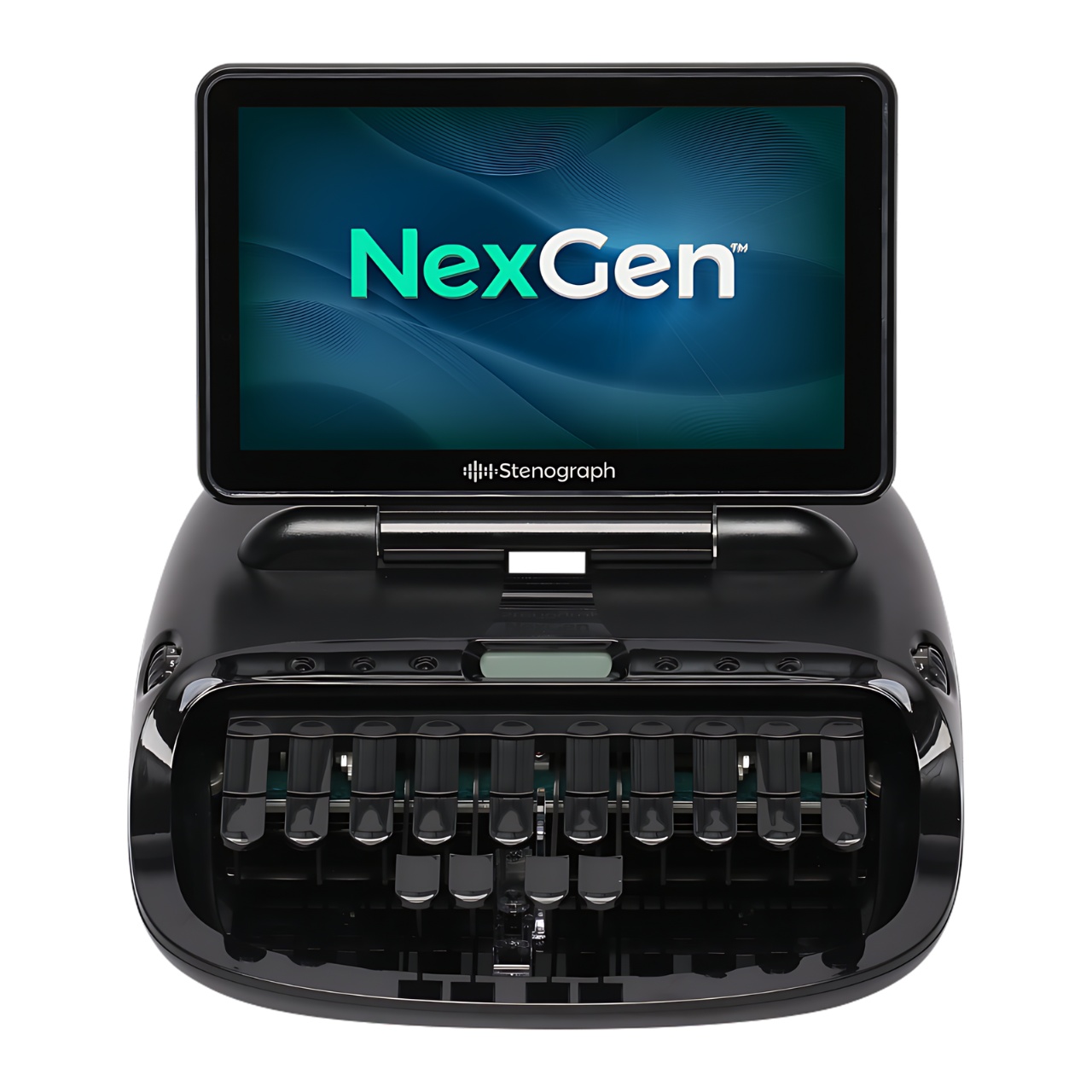
On October 1, 2026, the official store showed the Black and Black model at $4,999, against a $6,299 list price. The sale price is a snapshot, not a permanent promise. Either way, this is a professional equipment decision, with software, service, and other working costs still to consider.
ProCAT’s Xpression is an alternative writer; Advantage Software’s Eclipse competes in transcription software. A sensible comparison begins with a demonstration using the buyer’s actual workflow. Touch, familiar commands, editing habits, and support can matter as much as the advertised feature count. A bargain that forces a skilled person to relearn the day deserves careful arithmetic.
The witness finishes. The work continues.
Stenograph serves court reporters, captioners, CART providers who supply live text access, scopists who edit transcripts, and students. Reporting agencies buy tools for coordinating production. Lawyers and judges can receive the resulting realtime text. These customers occupy different points in the same chain, which helps explain why the product list extends well beyond a writer.
CATalyst handles translation and transcript production. Case Prep identifies terms missing from dictionaries. Hotspots keeps troublesome passages visible. Finish ’em creates delivery files, including protected PDFs with linked exhibits. The attraction is cumulative: fewer little administrative errands between hearing a statement and handing over usable text.
- 01 / CaptureWriter or recorded speech
- 02 / CorrectTranslation and human editing
- 03 / ShareRealtime text for participants
- 04 / DeliverTranscript, video, exhibits
A simplified workflow. The product mix depends on the reporting method.
CaseViewNet handles realtime distribution. Its viewers are free, while the reporter pays for the relevant service: Stenograph lists $360 a year or $30 a month with an Edge plan, with higher pricing without one. Cloud Session Codes have separate pricing. Reporters using other CAT software can connect through Cloud Gateway, although refresh and saving features differ.
The May 2018 acquisition of YesLaw extended the company’s reach into transcript production, video synchronization, and online delivery. The parent company, The Heico Companies, described customers wanting to create, produce, and store transcripts, videos, and exhibits more efficiently. This made commercial sense: the record has a useful life after the last spoken word.
The machine maker makes room for voices
Digital reporting brings another route into the portfolio. MAXScribe combines recording, annotation, recognition, and editing. Phoenix is Stenograph’s legal speech-recognition engine. The resulting text still needs the production workflow around it. A rough transcript and a finished transcript are different deliverables, whatever software made the first pass.
The TranscribeMe partnership makes that finishing work unusually visible. One published package costs $10,000 for 4,200 audio minutes and provides files for final proofing in MAXScribe. Another costs $10,000 for 3,508 minutes and supplies legally formatted transcripts. Different outputs buy different quantities. The human work has not politely vanished from the bill.
4,200 minutes - files for final proofing
3,508 minutes - legally formatted transcripts
Service packages listed by Stenograph; outputs and included work differ.
In July 2026, Stenograph and Speechmatics announced integrated on-device recognition for CATalyst VP, its voice-reporting software. Their stated target was the trouble of running separate applications together. Recognition runs locally, including without an internet connection; Dragon remains an option. It is a concrete response to software handoffs, although an announcement cannot establish every reporter’s eventual results.
This expansion fits the company’s stated concern with verbatim records. A record can begin with shorthand, voice, or digital audio. The useful question for a customer is what happens to it next, and how much checking, formatting, and distribution the tools help accomplish.
Sell the tool. Teach the person.
Student CATalyst provides a route into the professional product, but its boundaries matter. The license lasts four years. Translation, editing, and printing have 50-page limits; audio recording, Cloud Backup, and RealTeam collaboration are excluded. Stenograph offers purchase-price credit, or up to $399 of subscription payments, toward a professional upgrade. Students get practice software with an explicit next step.
Ascend adds a subscription learning community with webinars, live questions, recordings, and optional continuing education activities. It distinguishes training from technical support. The business therefore earns from equipment and licenses, then from support plans, streaming, learning, and agency services. Owning the machine is one relationship; becoming more useful with it is another.
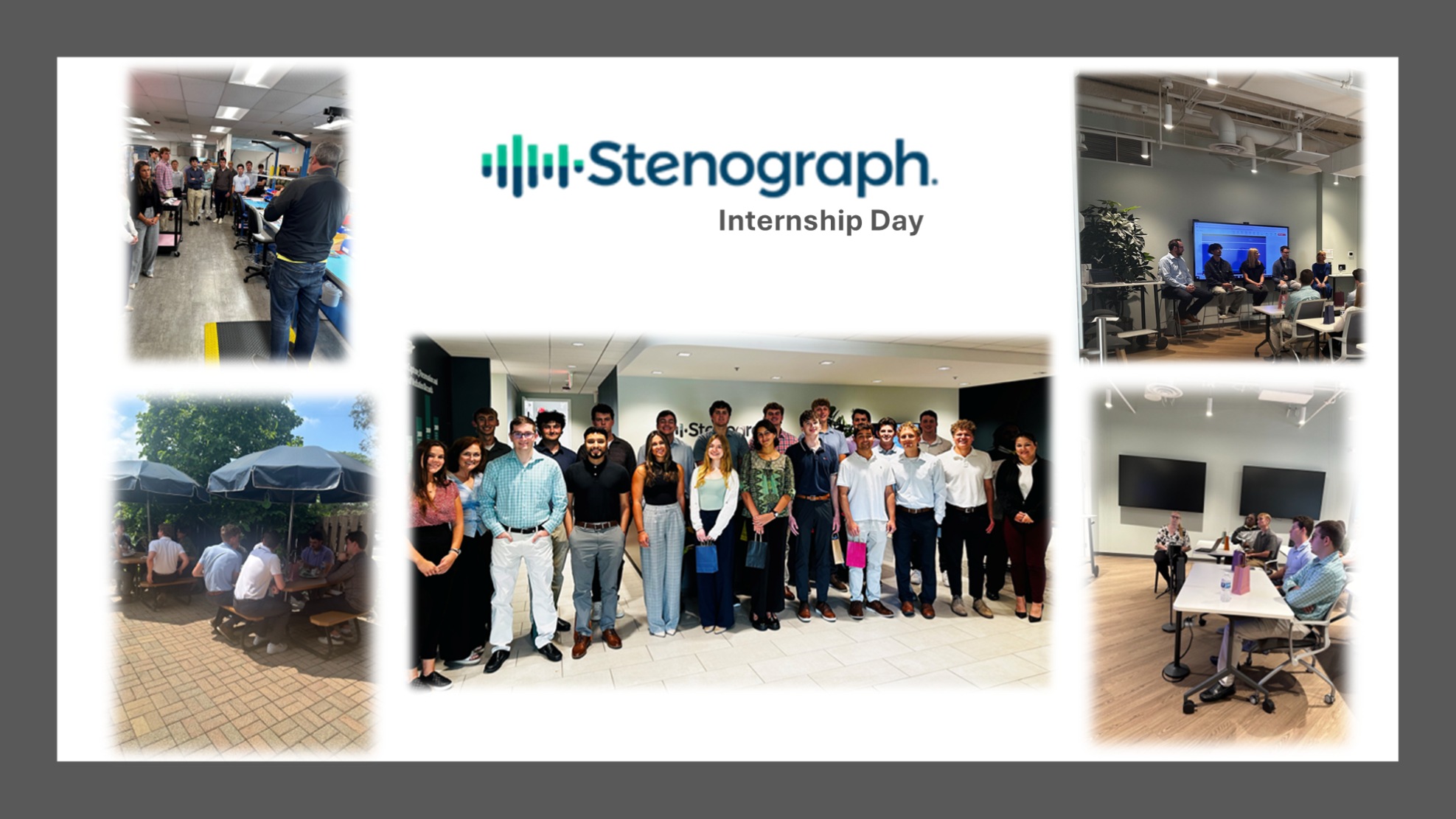
Stenograph says its products are developed, serviced, and supported by U.S.-based staff, and that some employees have stayed more than three decades. Those are company descriptions, but the underlying emphasis is revealing. Products built for a practiced trade benefit from people who remember why an apparently fussy requirement exists.
The approach has limits. A student license cannot simply become a professional production system. Remote text distribution needs the relevant connection. A recognition engine cannot guarantee that a difficult recording will become a satisfactory final transcript. Buyers need to match the method, permissions, service terms, and review work to the job they actually have.
For a product builder, the copyable idea is precise: preserve the skill your customer has earned, then inspect the whole working process for delays and unreliable handoffs. Stenograph began with an obstinate paper feed. Its opportunity now includes everything from the pressure under a fingertip to the file a lawyer opens later. A surprising amount of business can hide between those two moments.
Try the tools. Watch the hands.
Stenograph website · NexGen · MAXScribe · Ascend training · Company blog
Watch: NexGen demonstration
Watch: the machine-building team
Watch: Stenograph through the decades