Sridhar Guduguntla was being told to get a job. In the early 2000s, Synergycom was struggling, and the advice had the practical appeal of a door marked EXIT. A salary would have offered a more orderly answer to the uncertainty of running a business. He stayed. His account of that period gives an otherwise tidy company chronology something more useful than a founding date: a moment when continuing was a choice.
It is easy to admire persistence once the anniversary photographs have been taken. Living through it is a less decorative occupation. The early doubts, and the team that remained beside him, belong in his story because they interrupt the comfortable idea that a long career was always going to become one. A company can look inevitable in retrospect while having felt distinctly optional at the time.
Guduguntla founded Synergy Computer Solutions in Detroit in 1995. Today, the business is called Synergycom, and he remains its founder, president and CEO. Its work covers technology services and staffing. Those descriptions are accurate, although they leave out the recurring decision that makes his career interesting: how to keep serving customers as the work they need changes around you.
Three decades give that question some weight. A founder can preserve a company name quite faithfully and still have to reconsider what the company does. The pleasure of this particular story lies in that tension. Guduguntla has stayed with the business while allowing the business to move.
- 1995Founded in Detroit
- 2003Hyderabad delivery centre
- 2025Global AI practice
An engineer learns to count
His education joined two technical disciplines and two countries: electrical engineering at Osmania University in India, followed by computer science at New Jersey Institute of Technology. The latter degree was a master’s. It is a fitting preparation for a career spent translating between different requirements, though degrees alone cannot explain why someone chooses to sign the payroll.
Before Synergycom, he worked as a program manager at Anatec in Bingham Farms, Michigan. Finance began to interest him there. By 2011, alongside running Synergy, he was also handling its CFO responsibilities. The route is revealing: responsibility for delivery gradually acquired responsibility for the arithmetic behind it. A promising project still has to pay its way.
His mentor at Anatec was Gary Gentry. The lessons Guduguntla remembered concerned delegation, oversight and belief in people. Together, they describe a familiar managerial difficulty: giving colleagues enough room to act while remaining responsible for what happens. Trust requires judgement. An organisation chart, however handsomely drawn, cannot supply it.
That combination of technical training and financial attention helps frame the business he built. In services, a proposal becomes somebody’s working day. The hours, the skills and the customer’s expectations have to meet. There is little glamour in discovering that they do not, and considerable value in arranging matters so that they do.
Detroit acquires a longer address book
The company expanded to Chicago in 1997 and established its Hyderabad Global Development Center in 2003. Its headquarters moved to Bingham Farms in 2006. These are compact entries on a timeline, but they show a business developing an operating geography: a Michigan base, another American office, and a delivery centre in India.
Later expansion followed customer relationships. Offices in Canada and Mexico opened in 2022 to support Stellantis. A Sydney branch followed in 2023, the year Synergycom also established an IT services relationship with Stellantis Financial Services. Geography here has a practical purpose. Customers have operations in particular places; serving them can require a presence close to those operations.
A travel photograph offers a smaller, better illustration than a map bristling with pins. Guduguntla stands beside his luggage in an airport, on his way to Hyderabad for several weeks at the development centre. A global business still involves a person getting on a plane. International reach has a baggage allowance.
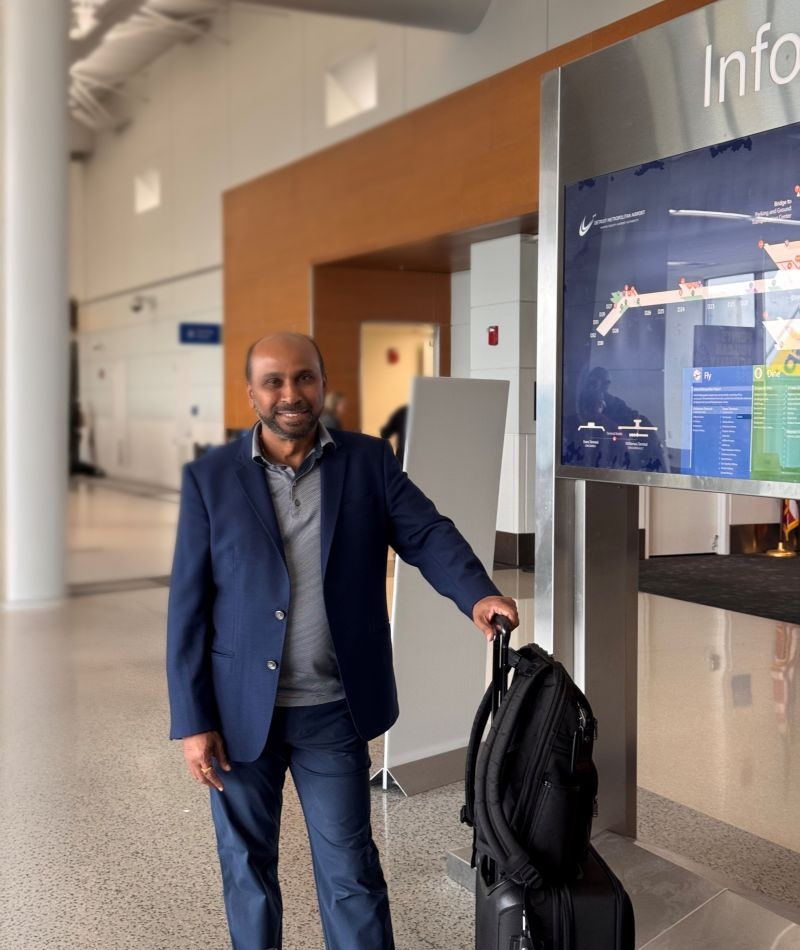
The Hyderabad operation includes recruitment, sales, IT and supporting functions. Its recruitment work also supports customers building teams at global capability centres in India. For Guduguntla, a visit connects the title on the organisation chart with the people carrying out those different jobs. The photograph supplies no grand revelation, which is part of its charm: this is what maintaining a connection can look like.
At the 26th Stellantis MatchMaker event, he appeared with sales director Leslie Knitter and Stellantis representatives Christopher Sim and Bruno Olvera. Supplier relationships have a social life as well as a contractual one. Somebody has to attend, listen and follow up. The meeting room remains stubbornly relevant to the technology business.
A supplier opens the door for other suppliers
Synergycom’s minority business enterprise certification dates to 2000. Its supplier diversity work includes mentoring other businesses and participating in procurement events. It also offers a programme to help customers manage spending with diverse suppliers. That makes the subject part of the company’s operating work, with buyers, suppliers and purchasing decisions attached.
There is an appealing circularity in a services company helping smaller suppliers navigate services procurement. Access to a buyer is valuable; knowing how to work with that buyer matters too. Mentoring and supplier management occupy the space between an introduction and an ongoing commercial relationship. The work is less photogenic than a ceremonial handshake, and rather more likely to determine what happens afterwards.
Guduguntla was named to Diversity MBA’s 2014 Top 100 Under 50 group. His profile described an interest in employee opportunity and community contribution, and listed memberships in the Detroit Chamber of Commerce, Detroit Economic Club and Chief Executive Network. These connections place him within a wider business community, beyond the customers on Synergycom’s own books.
An award can occupy one line in a biography. The more interesting question is what surrounds it. Here, recognition sits beside a development centre, commercial partnerships and a supplier programme. Read together, those details suggest a career concerned with the infrastructure of participation: who gets introduced, who gets hired, and who gets an opportunity to deliver.
The seventh API has to work
In July 2026, Guduguntla discussed enterprise AI with Meir Heimowitz on the RevGenAI Podcast. One example concerned a customer migrating application programming interfaces, or APIs, between technologies. After preparing six examples, the team asked the customer for a seventh to demonstrate live. The demonstration worked; further training and human validation helped turn the proof of concept into an active project.
The appeal of that seventh example is easy to understand. A prepared demonstration can be a charming dinner guest: agreeable, polished, and carefully briefed. An unfamiliar input asks a more useful question. Can the approach deal with something beyond what has already been arranged for its benefit? The customer has a reason to care about the answer.
Another example involved analysing changes to a manufacturing bill of materials. The workflow returned an analysis in 48 hours, compared with a process that had taken weeks. These are examples Guduguntla described, rather than a promise about every future deployment. Their interest lies in the specificity of the work: a migration, a change analysis, a customer waiting for something usable.
Human review and business context remained part of his explanation. That matters to the portrait of him as an operator. Speed has a customer only when the result can be used. A faster answer that needs to be treated with permanent suspicion creates its own workload. The demonstration is one stage in earning confidence, with the operating work still ahead.
Synergycom launched its global AI practice in 2025, the year of its thirtieth anniversary. The juxtaposition is pleasing. An anniversary invites a company to admire its past; a new practice asks it to learn something. Guduguntla’s recent work puts both activities on the same calendar.
A reported example from his July 2026 conversation. Further training and human validation followed.
Room for a different next chapter
There is a thread connecting the early company, its later staffing work and the current AI examples. His approach has involved adapting to what customers require, including changes in the kind of service offered. A customer relationship can outlast a particular technology. Preserving that relationship requires paying attention when the old answer stops being sufficient.
His description of leadership in 2011 included a memorable phrase: “my primary motivation is multiplication, not subtraction.” It is an economical expression of wanting people to contribute. Taken alongside his mentor’s advice about oversight, it also avoids making leadership sound like a permanent round of applause. Encouragement and responsibility have to share the office.
Away from work, he has spoken about golf during Michigan’s short season and the importance of time with his wife and two children. The seasonal detail is especially human. A business can arrange operations across continents; summer in Michigan remains disinclined to extend itself for the convenience of a chief executive.
For a reader following the dates, the recurring choice is worth pausing over. How much should a company change to remain useful to the people it serves? Too little movement can make an old relationship difficult to maintain. Change also asks people to learn, test and explain. His career provides a particular setting for that question, with customers close enough to supply an answer, or at least another demanding example.
The next chapter of Guduguntla’s business is already taking shape around enterprise AI. Its more durable subject is the same relationship that runs through the earlier chapters: people trying to solve a customer’s problem, and a founder deciding how his company should help. After thirty years, there is still something to demonstrate. Preferably with an example the customer chooses.
“my primary motivation is multiplication, not subtraction.”
Sridhar Guduguntla, 2011