The doorstep version
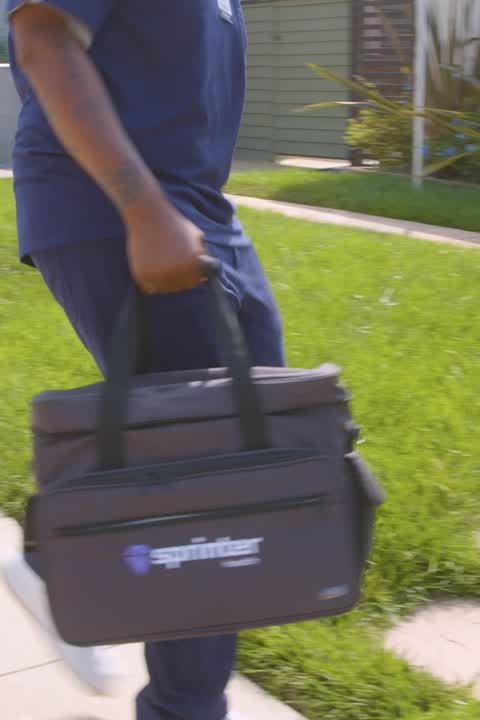
- Sprinter Health sends W-2 phlebotomists, cross-trained in medical-assistant and community-health-worker skills, to patients' homes.
- Health plans and health systems are the buyers. Eligible members generally pay $0.
- A virtual team handles consultation, medication review, escalation and care planning while field clinicians handle the physical work.
- The company's edge is operational: outreach, routing, documentation, specimen handoff and results delivery live in one system.
- The model works best when enough covered patients can be grouped into efficient routes and the service fits a partner's quality goals.
The most revealing object in Sprinter Health's story is not a needle, a blood-pressure cuff or an electrocardiogram. It is a windshield. A blood draw can take five minutes. The trip to the next patient can take forty-five. In the old house call, travel was simply part of the doctor's day. In a national healthcare business, travel is the business model waiting to fail.
Max Cohen and Cameron Behar saw the other half of the problem during the pandemic. Telehealth had made a clinician portable, but only in the peculiar sense that a face on a screen is portable. It could ask questions. It could observe. It could not collect a specimen, check the contents of a medicine cabinet or notice that the stairs to the front door were themselves a health risk.
The founders were old colleagues from Google, later Facebook in Cohen's case and Oculus in Behar's. For roughly a year, they met on Wednesday evenings by Cohen's pool, ate dinner and tested ideas. Both came from medical families. Both wanted to build something socially useful. The line that stuck was Behar's comparison: if a burrito could arrive at home, why not an HbA1c test?

A delivery network with a pulse
Sprinter Health launched in 2021 with mobile lab draws, vital checks and COVID-19 testing in California. The current version is broader. A field clinician - a "Sprinter" - visits the home for hands-on diagnostics and screenings. A virtual team of physicians, nurses, pharmacists and care navigators supplies oversight, consultation and follow-up. The software recruits the patient, books the slot, matches the worker, routes the day, records the visit and sends results back into the care system.
One care gap, three coordinated handoffs
That arrangement is unusual in two useful ways. First, the Sprinters are W-2 employees, not a marketplace of gig workers. Second, the company hires in the communities it serves and expands the phlebotomist's role with medical-assistant and community-health-worker training. The expensive clinician does not have to travel to every doorstep. The person at the doorstep is still equipped to do more than carry a kit.
“We need to make sure that our employees are spending as much time as possible serving patients rather than driving.”
This is where the route simulator matters. It accounts for traffic, weather and parking, and the company says it can help a Sprinter serve as many as 12 patients in a day. That sounds like a detail from a courier operation because, economically, it is. Andreessen Horowitz partner Julie Yoo has compared the model with Instacart and DoorDash: when people are moving through the physical world, idle miles eat the margin.
Sprinter reports those four operating figures, and they reveal its real unit of value. It does not merely sell a visit. It sells a completed task for a patient who had not completed it elsewhere. Its partner page says a single home visit can address more than 20 quality measures, from diabetes and kidney-health assessments to fall-risk screening, medication reconciliation and social-needs screening. The customer is usually a health plan, health system or provider group. The patient is the user. For an eligible member, the visit generally costs nothing.
The patient who does not arrive
A conventional clinic is organized around the patient who appears. Sprinter Health is organized around the one who does not. That might be a caregiver who cannot abandon a parent for half a day, a rural resident far from a lab, an older adult who no longer drives or a Medicaid member who has learned that every healthcare errand contains three more errands.
The home changes the evidence. A blood-pressure number sits beside the chair where it was taken. A medication list can be compared with the actual bottles. Food insecurity, fall hazards and transportation problems stop being abstract fields in a form. The virtual team can then review the visit, adjust the care plan, find community resources or reconnect the patient with primary care. Sprinter is not trying to replace that primary-care relationship. It is trying to make the next useful contact happen.
This logic has produced specific partnerships. Story Health used Sprinter's mobile phlebotomy in a cardiac-care program. Exact Sciences offers eligible patients in-home collection for certain blood tests. Central California Alliance for Health began a program aimed at more than 1,900 Medi-Cal members in 2025. Molina tells members the professional may be in the home for under 20 minutes and that covered visits cost them $0.
The driveway is the margin
The first thing that failed was not Sprinter Health. It was the fantasy that healthcare could become fully virtual. The company's response was not to reject telehealth, but to give it hands. That is the conceptual turn worth copying: automate the coordination around scarce people, then let those people do the part software cannot.
From regional service to a wider map
Scale arrived quickly. Sprinter went from five states in 2023 to 18 by May 2025, when Cohen said revenue had grown sixfold in a year. A $55 million Series B led by General Catalyst followed, with participation from Andreessen Horowitz, GV, Accel and the Regents of the University of California. In February 2026, the company announced that Preventive Care+ visits had reached 25 states.
But a map is not density. The model becomes harder when patients are scattered, drives are long, specimen drop-offs are time-sensitive or a partner sends too little volume to build efficient routes. It also cannot substitute for emergency care, complex procedures or every physical examination. And a patient cannot simply order a Sprinter like dinner; access generally depends on a participating health plan or provider.
A partner has a defined population, measurable care gaps, enough local density and a path for results and follow-up.
Travel overwhelms visit time, clinical needs exceed the home setting or no payer sponsors the service.
Competitors attack portions of the same territory. DispatchHealth brings higher-acuity care home. MedArrive deploys field providers. Getlabs focuses on specimen collection. Virtual-care companies manage the screen side. Sprinter's wager is that owning the untidy middle - outreach, W-2 labor, routing, the home encounter, virtual escalation and results - produces a more useful whole.
The small lesson inside the big system
There is a fashionable version of healthcare technology in which the patient disappears into automation. Sprinter Health is interesting for the opposite reason. Its software is most successful when the software itself recedes: the appointment arrives on time, the clinician knows what to do, the patient feels heard and the result finds its way back to someone who can act on it.
The reusable lesson is not “put healthcare on wheels.” It is narrower and better. Find the expensive human action that cannot be digitized. Remove the wasted motion around it. Train the person closest to the problem to notice more. Build the handoff before building the spectacle. Sprinter Health's product may be called a modern house call, but the house call is only the visible five percent. The rest is the promise that a person, a specimen and a piece of information will all arrive where they are supposed to.