There is a peculiar moment in a sales visit when the software has done its job and the salesperson still has a problem. The order is recorded. The photograph is uploaded. The dashboard will look splendid. But what should happen next, in this particular shop, with this particular manager? That question sits at the center of Spring Global’s latest chapter.
- The work: mobile sales, merchandising and delivery tools for consumer packaged goods teams.
- The shift: AI coaches that help turn store information into actions.
- The lesson: fix the behavior that produces the data before polishing the report.
The company, now using the shorter name Spring, sells into the unglamorous machinery of consumer goods distribution. Its users visit stores, take orders, check displays and deliver products. In that world, a useful application has to survive a van route, an unreliable connection and a busy shopkeeper. An elegant presentation at headquarters gets no special treatment.
01Nine minutes is a sales strategy
Consider the company’s Coca-Cola bottler case study. The improvements begin with everyday irritations: slow synchronization, cumbersome equipment and time swallowed by order taking. Spring supplied mobile tools with offline operation and connections to existing systems. Its account reports nine minutes saved per store, or 90 minutes per representative each day, and a rollout taking three months.
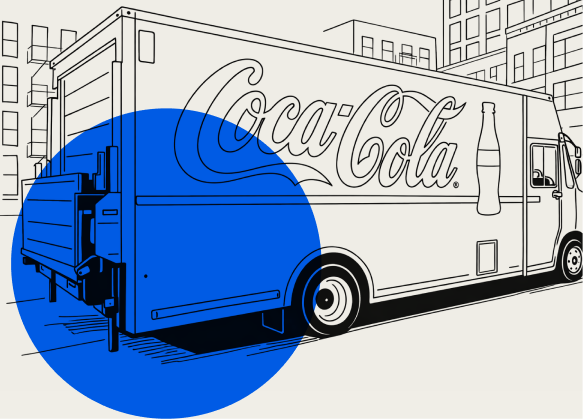
The equipment arithmetic is unusually concrete. The case study puts the old hardware at $3,000 per unit and replacement mobile devices at $600. Those are reported customer outcomes, rather than a promise for every installation. Still, they explain Spring’s appeal better than a cloud diagram. Less time wrestling with a device leaves more time to talk about the shelf.
Reported time saved per representative. The commercial opportunity is what the rep does with those minutes.
Hunt Brothers Pizza wanted a similar combination: easier field work and information its distributors could actually use. Spring’s published account describes mobile selling, a headquarters portal and lot tracking within the solution. Offline access mattered there, too. A product can contain sophisticated analytics and still win affection because it works when the signal disappears.
02The coach has three jobs
Spring launched Coach AI in November 2023, as self-service ordering was changing the representative’s role. If a store can place its own order, the visiting salesperson needs another reason to be useful. Spring’s answer was store-specific guidance, benchmarking and coaching aimed at making the visit more consultative.
Its current digital-coach lineup divides the problem by audience. FieldCoach helps representatives prioritize visits and recognize opportunities. LeaderCoach highlights performance gaps and proposed responses for managers. DataCoach explains the reasoning behind recommendations so analysts can examine and adjust them. The division acknowledges something sensible: the person entering a shop and the person reviewing a region need different answers.
This is a crowded neighborhood. Salesforce Consumer Goods Cloud also offers offline retail execution and an AI visit assistant; Repsly combines field management, reporting and integrations. Spring’s pitch rests on CPG experience and configurable coaching workflows. Buyers should compare the actual store routine each system supports. The presence of AI alone settles very little.
Spring’s Field Intelligence Platform supplies the machinery behind that guidance. Studios configures rules and escalation paths; Maestro coordinates coaches and automated actions. The intended sequence is straightforward: notice an exception, send it to someone who can help, support the response and record the outcome. Integration with existing field tools lets the company sell this approach without requiring every customer to begin again.
03The first version solved the wrong problem
Spring’s most instructive AI story happened inside its own operations. Its published account describes inaccurate time entries and delayed client reporting. A proposed software-and-data-warehouse solution would cost more than $100,000 and take six months. Instead, an internal builder used Claude Code to develop an agent.
After eight weeks, the first version could track hours. It also exposed the underlying problem: people were not consistently entering them. The second version added reminders and encouragement. Spring reports a total cost of $10,000, 12 weeks of work and a four-week payback. These are its own project figures, not a platform price list.
“Stated problems are usually symptoms.”
Spring’s account of its internal agent project
04Start with the person holding the tablet
The practical lesson is available without buying anything. Choose one recurring decision. Find the information it requires. Deliver a prompt where the work happens, then check whether anyone acts on it. Spring’s technology methodology explicitly starts with the person and problem, moving from simple rules toward predictive models or generative AI as needed.
Its business combines enterprise software with configuration and implementation services. That matters because a distributor’s existing systems, account records and working habits shape the result. A coach fed stale store information can recommend the wrong action with perfect confidence. A workflow that nobody follows will produce little benefit. These are practical dependencies, not problems a new interface automatically removes.
The sensible place to begin is a bounded pilot with a measurable task. Compare completion, time spent and the quality of the resulting action. Expanding from a working routine gives a buyer something firmer than an impressive demonstration: evidence that the advice fits the job.
05A pink app and a new chief executive
Tommy Bittner became CEO effective May 1, 2026, succeeding Conor Keane, who moved to the board. Bittner’s background includes more than 16 years at Cargill and roles at pricing software company PROS. Spring’s announcement names Coca-Cola, Unilever and Red Bull among customers and describes deployments serving tens of thousands of users.

At its July gathering in São Paulo, the team tried a revealing exercise: take a feature through design, engineering, testing and deployment in one day. The feature turned the application pink, exposing where a larger interface change might break. Call it an unexpected use for Barbie. It fits a company whose central challenge is making advice useful in practice: try something small enough to observe, and watch what happens.