The first version of SPR was hiding inside the wrong experiment. In the late 1990s, biomedical-engineering graduate student Maria Bennett worked with a Case Western Reserve University team using electrical stimulation to restore shoulder function after stroke. Movement was the assignment. Pain relief was the surprise. Patients talked about sleeping, working and moving with less misery. Bennett paid attention to the answer nobody had set out to collect.
That stray observation became a company in 2010 and, eventually, a new rung in the pain-treatment ladder. SPR Therapeutics built SPRINT, a prescription peripheral nerve stimulation system with a fine lead placed near a targeted nerve. A small external generator sends mild pulses for up to 60 days. Then the clinician removes the lead. No battery is buried in the body. No permanent implant remains. The product's most important feature is an expiration date.
01 / The useful detourThe endpoint nobody ordered
Bennett did not rush directly from thesis to startup. She learned the medtech machinery first. At Boston Scientific, she led work on a large angioplasty-balloon clinical trial that contributed to FDA clearance. She returned to Cleveland as vice president of clinical affairs at NDI Medical, helping develop a neurostimulation system for urinary incontinence before Medtronic bought NDI in 2008. Only then did she revisit her old pain idea, test whether clinicians and patients saw an unmet need, and form SPR.
“The most significant impact on the patient’s life was the reduction of pain.”Maria Bennett, describing the original research observation
The original plan had not exactly failed. Restoring function remained worthwhile. But pain was the result with emotional voltage, and the existing menu was ugly: long-term medication, repeated injections, nerve-destroying ablation, surgery or permanently implanted stimulators. SPR's bet was that some patients and physicians would accept neuromodulation earlier if the commitment became smaller.
02 / The productA temporary implant making a durable claim
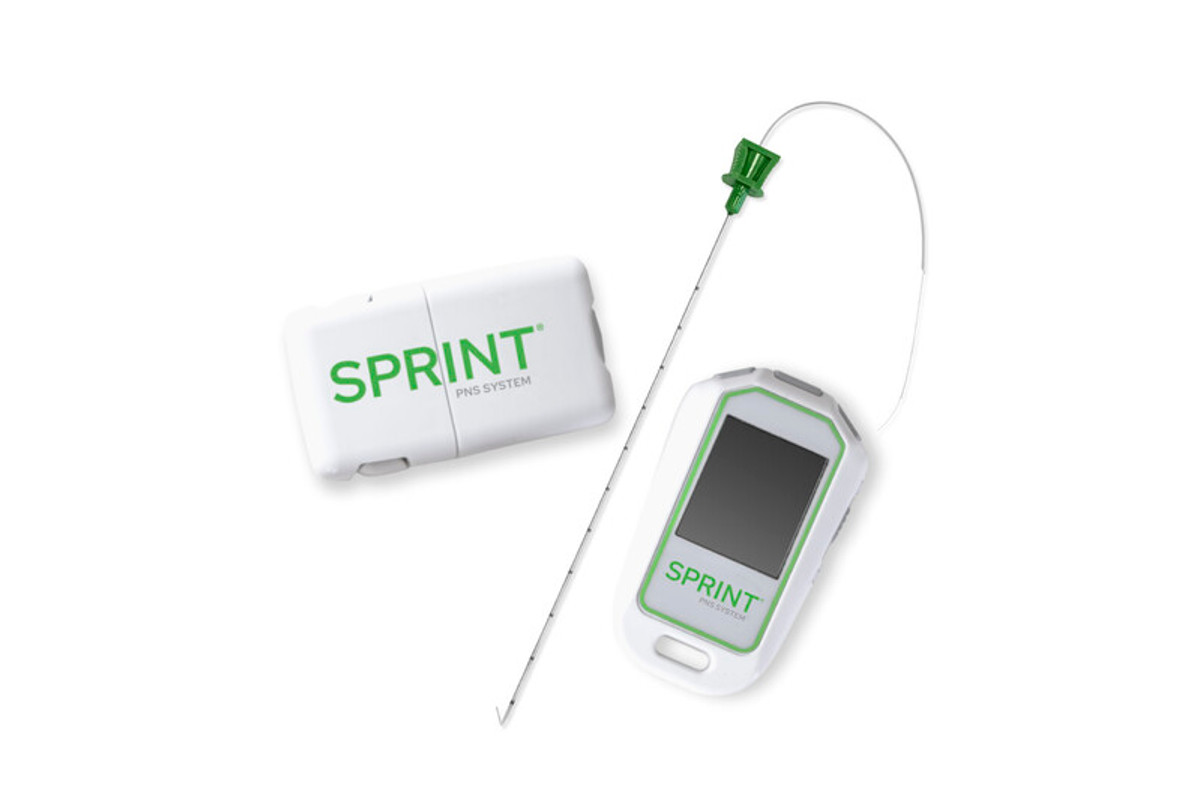
SPRINT is a four-part system: an introducer that helps a clinician position the lead, a coiled MicroLead near the nerve, an external wearable pulse generator and a handheld remote. Current configurations include single-lead endura, dual-lead extensa and extensa XT with bimodal stimulation. A patient app handles setup guidance, education and troubleshooting. Placement is minimally invasive and incision-free, but it is still a medical procedure performed by a trained clinician, usually with ultrasound or fluoroscopic guidance.
The mechanism is proposed to do more than mask a signal while the device is on. Selective stimulation near a peripheral nerve may alter how the central nervous system processes pain, allowing relief to persist after removal. The FDA-cleared labeling covers defined uses in severe intractable chronic pain of peripheral-nerve origin and symptomatic relief of chronic, postsurgical, post-traumatic and postoperative pain. It does not promise a cure, and response is not universal.
Medtronic's acquisition announcement offered a useful, less sparkly number than a company slogan. Across pooled results from 13 studies, 60 percent of patients achieved at least a 50 percent reduction in pain intensity at the end of treatment; responders averaged a 76 percent reduction. A separate real-world review of more than 6,100 patients found more than 71 percent reported significant pain relief and/or improved quality of life. Study designs and populations differ, so those figures are evidence to discuss with a physician, not odds printed on a lottery ticket.
03 / The marketSPR sold an earlier decision
SPR competes with PNS systems from Curonix, Nalu Medical and Bioventus, and indirectly with Mainstay Medical's restorative stimulation, spinal-cord stimulators, radiofrequency ablation, injections, drugs, physical therapy and surgery. SPRINT's distinction is not electricity. Pain specialists have used electricity for decades. It is the combination of a very small lead, an external generator, a 60-day course and no intended permanent hardware.
That positioning changed the sales conversation. SPR did not need a physician to abandon every familiar option. It asked for a place between conservative care and irreversible intervention. Medtronic explicitly described the acquisition as a way to reach patients earlier in the pain journey. The giant already owned a broad pain portfolio; SPR supplied the missing temporary step.
The customer is therefore a chain, not a person. Pain doctors and rehabilitation specialists select and place the system. Hospitals, ambulatory surgery centers and independent practices buy and bill for it. Patients wear it and control stimulation. Insurers decide whether the economics clear. SPR built field sales and clinical education, but also SPRcare, a patient-access operation that helps offices navigate coverage, prior authorization and appeals. In American health care, the reimbursement workflow is part of the user interface.
04 / The long middleWhat category creation actually cost
SPR's visible cost was years and capital. The company was founded in 2010 and did not receive its first FDA clearance until 2016. Early rounds included $5 million in Series A financing in 2013, supplemented by federal grants and loans. A $25 million Series C followed in 2017. The Department of Defense supplied $10 million in grants and awards in 2018. SPR raised $37 million in Series D financing in 2021, then secured another $85 million in 2024: $25 million of insider equity and a $60 million debt facility.
That money bought more than iterations of plastic and wire. It paid for trials, regulatory work, quality systems, clinician education, a territorial sales force and the patient-access plumbing. Commercial adoption began slowly: 1,000 patients in 2019, 2,000 in 2020 and 5,000 by May 2021. Then the curve bent. SPR reported 20,000 completed treatments in 2023, 30,000 by July 2024 and 50,000 implants in December 2025.
A 2026 Case Western Reserve alumni profile, citing Crain's Cleveland Business, put annual revenue at $76.8 million after 1,200 percent growth over five years. The same profile counted more than 300 employees. SPR had become a real commercial organization with offices around Cleveland, Minneapolis and Chapel Hill, not a clever patent waiting for a buyer.
05 / The payoffWhat Medtronic bought
On May 20, 2026, Medtronic agreed to buy SPR for approximately $650 million in upfront cash. The deal closed July 16. It was a tidy strategic fit: Medtronic had half a century in neuromodulation and permanent pain systems; SPR had the temporary product, clinical library, trained prescriber base and expanding reimbursement needed to intervene sooner. The buyer said the transaction would be minimally dilutive to adjusted earnings in fiscal 2027 and neutral to accretive after that.
The founder's arc contains a pleasing loop. Bennett helped NDI Medical build a neurostimulation product before Medtronic acquired that company in 2008. Eighteen years later, Medtronic returned for the company she founded herself. The exit price is the headline, but the strategic asset was a new decision inside a clinical workflow: stimulation without signing up for permanent machinery.
The moat was not merely the MicroLead. It was permission - regulatory, clinical, economic and emotional - to try neuromodulation sooner.
What can another builder copy? Start with an observed problem, not the grandeur of a platform. Lower the commitment required to try the product. Finance technical risk with non-dilutive money where possible. Publish enough evidence to survive a skeptical clinician. Design services for the customer who files the claim, not only the patient who wears the device. And measure the benefit people spontaneously celebrate.
What cannot be copied cheaply is the calendar. SPR needed six years to reach clearance and another decade to become acquisition-sized. Its model also depends on trained specialists, defensible clinical evidence, regulatory clearance, payer participation and a condition that responds to targeted stimulation. Remove any one and a gorgeous piece of hardware can sit unused in a cabinet. The company worked because it treated those constraints as the business, not as annoying scenery around the invention.