There is a peculiar moment in the life of a medicine when a molecule becomes a story. Until then it is assays, endpoints and adverse events. Then someone must explain it to an investigator, persuade a patient to consider a trial, prepare a physician for the data, help a company survive scrutiny and, eventually, make a market understand why any of it matters. Most healthcare companies have traditionally hired a different agency at each doorway. The molecule keeps moving. Its memory does not.
Spectrum Science has spent the past several years treating those doorways as one long corridor. The Washington, D.C.-based company started in 1996 as a health and science communications specialist. Today it sells seven connected disciplines: advertising, clinical trial experience, communications, consulting, media, medical communications and patient engagement. The list sounds like an agency menu. The consequential detail is hidden in the accounting. Spectrum says the services operate under a single P&L.
That means the advertising team and the clinical team are not supposed to protect separate little kingdoms when a brief crosses the hall. In an industry where "integrated" often means several logos arranged on the same slide, shared economics are a practical design choice. Spectrum's product is not simply a campaign. It is the reduction of organizational friction around a scientific idea.
A publicist walks into an agency
The first useful story about Spectrum is not an acquisition. It is a conversion. Founder John J. Seng built the firm after seeing the politics and inefficiency of conventional agency models from both the client and agency sides. In 2014, Jonathan Wilson visited Spectrum with no settled plan to buy it. He later wrote that the place changed his mind almost immediately: the science focus, the people and the sense of purpose felt like home. He joined, then completed his purchase from Seng in June 2018, one year ahead of schedule.
The old model had not exactly failed. Spectrum was growing at double-digit rates. But success revealed its boundary. A communications firm can shape a scientific narrative; it cannot, by itself, recruit the participants who generate the data, build the brand system that commercializes the therapy or optimize the media that finds the right audience. The first thing to give way was the assumption that excellent PR was a sufficiently large container.
“John started Spectrum in 1996 to deliver something better.”Jonathan Wilson, reflecting on the founder and the 2018 sale
The shopping list was a workflow
Spectrum waited 26 years to make its first acquisition. Then the restraint ended. In 2022 it bought SONIC Health for medical communications, The Seismic Collaborative for early-stage health technology and biotechnology, and Aurora for a stronger European base. The next year came CrowdPharm, whose technology-supported network supplied advertising talent, and Hot Iron Health, a strategy consultancy. In 2024, Spectrum acquired Continuum Clinical, a 30-year-old patient recruitment business with proprietary engagement technology.
These were not random agencies bought to make the revenue line taller. Read from left to right, they resemble the life of a drug company: early innovation, clinical evidence, participant recruitment, scientific exchange, brand strategy, launch and sustained engagement. Spectrum followed the client problem upstream and downstream until the communications assignment became a company-and-product-life-cycle assignment.
One operating spine
The most economically urgent doorway is clinical recruitment. When Spectrum announced the Continuum deal, it cited estimates that more than 80 percent of trials extend their timelines and that delays can cost sponsors as much as $8 million per day in opportunity cost. Continuum brought more than 130 clinical-solutions specialists in the combined team and MERIS, a suite for participant and research-site engagement with live performance data for sponsors. Here, "communications" is not reputation varnish. A confusing ad, a missed follow-up or a burdensome participant experience can slow the underlying business of producing evidence.
What did the expansion cost? Spectrum did not publish transaction prices. Monroe Capital financed the three 2022 acquisitions, and growth investor Knox Lane made a strategic investment in February 2023. The visible cost is organizational: several cultures, systems and client teams had to become one platform.
The number that made the strategy visible
In 2022, fee income rose about 63 percent to roughly $80 million. Acquisitions helped, as did a reported 56 percent new-business win rate. Public client lists have included AbbVie, Moderna, Regeneron, Takeda Neuroscience, Vertex Therapeutics, BeiGene and PacBio. Spectrum was named North America Healthcare Agency of the Year by PRovoke Media in 2023.
But rapid assembly creates a familiar risk: the customer still experiences a collection, even after the owner calls it a platform. Spectrum's answer arrived in December 2025, when Aurora, Continuum Clinical, CrowdPharm and Hot Iron Health gave up their separate public identities and became Spectrum Science. The company said the teams had already operated together for years. The rename made a claim about behavior: a client should no longer need to understand the acquisition history to find the right expertise.
A specialist is born
John Seng starts a health and science communications firm in Washington.
The ownership handoff
Jonathan Wilson completes his purchase after joining the business four years earlier.
Six businesses, three years
Medical, biotech, European, advertising, consulting and clinical capabilities arrive through acquisitions.
The names disappear
Four acquired brands become one Spectrum Science identity.
Software in the agency cupboard
A services company usually keeps its cleverest machinery backstage. Spectrum has begun naming its tools. Galileo6 is an AI-powered media analytics and modeling platform designed to combine data, predict outcomes and clarify return on advertising spend. Mo is a custom language model grounded in approved brand information, client preferences and team norms. Source helps assemble flexible talent from a pool of nearly 11,000 health and life-sciences specialists. MERIS supports clinical-trial engagement and measurement.
The logic is sensible. Healthcare work needs people who understand a narrow disease area, a regulation, a market and a communication channel, often at once. A permanent payroll cannot contain every combination. Source turns specialist access into a variable resource; Mo tries to stop context from evaporating as the team changes. The advantage is not AI-generated prose. It is faster retrieval of the constraints that make healthcare prose safe and useful.
Independent, but not alone
Spectrum also needs geography. It founded and chairs Global Health Marketing & Communications, an independent network with reach into more than 60 countries. This is the anti-holding-company part of the proposition: local agencies remain close to their markets, while Spectrum offers a route into the network. The model can preserve local judgment without maintaining owned offices everywhere.
That positioning sits between two alternatives. A client could hire a huge global health network with more centralized scale, or assemble best-in-class boutiques for every task. Spectrum argues for a third route: healthcare-only depth, selected ownership where continuity matters, and partnerships where local knowledge matters more. Competitors include Real Chemistry, EVERSANA INTOUCH, Fingerpaint, Inizio Evoke, Publicis Health and the healthcare arms of large communications groups.
The model is useful under particular conditions. It fits a pharmaceutical or biotech company with complicated science, several audiences and work that will migrate from development toward commercialization. It is less persuasive for a buyer seeking a cheap, isolated production task, a category outside health, or a procurement structure that deliberately keeps strategy, media and execution in separate firms. Integration only pays when the client is willing to share context across functions. Otherwise, one P&L is merely an internal fact.
What another services company can copy
- Map the customer journey before drawing the acquisition map. Buy the missing handoff, not the fashionable capability.
- Integrate incentives. Shared branding matters less than removing the reasons teams hoard revenue and information.
- Keep scarce expertise elastic. A vetted specialist network can cover the long tail that no fixed staff can economically hold.
- Give internal tools a job tied to context or measurement. "AI" is not a job.
- Retire acquired names only after teams can actually deliver together. The logo should describe reality, not promise it.
The human part of the machine
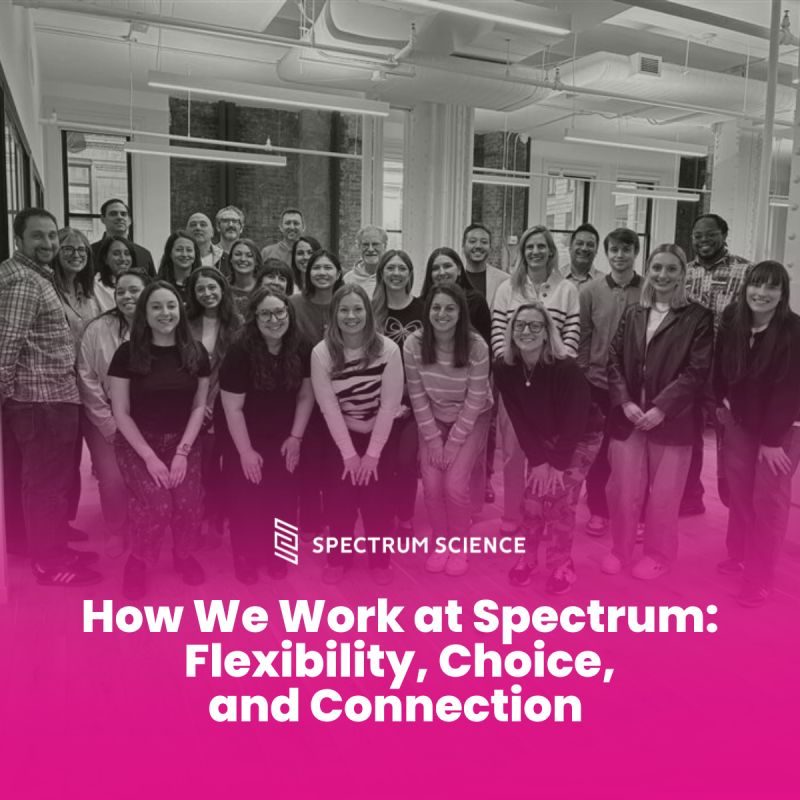
Spectrum calls itself remote-first. Its offices are for the moments when proximity adds something: welcoming people, solving a problem, making an idea less lonely. The company publicizes mentoring, learning programs, mental and financial health support, employee interest groups and philanthropy. Workplace lists have noticed; so have industry award programs. Those signals do not settle what every employee experiences, but they do show that culture is being treated as operating infrastructure rather than office decoration.
That matters because Spectrum's strategy asks people to surrender a little territory. A clinical specialist must let a creative person into the problem early. An acquired leader must trade a familiar brand for a common one. A permanent team must accept a specialist from a flexible network. The corporate structure can encourage those exchanges. It cannot perform them.
The company that began by translating science has ended up translating organizations to one another. That is the quiet insight beneath the acquisitions. A medicine does not experience the neat departmental borders printed on an agency chart. Neither does a patient. Spectrum Science has built a business around remembering that the corridor is real, even when the doors have different names.