The first piece of American market research Vittoria Losio conducted for Sparkle Agency came with fluorescent lights, a shopping cart, and perhaps a suspicious amount of lingering in the cereal aisle. She had moved from Italy to the United States to build the agency's U.S. branch. She had no local network, no warm introductions, and no reputation that crossed the Atlantic ahead of her. So she walked supermarkets, wrote brand names into her phone, went home, and searched for the people behind their creator partnerships.
Two years later, Losio wrote that a number of those brands had become clients. It is a tidy origin story, but the useful part is its lack of magic. The insight was not that groceries are secretly glamorous. It was that a shelf is a live database of companies selling to actual people. Losio did the slow work that expensive software can make look unnecessary: observe, list, research, contact, repeat.
“Good management compounds: relationships, repeat brands, better rates. That happens over seasons and years, not days.”Vittoria Losio, co-founder
The product is a longer time horizon
Sparkle began in Milan on February 14, 2018, founded by Losio and Francesca Citterio. The date is almost too convenient for an agency whose business depends on chemistry. The pair describe their method as creative, transparent, and tailored to each combination of brand and talent. The company represents more than 30 creators, artists, and actors, develops influencer campaigns, manages social channels, advises on publishing, and runs an internal video arm called Sparkle Production.
Most of those services are familiar. The distinction is where Sparkle says the work should end. A transaction-minded agency can optimize for the next brief: identify an audience, negotiate a rate, approve the post, collect the report. Sparkle talks about a creator's image, training, professional development, and ability to emerge beyond the web. In that version of the business, the sponsored post is cash flow. The career is the asset.
That helps explain the odd variety in Sparkle's portfolio. Juno, created by Cleo Toms, was not another cosmetics placement. It was a vegan, cruelty-free, Made in Italy beauty label developed over more than a year, launched with a Basic Witch palette and three digital billboards in Milan. Emanuele Ferrari's family stories and recipes became Il sapore dei ricordi, published by HarperCollins; more than 500 signed copies sold out within three hours of the announcement. Marco Ferrara's life between Monza and Seoul became a DeAgostini book. These are not merely deliverables. They leave the creator with intellectual property, a product, or a new professional lane.
The compounding loop
- Find the human angle
- Match brand and creator
- Make the work
- Build what survives it
A bus is harder to scroll past
The project that makes this philosophy easiest to see is AttraversaTAM. Creator Stefano Maiolica, known as “Un terrone a Milano,” had built an initiative to help students and workers living away from home return south for Christmas, when travel prices rise. By its third edition, with Galbani's support, the project sent two buses from Milan toward Puglia and Sicily and carried more than 130 people home for free.
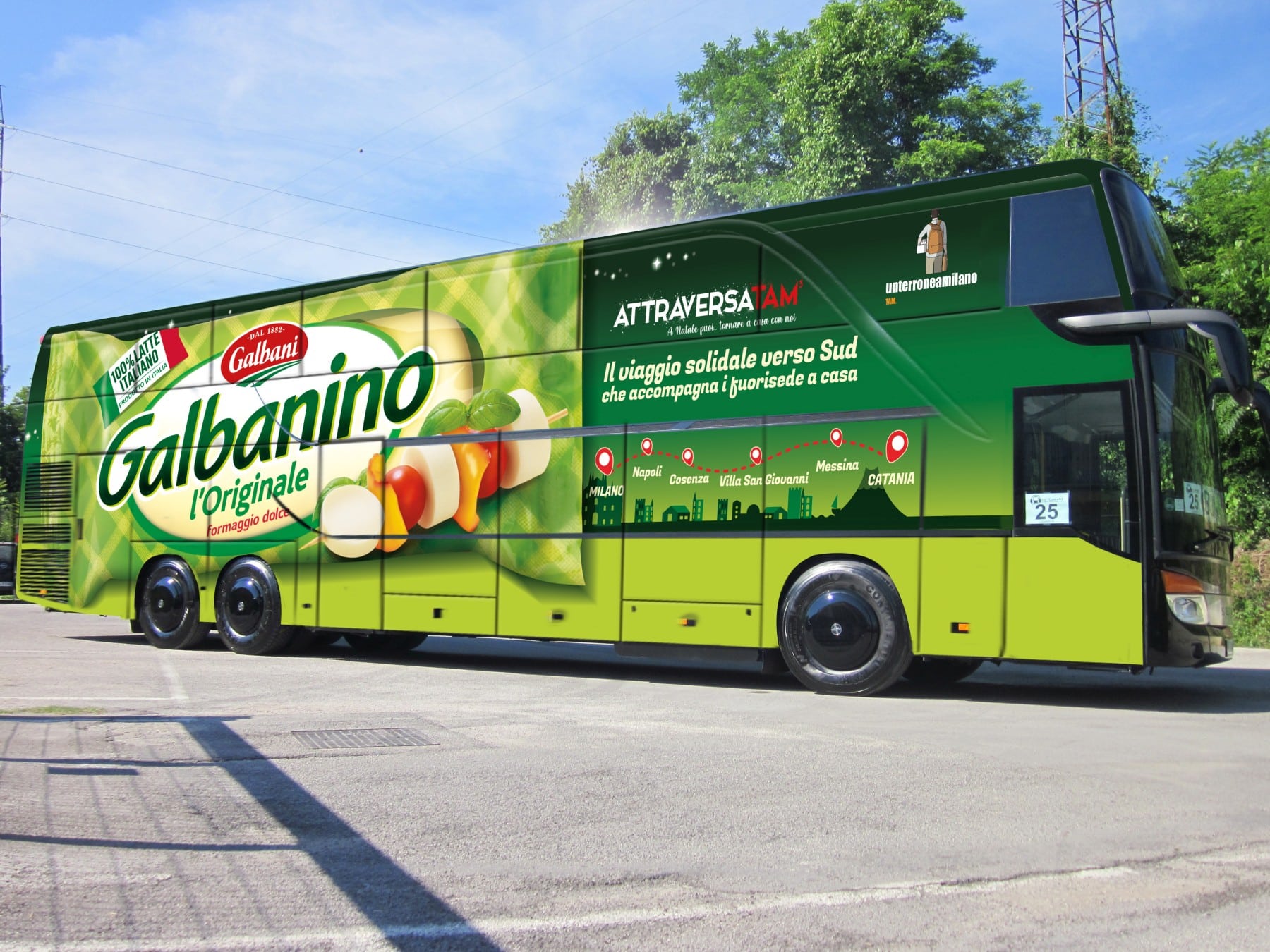
This is the cheerful extreme of brand-creator fit. Galbani did not hover beside the story as a logo pasted onto somebody else's idea. The company helped the idea become larger and more useful. The creator supplied cultural recognition and an audience; the brand supplied the means to move people. Sparkle's role sits between them: identify the fit, protect the creator's voice, shape the campaign, and make sure a promising premise survives contact with schedules, contracts, production, and measurement.
The agency's client wall ranges from Adidas and Armani to Barilla, Disney, eBay, L'Oréal, PayPal, Prime Video, Sephora, Sky, TikTok, Universal, and Zalando. For those customers, Sparkle offers the practical middle: scouting, creative design, creator contact, management, production, and results analysis. Brands avoid assembling that chain themselves. Creators gain an advocate who can judge whether the work fits the career they are trying to build.
What a campaign costs when the paperwork is public
Private agencies rarely publish prices, and Sparkle has no public rate card. One government document provides a useful keyhole. In July 2024, the Cuneo tourism authority assigned Sparkle a project involving creator Sofia Montagna for digital content supporting “Anima Alpina delle Alpi di Cuneo.” The stated amount was €10,000 plus VAT.
Plus VAT. One documented 2024 creator-content assignment for a regional tourism project. A real price, but not a universal Sparkle fee.
The caveat matters. Creator fees move with scope, usage rights, production demands, audience, exclusivity, and distribution. Copying the number would be foolish. Copying the clarity is not. Name the person, the content, the campaign objective, and the commercial terms. Influencer marketing becomes much less foggy when it is treated as commissioned professional work rather than purchased attention.
The first failure was borrowed credibility
Sparkle's American start clarifies what did not travel. The Italian track record did not automatically produce U.S. introductions. Losio has described doubt, discomfort, and the difficulty of working under new rules far from what was familiar. Her response was not a rebrand or a dramatic fundraising round. She changed the unit of progress. One researched brand was useful. One relevant contact was useful. One honest outreach was useful.
She has also become vocal about a different kind of failed shortcut: third-party creator databases whose estimated demographics and engagement rates can diverge from the first-party analytics held by creators. Her complaint gets to the heart of Sparkle's market position. Software can narrow a list. It cannot fully judge voice, timing, reputation, ambition, or whether a “no” today protects a more valuable career tomorrow. The agency competes with other Milan management firms and campaign platforms, but also with the belief that matching can be automated without losing context.
“A ‘no’ is sometimes worth more than a ‘yes’.”Losio on protecting a creator's personal brand
The useful parts to steal
There are three. First, research where demand is visible. A supermarket aisle, an app store, a trade-show floor, or a customer-support forum can reveal buyers faster than a generic prospect list. Second, make the match specific. Sparkle's own language is “Talent-Cliente,” a pairing rather than a slot. Start with the creator's actual habits and the brand's actual problem; follower count arrives later. Third, design an afterlife. A campaign is stronger when it also produces a repeatable format, a product, a book, a live event, a reusable asset, or a deeper relationship.
The conditions matter.
This model needs time, judgment, and enough trust for the manager to reject bad-fit revenue. It is poorly suited to buyers shopping only for the cheapest impressions, creators unwilling to share real performance data, or engagements too short to learn from. In those cases, a marketplace may be quicker. Sparkle's advantage appears when the brief has room for craft and the relationship is allowed to compound.
There is a nice symmetry here. Sparkle tells creators not to confuse a loud month with a durable business, and its own U.S. expansion seems to follow the same advice. The grocery-store story is memorable because it is visual, but its lesson is plain: do the unscalable work until relationships begin to scale it for you. A creator's career and an agency's market entry may be the same sort of project after all - a succession of intelligent, patient bets, none of which looks inevitable while it is happening.