There is a peculiar moment in the life of a successful internet creator when the thing that made the career possible starts making the career impossible. The videos work. The inbox fills. A brand wants a campaign. Another wants usage rights. An editor needs footage. A platform needs a different crop, title and posting rhythm. The creator, who was rewarded for seeming spontaneous, discovers that spontaneity has acquired a legal department.
Onefluent Inc. has built its business around that moment. Founded in 2019 and headquartered in Los Angeles, with much of its leadership and staff in Canada, the company presents itself as a vertically integrated creator-services agency. The phrase is corporate, but the idea is plain: put talent management, brand sales, contracts, payment, production, editing, distribution and measurement in the same shop. Let the person on camera remain the person on camera.
That makes Onefluent part Hollywood agency, part production house and part performance-marketing desk. It represents creators across comedy, kindness, beauty, fashion, family, gaming and food. It also works for brands that need those creators to do something more specific than appear charming: create awareness, drive an app install, sell a product or produce material that can survive beyond one post.
The first thing to fail is time
Onefluent’s most candid product description begins with a shortage. Creators, it says, lack the time, team or capital to publish everywhere they could. This is not a glamorous diagnosis, which is why it is probably the right one. A good YouTube idea does not automatically become a good Snapchat show. It needs another cut, another title, another thumbnail and often another person who knows what that platform pays for.
The company’s media arm says it can fund projects, assemble crews, handle locations and casting, edit long videos, then slice the work for distribution across platforms. Its Snapchat operation says it manages hundreds of shows. For brands, the sequence runs in the other direction: start with the audience, identify creators who genuinely fit, negotiate and contract, make the content, boost it when useful, then measure the result downstream.
The useful distinction is between a roster and a system. A roster says, “We know popular people.” A system asks whether the creator’s audience matches the buyer, whether the price makes sense, whether the idea can be produced reliably and whether the campaign changed anything. Onefluent says its databases cover more than 200 million creator records and contacts. The number is company-reported, but the operating principle is worth keeping: follower count is an opening clue, not a verdict.
The twenty-million-fan case
The agency’s clearest proof point is Zachery Dereniowski, better known as MDMotivator. CEO Samuel Reid has written that Dereniowski arrived with nearly 100,000 fans and a problem larger than audience growth: his kindness videos were becoming a business with partners, production needs and promises to keep. In less than two years, Reid said, the audience passed 20 million, direct impressions exceeded 40 billion and the work raised more than $1 million for people in need.
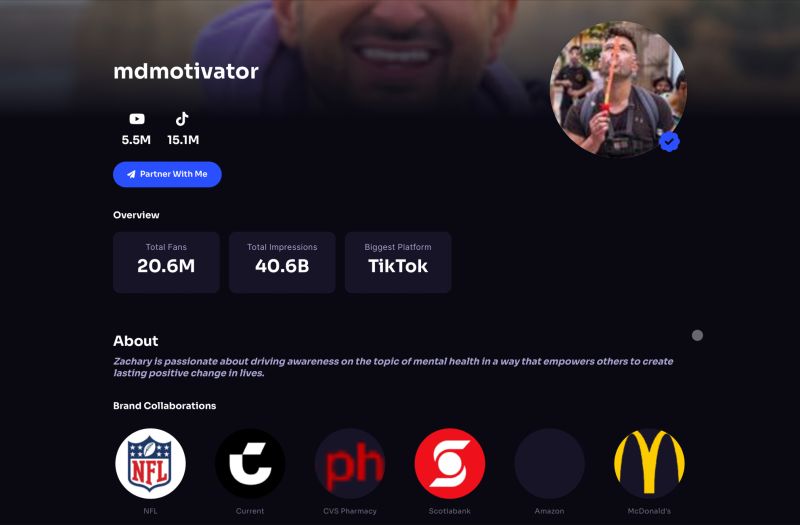
Later campaigns connected the creator with Air Canada, REFORM Alliance and public figures including Kim Kardashian. Onefluent’s role sits deliberately off-camera: coordinate partners, arrange logistics, manage the commercial obligations and protect the creator’s central promise. A giveaway video feels immediate because a team made sure the car, recipient, sponsor, releases and cameras arrived in the same place.
Company-reported MDMotivator figures published by Onefluent CEO Samuel Reid in 2023.
Trust wears a data-business jacket
If analytics were sufficient, creators would hire dashboards. One testimonial on Onefluent’s site reveals the more fragile transaction. The creator known as Turnip Vegan says he was wary of the industry, took a first meeting, then waited two months before signing. What changed his mind was not a new reach forecast. An agent kept explaining how the relationship would help until the creator believed he would not be left alone with the work.
That hesitation matters because management contracts touch income, identity and creative control at once. Onefluent’s own pitch tries to lower the temperature. A testimonial from Luke Davidson says creators may find their own brand deals without owing the agency a percentage, while Onefluent takes a cut of deals it brings in. No public rate card is attached. The principle, however, aligns the commission with the work that produced it.
Management, brand sales, negotiation, legal and payment support, production, editing and new-platform distribution.
Creator selection, campaign strategy, contracts, content production, paid amplification and performance reporting.
Titles, thumbnails, pacing, posting schedules and recuts built for YouTube, Snapchat and short-form feeds.
Manufacturing, websites, merchandising, distribution, accounting expertise and access to capital.
A wide service menu, and one old bet
Onefluent’s breadth is both the point and the test. Its website lists talent management, brand creation, e-commerce conversion, app-install campaigns, a production studio and Snapchat publishing. In 2022 it also announced a multi-year NFT and metaverse partnership with NFT Brands Inc. that the parties valued at $100 million. It was a very 2022 promise: giant audience totals, interoperable virtual worlds and digital-collectible infrastructure.
The durable pieces of Onefluent’s offer are less fashionable. Creators still need contracts read. Brands still need to avoid overpaying for the wrong audience. A video still needs an editor. The NFT announcement shows what can happen when an agency’s appetite for adjacent opportunity outruns what the public record can later demonstrate. Onefluent’s present-day pages put much more weight on creators, media production, commerce and platform distribution.
What a marketer can copy
The transferable lesson is a sequence, not a celebrity list. First, define the behavior the campaign should produce. Second, select for audience fit and demonstrated trust rather than raw following. Third, settle rights, price and measurement before production. Fourth, shoot with reuse in mind, so one idea can travel across several formats without feeling like leftovers. Finally, watch what happens after the view: installs, purchases, qualified attention or a measurable change in awareness.
This works when the creator already has a recognizable relationship with an audience, the brand has a clear objective and both sides will tolerate the unphotogenic discipline of contracts, edits and reporting. It is a poor fit when a brand wants celebrity as decoration, when the product clashes with the creator’s usual life, or when nobody can agree what success means. No database rescues a false match.
Onefluent competes with large creator agencies such as Viral Nation and Dulcedo, specialist talent managers, production companies and software platforms that let brands do parts of the job themselves. Its answer is integration. The company does not merely introduce two parties; it wants to stay for the whole relay. That can reduce handoffs and preserve context. It also means the agency must be good at several businesses that are difficult on their own.
The sharpest way to judge Onefluent: not by the loudest campaign or the biggest database claim, but by whether a creator makes better work, earns more cleanly and still trusts the team when the weekly call begins.
The company’s latest public signals point outward. Reid said in 2026 that Onefluent was expanding into Europe. A new community-management hire described work with artists, athletes and creators, and Onefluent appeared among partners supporting a L’Oréal Paris Skin campaign in the DACH region. For an agency born in 2019, this is the natural next experiment: can a relationship-heavy operating model cross borders without losing the closeness that sold it in the first place?
The creator economy likes to talk about attention as if it were a commodity. Onefluent’s story suggests the opposite. Attention is perishable. It has to be converted into the right partnership, produced in the right form, delivered on time and handled in a way that leaves the audience’s trust intact. The person on screen gets the view. The company behind the screen earns its place by making sure the view was worth having.