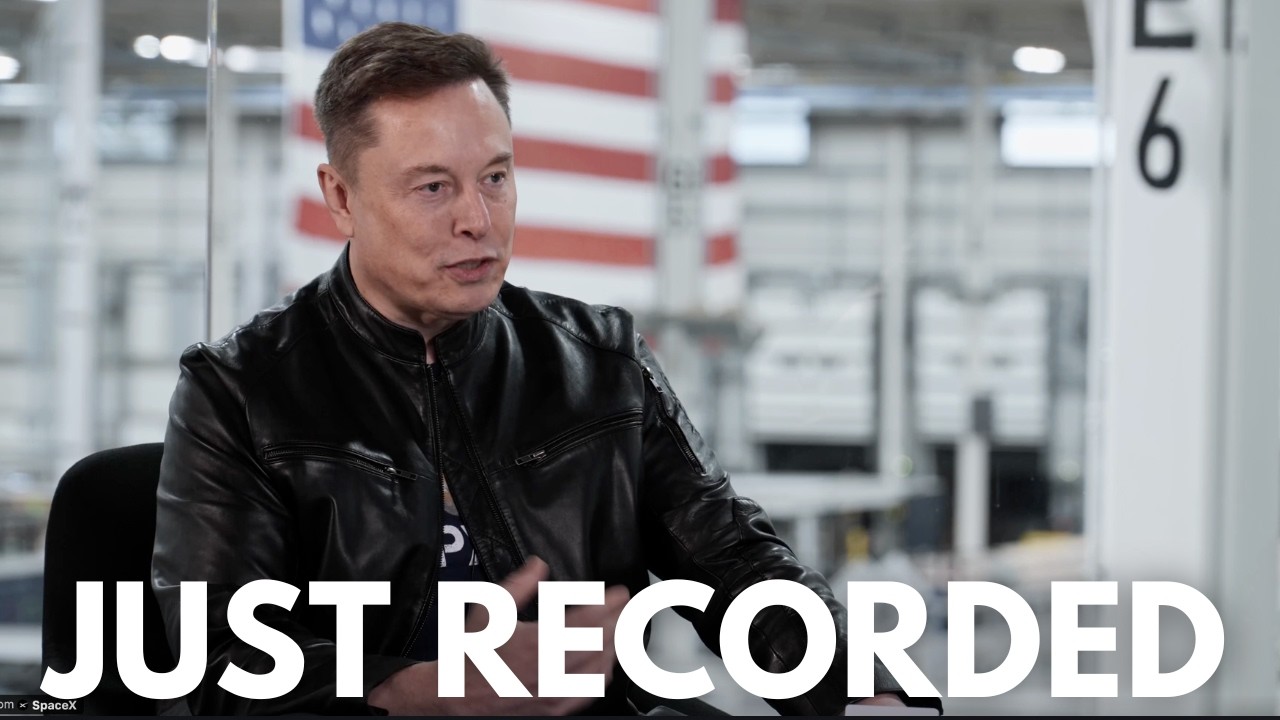
There is a certain kind of ambition that no longer fits inside a boardroom, a balance sheet, or even a planet. Sitting in a studio wedged into a roaring satellite factory in Bastrop, Texas, Elon Musk reached for the only yardstick large enough to hold the idea he wanted to describe. Not revenue. Not market share. The Kardashev scale — a measure of civilizations by the raw power they can bend to their will.
The occasion was a casual-looking check-in with members of the SpaceX Starlink team, the sort of fireside chat the company periodically stages to connect the dots between its dizzying list of projects. But the through-line this time was audacious even by SpaceX standards: a plan to move the world's artificial-intelligence compute off the surface of the Earth and into orbit, powered directly by the sun, at a scale that would make today's largest data centers look like desk lamps.
"It's been a typical SpaceX year," the host offered dryly at the top. "Launched a brand new vehicle. Acquired XAI, now SpaceX AI. Announced a terra-sized chip-building project." Musk's reply was a shrug wrapped in a grin: "Never a dull moment." What followed was less a product announcement than a cosmology lesson, a tour that began at galactic scale and worked its way down to the machines humming behind the camera.
Part I — The YardstickA Civilization Measured in Sunlight
The Kardashev scale, Musk explained, is the closest thing we have to an objective grade for a species. "That's the most objective metric that any alien species, say visiting us, would calibrate how much progress we've made as a civilization," he said. Devised by the Russian physicist Nikolai Kardashev, it ranks civilizations by the fraction of available power they harness: Type I commands the energy of its home planet, Type II its star, Type III its entire galaxy.
By that measure, humanity is barely a rounding error. "We currently use much less than a trillionth of the power output of the sun," Musk said, letting the number land. "A trillion is a million times a million." When the host suggested that on the Kardashev scale we're "still non-existent," Musk didn't argue. "We're not even registering," he agreed. Reaching even one-millionth of the sun's output — a "micro soul," as the group joked — "would be an epic achievement relative to where we are right now."
The reason we're stuck, in Musk's telling, is geography. The sun is almost incomprehensibly large; it accounts for roughly 99.86 percent of all the mass in the solar system, with most of the tiny remainder locked up in Jupiter. Earth, by contrast, "is a tiny dust mote compared to the sun." And even the sliver of solar energy that reaches us is mostly unusable. Seventy percent of the planet is water — "our planet should be called water," Musk quipped — and much of the remaining land is Antarctic, Siberian, or otherwise inhospitable to both people and solar panels.
The pitch, then, is deceptively simple. Stop fighting Earth's clouds, oceans, and gravity for scraps of sunlight. Go where the light is constant and cooling is free — because in the vacuum of space, waste heat can simply be radiated away. "Cooling is actually much easier in space than it is on Earth," Musk noted. "You can just radiate to the vacuum." The goal he set was almost modest in framing and staggering in substance: to climb to "a respectable civilization," one that isn't "totally pathetic" if the aliens ever do decide to call.
Mass, Power, and Silicon
If the destination is orbit, the path there runs through three bottlenecks, each of which SpaceX believes it is uniquely positioned to break. "Things it takes to scale," Musk said, ticking them off: "You need a large mass-to-orbit capability, which is what Starship will give us. You need the power — a terawatt of solar. And you're going to need a terawatt of AI chips." Mass, power, silicon. Solve all three and the ladder is climbable.
Lock One: Getting There
The first is the rocket, and here Musk returned to the theme that has animated SpaceX from the start: reusability. "Reusability is the fundamental breakthrough that is necessary to make life multi-planetary as well as to ascend the Kardashev scale," he said. His analogy was characteristically plain. Every other mode of transport — "cars, planes, boats, horses, bicycles" — is obviously reusable. "If we had to throw away airplanes every time we flew, flying would be far too expensive and basically no one would be flying."
Rockets are harder because Earth's deep gravity well and thick atmosphere make full reusability "just barely possible." Prior attempts, he noted, were "abandoned halfway through because they didn't think they could succeed." Starship's answer is total optimization — catching the booster with the launch tower rather than weighing it down with landing legs. SpaceX hasn't achieved full reusability yet, Musk conceded, but expects to "hopefully later this year." The next step beyond that is rapid reusability: land, catch, restack, and fly again "without any refurbishment or laborious inspection, like an aircraft." The company expects Starship, eventually, to fly "more than once per hour."
The numbers already strain belief. Starship V3 produces more than double the thrust of the Saturn V moon rocket; V4 will approach three times. SpaceX already delivers "almost 90 percent of all Earth mass to orbit" with Falcon 9 and Falcon Heavy. With Starship, the ambition is to leap from roughly 2,500 tons a year to orbit to millions of tons per year — reaching a million tons annually "in about three years, thereabouts."
Lock Two: The Power
Here the conversation turned to the hardware itself, and to Ian, the Starlink engineer who demystified what a "data center in space" actually is. "A lot of people don't actually know what the inside of a data center even looks like," he said. "It's some like mythical place where the internet's in the cloud or something." Strip away the mythology and a data center is just chips plus power plus cooling. The chips are small. The hard part is delivering power and dumping heat.
That's precisely where SpaceX's Starlink experience becomes a superpower. The AI satellite, Musk stressed, "is actually much simpler than a Starlink satellite," which bristles with phased-array antennas, parabolic dishes, and laser links. An AI satellite is "essentially a lot of solar cells, a radiator, and some laser links." The draft "version one" they showed targets 150 kilowatts of peak power and 120 kilowatts of sustained compute — roughly matching an Nvidia GB300 rack of 72 GPUs. "Basically think of it as a rack of compute in space," Musk said.
The design borrows directly from Starlink's V3 solar arrays — double-sided radiators oriented knife-edge to the sun, roughly a 70-meter wingspan, and about a terabit of laser-link connectivity. Concerns about latency, a common objection to orbital compute, got waved away. At 600 to 800 kilometers up, and with light traveling 300 kilometers per millisecond, a signal is "about three milliseconds away. It's not very far." As Ian put it: "Light moves pretty fast."
Nor, the team insisted, is space about to get crowded. "Space is really big," Musk said. "If you zoom in close to the satellite, it looks big, but if you actually look at it relative to the Earth, these satellites are so tiny you can't even see them." With around 10,000 Starlinks already in orbit, SpaceX claims to be "the only operator that has any experience at that scale" — experience it says lets it pack and fly enormous constellations safely, even at thousands or a million satellites.
Lock Three: The Silicon
In the beginning, the satellites will fly chips that already exist — Nvidia's GB300 and forthcoming Rubin parts, with a reference design for Google TPUs as well. "You can put any existing chips into orbit," Musk said. But the industry as a whole is heading toward perhaps 100 gigawatts a year of AI compute, and that "doesn't answer the question of, well, how do you get to a terawatt?"
Part III — The EscalationThe Terafab and the Moon
The answer, inevitably, is bigger. To reach the next order of magnitude, Musk described a "terafab" — a chip factory around 100 million square feet, ten times the size of Tesla's Gigafactory Texas. Even with no fundamental breakthroughs, he argued, existing chipmaking could be scaled "with a lot of difficulty" to a terawatt of output per year: about a billion full-reticle chips, each drawing a kilowatt, plus vast quantities of memory.
The timeline he offered came hedged with unusual candor. "People should take this with a grain of salt," Musk said. "This is not a promise of what we'll do. This is what we are going to try to do and think we probably can do." The aspiration: an annualized rate of roughly one gigawatt per year of space AI compute by the end of next year, then scaling "an order of magnitude per year" — 10 gigawatts in two and a half years, 100 gigawatts in three and a half, and ultimately a terawatt, or a thousand gigawatts. That figure, Musk noted almost casually, is "twice the current electricity consumption of the United States."
And still he refused to stop there. When the host asked what comes after Earth's limits are exhausted, Musk cut in: "Why stop there? Why think small? A terawatt actually is very small." The only way he can see to gain another three orders of magnitude — a thousandfold beyond a terawatt — is the moon. There, local production of photovoltaics and radiators, combined with no atmosphere and one-sixth Earth's gravity, opens the door to a mass driver: an electromagnetic launcher, "basically a linear electric motor," that could fling AI satellites into deep space with no rocket at all.
It was the moment the conversation tipped fully into science fiction — and the participants knew it. "I'm fired up to see a mass driver on the moon," the host said after a wordless, music-scored animation played out the vision. Musk offered a grace note about access: if that much mass is heading moonward anyway, "anyone who wants to go to the moon will be able to go." First in line, the host joked, would be him.
Part IV — The Ground TruthBuilt in Bastrop
For all the galactic framing, the segment kept circling back to a concrete place: the sprawling Bastrop facility where it was filmed, machines audibly humming behind the hosts. SpaceX already runs solar manufacturing and satellite construction there, and plans to stand up dedicated AI-satellite production "operating at some reasonable volume by the end of next year." The same building still churns out Starlink user terminals — new production lines are coming online, and Musk expects "probably a few hundred million Starlink terminals" eventually, alongside a direct-to-cell constellation beaming broadband straight to phones.
That grounding is the quiet argument beneath the spectacle. The AI satellite isn't a moonshot requiring invented physics; it's a Starlink solar array made bigger, a radiator pointed at the dark, a familiar chip flown high. "We basically don't think this is a super hard problem compared to things we already do," Musk said. Whether the terafab and the lunar mass driver arrive on anything like the promised schedule is another matter entirely — and Musk, to his credit, said as much.
But the reframing is the point. For most of history there was no reason to harvest the sun in earnest, no demand large enough to justify the climb. Artificial intelligence, hungry for power on a civilizational scale, may finally be that reason. "If that doesn't get you excited for the future," the host said as the meeting wound down, "I don't really know what will." Musk's closing note was, for once, almost understated. "It's a big future," he said, "but I'm excited to see everybody at this company go out and build."
Whether the aliens are impressed remains to be seen. But for the first time, the ladder has rungs.