Breaking
GRADIAL closes $35M Series B led by VMG Partners T-MOBILE reports 80% faster time-to-market STARLINK scaled 0 to 500,000+ customers on his watch SEATTLE AI startup hits ~$53M total raised STAGWELL partnership signed to widen agentic marketing reach DARTMOUTH physics grad, four co-founders, one alumni network
Profile / Founder & CEO, Gradial

Doug
Tallmadge

He once tuned a satellite network for half a million people. Now he is after a smaller, stranger frontier: the marketing approval queue.

Ex-SpaceXAgentic AIMarketing OpsDartmouth Physics
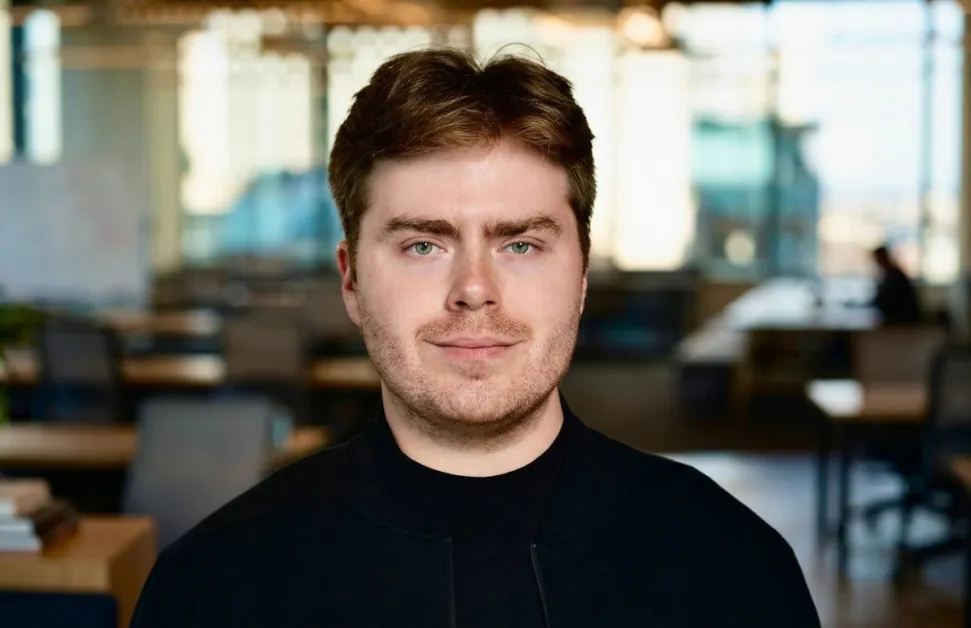
Doug Tallmadge, co-founder and CEO of Gradial
Doug Tallmadge / builder of unglamorous infrastructure
500K+
Starlink customers scaled to
$53M
Raised across 3 rounds
80%
T-Mobile time-to-market cut
4
Dartmouth co-founders
The Pitch

The hard part isn't making the thing. It's getting it out the door.

Walk into any large marketing team and you will find people who are not short on ideas. They have decks, drafts, campaigns half-built and waiting. What they do not have is a way through the maze that stands between a finished idea and a live one: the approvals, the compliance checks, the asset tagging, the brand reviews, the ticket that sits in someone's queue for nine days. Doug Tallmadge looked at that maze and decided it was the whole business.

Gradial, the Seattle company he co-founded in 2023 and runs as CEO, builds AI agents that do that middle work. Not the brainstorming. Not the headline. The unglamorous relay race between creation and a customer actually seeing something. The bet is contrarian in a market drunk on content generation, and Tallmadge says so plainly.

"Most AI investment was going toward creation, while the harder problem of actually getting content out the door was completely ignored."

The phrasing matters. Gradial does not promise to replace the marketer or the tools they live in. Its agents reach into the systems enterprises already run - Adobe, Salesforce, Jira - and handle execution inside them: author, optimize, tag, quality-check, publish, all while enforcing governance, accessibility, and brand standards. The sales line is almost an anti-pitch. "Gradial isn't asking anyone to change how they work."

That restraint is the product. Most enterprise software fails not because the technology is weak but because adoption is brutal, and Tallmadge has organized the company around removing reasons to say no rather than inventing reasons to say yes.

In His Words

"Marketers aren't struggling to produce ideas. They're struggling to move content through review cycles."

- Doug Tallmadge, on the insight behind Gradial

Before The Maze

A physicist who kept choosing hard engineering

The path to a marketing-operations company runs, improbably, through aerospace, a hedge fund, and rockets. Tallmadge studied physics at Dartmouth College, graduating with High Honors. His early career took him to Lockheed Martin and to Bridgewater Associates, two institutions with little in common except a tolerance for complexity and a low tolerance for hand-waving.

Then came SpaceX, where he spent close to five years as a software engineering manager. This was not a quiet posting. He helped scale the Starlink network from its earliest days to more than 500,000 customers, led the network analysis and optimization work that kept that growth from collapsing under its own weight, and managed teams of software engineers and data scientists running simulation and optimization. He also touched Starlink's direct-to-cell satellite initiative, the effort to beam connectivity straight to ordinary phones, and early satellite power systems.

"A system of record was built to organize information, not move fast."

You can hear the satellite engineer in that sentence. At SpaceX, the difference between a network that works and one that does not is throughput and latency - how much moves, how quickly. Tallmadge carried that lens into a domain that rarely thinks in those terms. Marketing teams measure creativity and brand. He started measuring the speed of the pipe. The conclusion was that the pipe was the problem, and nobody was building for it.

Founding Gradial in 2023, he did not do it alone. He brought three Dartmouth classmates: Anish Chadalavada, Deip Kumar, and Anup Chamrajnagar. Four alumni from the same small New Hampshire college, now building enterprise AI together in Seattle. The founding team was an old network put to new use.

The Arc

From orbit to org chart

EARLY

Lockheed Martin & Bridgewater Associates

Aerospace and finance - large-scale systems, business operations, and a habit of working where the math has to be right.

~2018-23

Software Engineering Manager, SpaceX

Helped scale Starlink from zero to 500,000+ customers. Led network analysis and optimization; contributed to direct-to-cell and satellite power systems.

2023

Co-founds Gradial

Launches in Seattle with three Dartmouth classmates to attack marketing's execution bottleneck with AI agents.

FEB 2024

$5.4M Seed

Raises seed financing for a generative-AI approach to content management and marketing operations.

2025

$13M Series A, led by Madrona

Capital to expand the platform and the Seattle team across engineering, product, and go-to-market.

NOV 2025

Stagwell partnership

Gradial teams up with Stagwell (STGW) to bring agentic marketing to more brands.

DEC 2025

$35M Series B, led by VMG Partners

Madrona and Pruven Capital return. Total raised climbs to roughly $53-55M to scale agentic marketing automation.

Selected Quotes
"

Gradial isn't asking anyone to change how they work.

"

The operational layer of marketing will be autonomous.

"

Their current tools and processes are too fragmented for them to move at the speed they need.

"

Most AI investment was going toward creation, while the harder problem of getting content out the door was ignored.

The Category

"Agentic" is not just a fancier word for "generative"

The distinction sits at the center of Tallmadge's argument, and it is easy to miss. A generative tool produces an artifact when you ask: a paragraph, an image, a variant. An agentic system goes a step further. It orchestrates a workflow in real time, taking actions across multiple tools, making decisions inside a process, and carrying a task from start to finish rather than handing you a draft and stopping.

That is the lane Gradial occupies, and it is a fast-moving one. The company's agents do not just write a piece of marketing copy. They author it, optimize it, tag the assets, run quality and compliance checks, enforce accessibility and brand standards, route it through the right approvals, and publish it - the full content supply chain, automated between the moment of creation and the moment a customer sees it.

Tallmadge is blunt about why most companies fail to get a return on AI. The mistake, he argues, is treating the technology as a productivity tool bolted onto a broken process rather than a way to fix the process itself. Buying a faster way to draft does nothing if the draft still waits two weeks in a review queue. The bottleneck simply moves.

Brand redesigns are a useful example of the scale involved. When a large enterprise refreshes its identity, every asset across every channel has to be found, updated, checked, and re-published - work that can consume teams for months. Gradial pitches its agents at exactly this kind of high-volume, low-creativity execution: the campaigns, the authoring, the quality assurance, the redesigns that nobody wants to do by hand.
Why It Lands

Four things that make the bet interesting

// The Anti-Disruption

It hides inside your tools

Agents operate within Adobe, Salesforce, and Jira rather than replacing them. The switching cost is close to zero, which is the entire point.

// The Proof

T-Mobile's numbers

An 80% reduction in time-to-market and capacity to handle ten times the work volume. AWS and Prudential sit on the customer roster too.

// The Governance

Trust as a feature

Human oversight, compliance checks, accessibility, brand standards, and complete audit trails. The agents move fast but stay accountable.

// The Founder Edge

Throughput thinking

A SpaceX network manager treats a content pipeline the way he treated a satellite link - as a system to be measured and optimized, not admired.

// The Category

Agentic, not generative

Gradial sits in the fast-moving lane that orchestrates workflows in real time, a step beyond tools that only produce text and images.

// The Backers

VMG, Madrona, Pruven

A consumer-brand-savvy lead investor in VMG Partners, plus repeat support from Seattle's Madrona and Pruven Capital.

Margin Note

He failed to study marketing on his way here. A physics degree, a stint at a hedge fund, and a few years on satellites, then he points all of it at the question of why a campaign takes nine days to clear review. The least obvious person to fix marketing turns out to be an engineer who never trusted the queue.

The Network

People and places in his orbit

Gradial's founding rests on a single college bond, and its growth on a particular set of institutions and customers. The connective tissue is worth tracing.

Co-founder Anish Chadalavada
Co-founder Deip Kumar
Co-founder Anup Chamrajnagar
Alma mater Dartmouth College
Past SpaceX / Starlink
Past Lockheed Martin
Past Bridgewater Associates
Investor VMG Partners
Investor Madrona
Investor Pruven Capital
Customer T-Mobile
Customer AWS
Customer Prudential
Partner Stagwell (STGW)
Follow The Money

Three rounds in roughly two years

Gradial's funding history reads as a steady accumulation of conviction rather than a single fireworks moment. It opened with a $5.4M seed in February 2024, framed around a generative-AI solution for content management and marketing operations. A $13M Series A followed, led by Madrona, the Seattle venture firm with a long history of backing local enterprise software. The capital went where Tallmadge said the work was: building the platform and growing the team across engineering, product, and go-to-market.

Then, in December 2025, came the $35M Series B led by VMG Partners, with existing investors Madrona and Pruven Capital returning. That round pushed total funding to somewhere in the range of $53 to $55M and signaled that the agentic-marketing thesis had found believers beyond the early Seattle circle. The plan for the money is familiar by now - accelerate the platform, expand the Seattle-based team - but the customer evidence underneath it had grown teeth.

That evidence has names. T-Mobile, represented publicly by a senior director of digital business management, reported an 80% reduction in time-to-market and the capacity to handle ten times the work volume. AWS and Prudential appear on the customer roster. A partnership with Stagwell, the publicly traded marketing network, was struck in November 2025 to put agentic marketing in front of more brands. For a company that asks no one to change how they work, the proof points are doing the persuading.

"The operational layer of marketing will be autonomous."

- Doug Tallmadge, on where this is all going

Go Deeper

Links & sources