A software buyer can have plenty of information and still be stuck. There are feature lists, star ratings, pricing pages, and a cheerful invitation to book another demo. The missing piece is often smaller: which of these products will cope with the way this particular business works? Software Finder has made that uncomfortable gap its business.
- Businesses get comparisons, reviews, and free recommendations.
- Vendors pay for leads, visibility, and buyer intelligence.
- A shortlist helps most when you bring specific requirements.
A buyer’s problem, a seller’s opportunity
Software Finder sits between two people with opposite complaints. The buyer has too many products to investigate. The vendor has too few conversations with people ready to buy. A directory brings them into the same room; a consultation can establish whether they have anything useful to say to each other.
The marketplace covers business software including electronic medical records, human resources, learning management, CRM, and project management. Those categories matter because the person choosing a system often has another job. A practice manager needs to run a practice. Becoming a part-time software analyst is an inconvenient addition to the job description.
Revenue before the website
Its founders had seen the problem from the selling side. Adnan Malik, Marium Lodhi, and Shane Elahi worked together at healthcare software company CureMD. In their account on the Thought Behind Things podcast, the idea developed over several years before a conversation in 2018 brought it back into motion.
The revealing detail is what they sold first. Before their own website was finished, they generated leads and sold them through a third party. There was already something a customer would pay for while the storefront was still being assembled.
The personal cost was less tidy. The founders describe keeping their day jobs initially, working long double shifts, and accepting pay cuts of roughly 50 to 60 percent as they moved into the business. Elahi describes it as bootstrapped. Their experiment offers a useful principle: find a paying transaction early enough that it can teach you what to build.

In a founder reflection updated in March 2026, Malik reported roughly 113 percent revenue growth in 2024 and 110 percent in 2025. These are company-reported figures. His explanation also concerned organization: move responsibility into teams as the business grows, rather than make every decision wait for a founder. The marketplace needs people who can understand individual categories; its management has to let that expertise travel.
The useful part is the conversation
For a buyer, the service begins with the business problem. Software Finder asks about requirements and budget, then recommends options. Its public site lets visitors browse product information, read reviews, compare alternatives, and request demonstrations. The consultation is free.
That makes the company a research intermediary in a market also occupied by G2, Capterra, Software Advice, and TrustRadius. Its pitch combines self-service browsing with human help. Assisted discovery is not exclusive to Software Finder; the practical question is whether the advice makes your next conversation more specific.
There is also a service beyond choosing. HubSpot’s official partner directory lists Software Finder for onboarding, CRM implementation and migration, training, and integrations. It is a useful extension: picking a tool and getting a team to use it are separate pieces of work.
- 01Describe the jobRequirements + budget
- 02Build a shortlistResearch + advice
- 03Meet the vendorQuestions + demonstration
Free advice has a paying customer
Look at the vendor offering and the economics become clearer. Software Finder sells phone-qualified leads, premium placement, advertising charged per click, review campaigns, and content partnerships. Its Vendor Portal lets companies manage their presence and, on paid plans, examine buyer activity.
The public pricing page lists a free tier, then Starter at $995, Growth at $2,495, and Enterprise at $4,995. Vendors should confirm billing terms and allowances before budgeting. Lead-generation pricing is customized, including factors such as volume and exclusivity. Free buyer advice and paid vendor access coexist inside the same marketplace.
Buyer Intelligence adds another layer: researching companies, available contacts, and signals about their activity. To a vendor, a prospect comparing products is more useful than an anonymous visitor. To a buyer, that is a reason to understand what happens when research turns into a request for help.
There is a telling detail in the pricing table: paid vendors can hide the alternatives page on their profiles. The listing-management documentation also describes controls over displaying pros and cons. Those controls concern presentation; they do not, by themselves, establish that review scores change. They do show why a product profile deserves to be read alongside other evidence.
“Good software shouldn’t go unnoticed.”
Marium Lodhi, CMO, announcing the company’s new identity in 2025
A review is evidence with a history
The review tools make context especially important. Vendors can invite customers through email campaigns and offer optional rewards. Software Finder says submissions pass verification and quality checks, with rejection reasons including conflicts of interest, insufficient experience, and automated content.
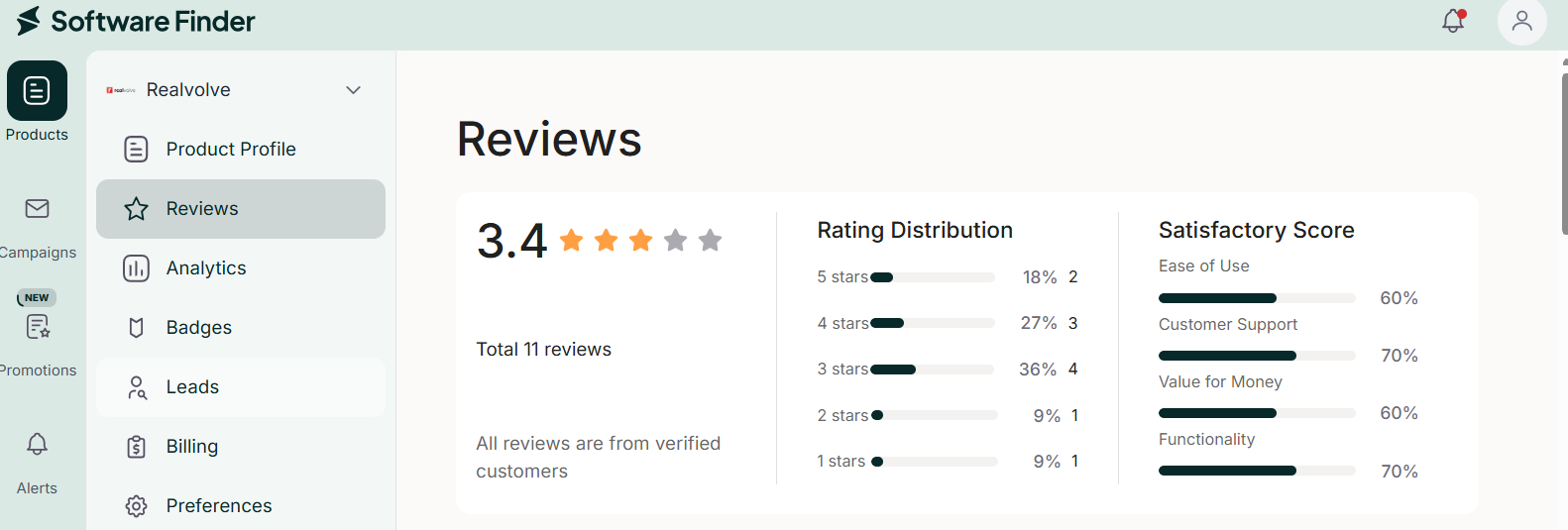
Its review dashboard separates the average rating from the distribution of scores and measures such as support and ease of use. That is more informative than one large star. A buyer can ask whether a recurring complaint comes from organizations with a similar size, workload, or length of use.
Bring the awkward workflow
The most useful way to copy this approach is to start with constraints. Write down the task your current system mishandles, the integration you must keep, and the people who will use the replacement. Ask for a shortlist against those requirements. Then make every vendor demonstrate the same awkward workflow.
A marketplace cannot do all the buying work. Migration costs, security requirements, contract terms, and staff adoption still need direct examination. A team seeking a highly specialized system may need expertise beyond a directory consultation. Software Finder can make the field smaller. The buyer’s job is to make the test sharper.