The interesting object in Society’s world is a key. It happens to look like a digital collectible. You might admire it, keep it, or give it to somebody else. But its practical value begins when it lets you into a room, qualifies you for a reward, or gives your opinion more weight. Society builds the machinery that makes those privileges work.
- Digital collectibles become credentials for membership and rewards.
- Brands manage tiers, access and polls through one platform.
- The useful question: what does membership let someone do?
This is an intriguing place to put an NFT business. Society’s customer is the organization trying to keep a community interested: a brand, an enterprise, a creator, an existing collectible project. Its proposed job is to connect ownership with participation. The picture is the visible part. The relationship is the product.
A membership card with instructions
Consider a hypothetical fan club. Some members have just arrived. Others have been around for years. A few own a particular collectible. The organizer wants different benefits for each group, without maintaining an increasingly heroic spreadsheet. Society’s rules engine lets the organizer define eligibility and connect it to a reward.
The company’s November 2022 explanation gets pleasingly specific. A condition might involve holding one NFT, or holding a particular NFT for a minimum period before burning it. A criterion can reference an entire collection or a trait, such as background color. Rewards can include points, Discord roles, discount codes, votes or contest entries.
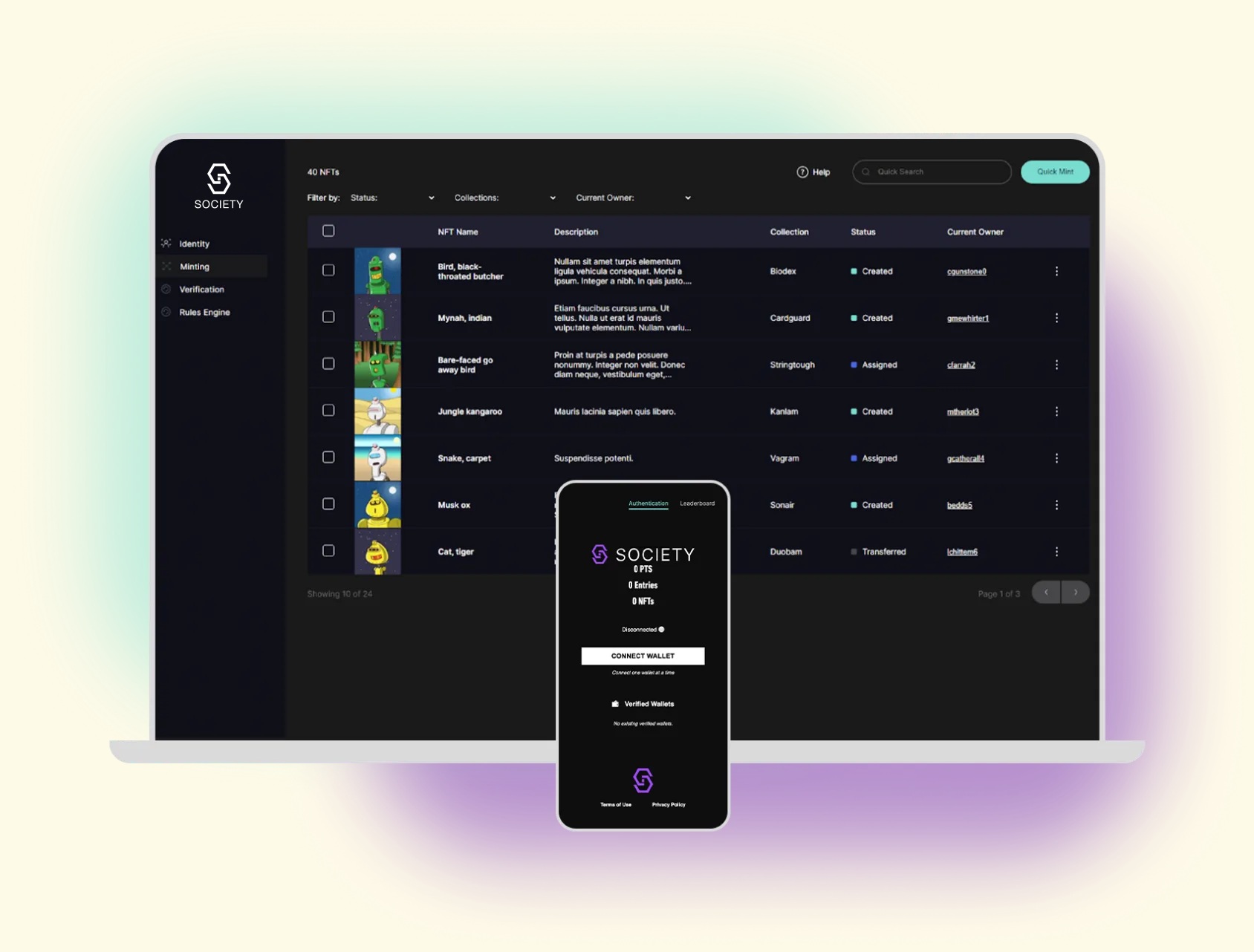
Its snapshot tool adds another useful wrinkle: eligibility can be frozen at a particular moment. That matters whenever membership changes between announcing a benefit and distributing it. The product takes something fluid, a set of wallet holdings, and gives an organizer a definite list to work with.
Conceptual workflow, based on Society’s documented rules.
The room matters more than the badge
Society also describes gated Discord rooms, protected media and member-only stores. These are places where a credential acquires meaning. A brand can offer a conversation, content or an opportunity that belongs to a particular group. For the member, the benefit needs to be recognizable without an explanation of blockchain architecture.
The distinction helps locate Society in the market. Conventional loyalty software organizes points and benefits. Token-gating tools restrict access. Custom development can connect separate systems. Society’s proposition combines collectible creation and management with verification, reward rules and community functions. Its attraction is having those pieces work together with existing software.
There is a condition hiding inside that proposition. If a company only needs a straightforward discount program, wallet-based membership may add work without adding much value. Society makes more sense where ownership, differentiated access and ongoing community activity are central to the experience. The token needs an actual job.
The wallet is another practical consideration. Society’s terms describe an account linked to a blockchain address, with a third-party wallet required for blockchain interactions. The service does not hold the wallet’s contents or recover them for the user. That division of responsibility matters when designing onboarding: a familiar-looking loyalty experience still depends on members understanding what they are connecting and keeping their access secure.
A vote is an invitation, with limits
The voting system makes the idea more interesting. Society documents ordinary polls, polls weighted by loyalty tier, and extra votes for particular holdings. A collectible can therefore affect a member’s influence as well as admission. The organizer decides which kinds of participation deserve additional weight.
But Society’s own discussion of feedback loops draws a clear boundary. These votes are non-binding and off-chain. A brand decides how much effect the results have. The company describes something closer to a recurring focus group than a transfer of corporate control. For readers evaluating the product, that distinction is essential.
The practical lesson is available even to businesses that never issue a collectible. Invite customers to influence a decision they understand. Tell them what the vote can change. Then respond to the result. A meticulously designed voting system cannot rescue a conversation in which nobody at the company is listening.
The free trial came with people
Society’s February 21, 2023 beta announcement offered selected organizations six months of free access in exchange for regular feedback. The published package included Discord setup, a strategy call, premium support and access to a members-only community. The onboarding was part of the proposition. Participants were being asked to try a working relationship: use the tools, report what needed improving, and receive help while building their program. Feedback was part of the exchange.
Society valued the software access at $3,000. That valuation is distinct from a current subscription quote.
That package says something useful about the business model. Society sells software to organizations, but getting value from it involves designing a program and running a community. The support recognizes that operational burden. A dashboard can assign a privilege; somebody still has to decide whether the privilege is worth earning.
Society’s services page extends the picture to NFT platform integrations, marketplaces and loyalty implementation, describing work under the Society/Shrine names. Shrine Development also lists Society as a product. The combination places the platform beside a software development practice, with expertise in connecting enterprise systems to customer experiences.
The engineering behind the easy button
The people behind Society include Doug Drouillard, listed as CEO and co-founder, and Malissa Drouillard, Head of Development and co-founder. The team page also names Geoff Wolfe as Head of Operations. It is a product with software and operations represented in its published leadership.

A contributor’s account supplies a glimpse behind it. On his public résumé, developer Dee Acharjya describes fixing scaling and deployment issues in Shrine’s loyalty SaaS platform, moving a monolithic application into Docker containers on Kubernetes. The same account identifies front-end work on Society using React and Next.js.
This is a contributor’s description of engineering work, rather than a measured claim about customer outcomes. Still, it is a revealing detail. A no-code experience depends on considerable code, along with deployment choices the customer should never have to consider. Ease of use is something the builder has to manufacture.
“empowering our users to engage with the digital world on their own terms.”
Douglas Drouillard, describing Society’s ambition
Society’s most transferable idea is to begin with the privilege. Decide what a loyal customer should be able to access, influence or earn. Make the qualifying rule understandable. Give the community somewhere worth returning to. Only then does the collectible have a reason to exist beyond the moment it was issued.