A hospital can deliver the right care, document most of it, code almost all of it - and still fail to get paid for what happened. The culprit may be a diagnosis buried in a lab trend, a medication order, a pathology result or an imaging report that never made it cleanly into the final story. SmarterDx has built a business around that awkward gap between care delivered and care legible to a payer.
Its software reads the complete inpatient record, not only the discharge note. It connects evidence across labs, medications, orders, vitals, radiology, pathology, notes and codes, then surfaces possible missing or incorrect diagnoses. A clinical documentation integrity specialist or coder reviews the finding. Nothing moves to final billing unless the hospital team approves it.
That last sentence is the product. The AI does not stroll into the revenue-cycle office wearing a white coat and declare itself chief physician. It arrives with receipts.
Two physicians find the expensive blank space
Michael Gao and Joshua Geleris met as residents at NewYork-Presbyterian. Both had technical instincts, and both were irritated by the same mismatch: physicians carried heavy patient loads while being expected to produce a perfectly complete account of every case. Gao later became Medical Director for Transformation at the health system and led applied AI work. According to investor Transformation Capital, his proof-of-concept model identified millions of dollars in missed revenue.
That result changed the question. Incomplete documentation was not merely a clerical nuisance. It changed reimbursement, the recorded severity of illness and quality metrics. Gao brought in Geleris to lead product, and SmarterDx was founded in 2020.

The first failure was coverage. Traditional teams can inspect a selection of charts very deeply or review a broad population more lightly. They cannot consistently do both when a chart contains tens of thousands of data points. At UAMS, an earlier technology helped prioritize which charts deserved attention. It was useful until leaders asked the uncomfortable follow-up: what about all the charts the prioritization tool did not choose?
The market moved the answer from “more people” toward “better leverage.” UAMS revenue-cycle leader Terri Meier saw payers deploying several AI vendors for payment integrity. Her hospital could not mirror that stack. She wanted one system that could scan every chart, surface the cases that deserved judgment and minimize financial risk. SmarterPrebill checked those boxes.
“But what happens to all the charts that don’t get that deep dive?”Terri Meier · UAMS revenue-cycle leaderHow it works
A second pass, with evidence attached
SmarterPrebill sits after coding and before the final bill. The system ingests the record for each discharge and looks for diagnoses or procedures that appear unsupported, incomplete or absent from the coded account. Its recommendations arrive with clinical reasoning and links to the source data. The hospital’s CDI or coding team validates the recommendation and makes the final call.
One chart, three accountable steps
The difference from a simple chart-prioritization tool is depth plus population coverage. The difference from outsourced manual review is speed and software leverage. The difference from a generic language model is the clinical data, task-specific modeling and audit trail. SmarterDx says its algorithms identify more than 32,000 diagnoses and procedures and have been trained or validated across more than 21 million encounters.
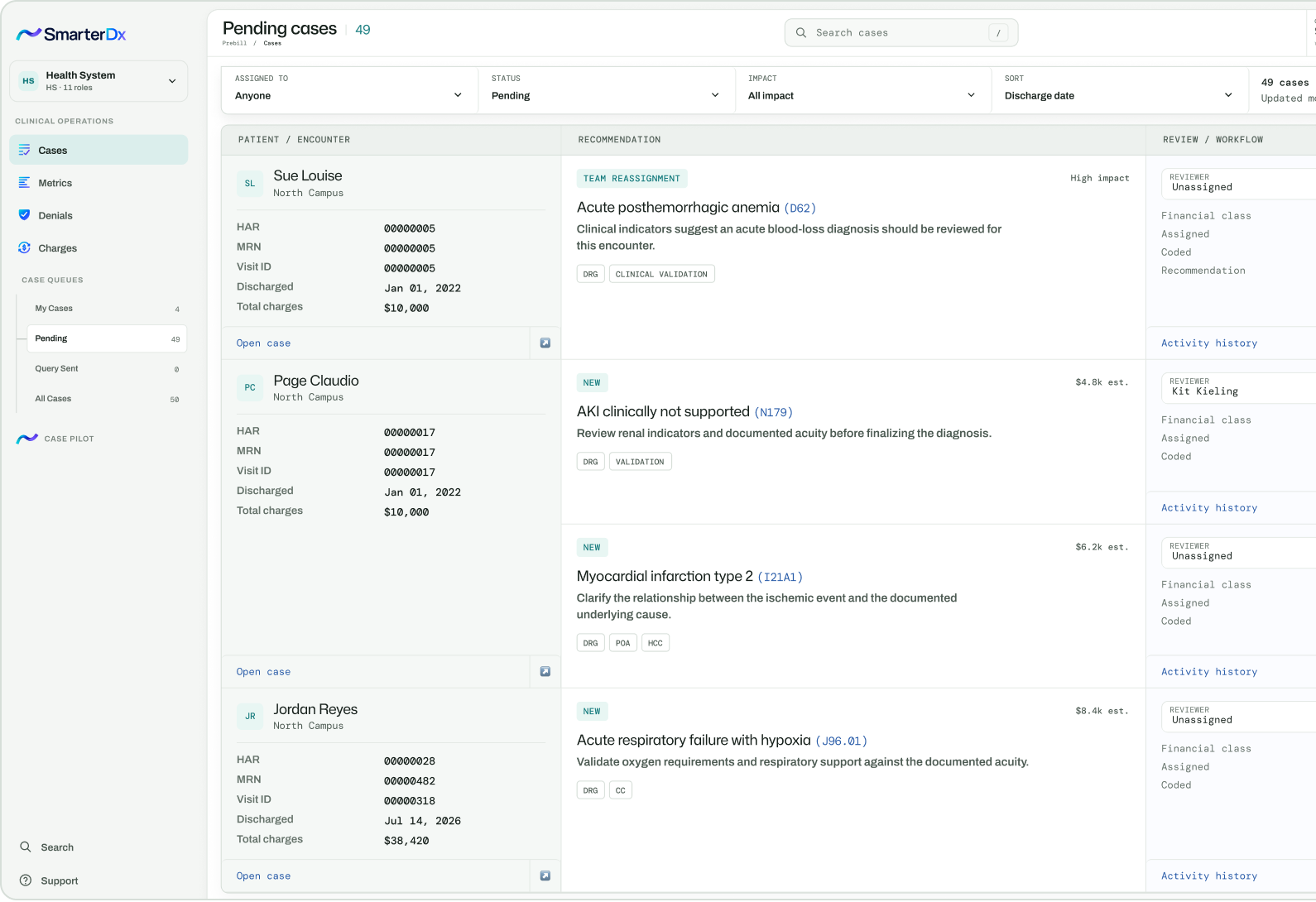
The product works with major electronic health records and is designed to fit existing workflows rather than replace them. SmarterDx advertises implementation in under eight weeks. Novant Health says it rolled out across 15 hospital sites in eight weeks; McLaren Health Care reports a 10-week go-live across seven main campuses.
The moneyWhat it costs - and why the contract matters
SmarterDx does not publish a conventional license price. For SmarterPrebill, it describes a results-based model with no upfront cost: a hospital pays only for findings its team approves and bills. The percentage or fee schedule is not public. This is less mysterious than it sounds. The company is tying its invoice to a line item the buyer can measure.
The arrangement also answers the most common enterprise objection: “What if the demo is lovely and the value never appears?” SmarterDx claims a 5:1 return starting on day one and an average $3.5 million in realized annual revenue per 10,000 DRG discharges. Those are company figures, not a universal guarantee of what any hospital will earn.
Named customers provide more useful texture. UAMS reports $5.3 million in annual net-new DRG revenue. McLaren says it realized $3.8 million in the first four months and annualized $11.3 million after fees. Novant reports that captured revenue more than doubled its original projection. Each result reflects that health system’s scale, case mix, workflow and baseline performance.
Read the numbers like an operator
$11.3 million is not a software feature. It is a customer-reported outcome after implementation, staff review, approval and billing. The defensible lesson is the measurement loop, not the assumption that every hospital has the same buried treasure.
One missing story, five places to fix it
The original wedge was prebill review. The company has since followed the same patient story in both directions. SmarterUtilization brings clinical evidence to medical-necessity and patient-status decisions. SmarterNotes, launched after parent company Smarter Technologies acquired Pieces Technologies in 2025, pairs note generation with coding and revenue intelligence at the point of care. SmarterCharges targets charge capture. SmarterDenials examines a rejected claim and drafts an appeal letter with case-specific evidence and coding references.
That expansion is logical, though not trivial. A missing clinical fact can cause trouble before a claim goes out, while it is being reviewed and after it is denied. A shared intelligence layer can reuse context across those moments. But every added workflow also brings a new user, buying committee and implementation burden.
In 2024, SmarterDx raised a $50 million Series B led by Transformation Capital, bringing disclosed funding to $71 million. In April 2025, New Mountain Capital announced a strategic investment that reports described as a control acquisition. SmarterDx then joined Access Healthcare and Thoughtful.ai inside a new umbrella, Smarter Technologies. The combination gives it automation and services around its clinical intelligence. It also creates the ordinary integration risk that accompanies any broad platform: customers will judge whether the parts become one useful system or merely share a sales deck.
The stealWhat another builder can copy
The most portable idea is not “use AI in healthcare.” It is to choose a costly, repetitive decision where data already exists, experts remain necessary and the result can be audited. SmarterDx made the model useful by narrowing its authority. The software searches and explains; the customer decides.
When the playbook does not work
This model is built for hospitals with meaningful inpatient discharge volume, structured access to clinical records and trained staff who can review findings. A small practice with few inpatient claims will not have the same economic pool. A hospital that cannot deliver usable data, cannot assign CDI or coding reviewers, or cannot track approved findings through billing will struggle to prove value.
It also weakens when the starting process is already unusually complete. Results-based pricing protects the buyer from paying for findings that do not exist, but it does not manufacture opportunities. And no evidence interface erases the governance work required for clinical AI: security review, workflow ownership, model monitoring and clear accountability still matter.
SmarterDx occupies a busy neighborhood. Iodine Software, Accuity, Regard, Cofactor AI, Sift Healthcare and larger revenue-cycle vendors attack adjacent pieces of documentation, coding, utilization and denials. Internal CDI teams and outsourced chart review remain alternatives. SmarterDx’s position is that it can cover the full record and a widening portion of the revenue cycle while keeping clinical reasoning visible.
The company now says it serves more than 85 health systems and employs more than 500 people, whom it calls “Smartians.” The nickname is cute. The business underneath it is severe: hospitals are squeezed, payers scrutinize claims with sophisticated tools, and the patient record is too large for any team to inspect perfectly. SmarterDx does not need the record to become smaller. It needs the missed evidence to become findable.